Growing up in Nigeria, Titilayomi Abiodun saw many people in her community get sick with malaria. The illness, spread through infected mosquitoes, is the top killer of children under 5 in the country. As a child, Abiodun wanted to understand why this was happening — and what she could do about it.
“This was always a question I asked my mom,” she says. “And there were so many factors in the environment that were harboring and festering mosquitoes.”
The desire to help solve this issue and others led Abiodun to a career in public health, although she didn’t have a name for it before coming to the University of South Carolina.
“My mom thought I would become a doctor, but I knew my interest was more in helping prevent people from getting sick in the first place,” say Abiodun, who moved to the United States to attend college after high school.
“USC was really the first place where I learned there is name for that job, and it’s public health and epidemiology.”
With an interest specifically in vector-borne diseases, Abiodun enrolled early on in an epidemiology class taught by Melissa Nolan, who would become her mentor. Nolan is one of USC’s foremost experts in tick- and mosquito-borne illnesses, with ongoing research supported by the Centers for Disease Control and Prevention and other agencies.
Nolan quickly recognized Abiodun’s potential and invited the public health major to work in her lab. She helped Abiodun apply for various research grants, including USCS’s Magellan Scholar Grant to conduct a study on the risks of tick-borne illnesses in certain occupations in South Carolina. Abiodun says the support and guidance from Nolan helped her fall in love with research.
“Dr. Nolan wasn’t just trying to get people to work in her lab, but also to develop them into skilled professionals. She encouraged us even as undergrads to go for conferences,” she says. “When someone is pushing you to excel, it’s very motivating.”
Abiodun presented her research at a conference held by the South Carolina Department of Natural Resources. She also presented twice at Discover USC and won top honors her senior year. Her undergraduate work with the Nolan Lab resulted in two published papers, which opened doors for Abiodun to go to graduate school.
“Dr. Nolan is really big on translational research: not just showing data and publishing articles, but doing research that is reflected in policy, in society, in government. That’s one of the main things I’ve chosen to emulate in my research career.”
After earning her bachelor’s at USC in 2024, Abiodun completed her master’s degree at the Rollins School of Public Health at Emory University. But even after moving to Georgia, Abiodun stayed involved with Nolan’s research: She accepted a part-time role collecting specimens in Georgia in partnership with the state’s public health department.
These connections proved valuable for Abiodun’s colleagues at Emory as well. When she started an additional lab position through her graduate program, Abiodun realized that her new professor’s work aligned well with Nolan’s.
“Here were these two public health professors who both studied vector-borne illnesses, but they had never met,” she says. “In graduate school, I was trying to bridge the gap between the tick-borne research being done in South Carolina and other states and at Emory as well.”
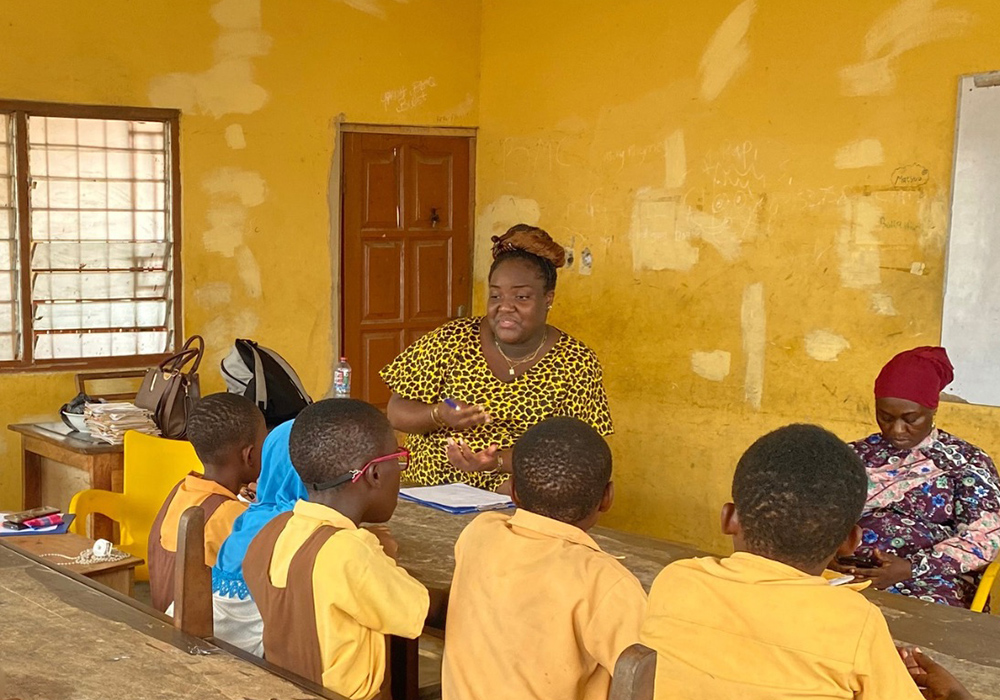
While much of her research continued to focus on how vectors spread disease, Abiodun also branched out to examine how hygiene, water and sanitation practices affect public health. She did field work in Ghana developing tools and training community health workers to collect data on sanitation practices and contamination of the food supply chain.
“When it came to the work I did in Ghana, that was not by initial interest,” Abiodun says. “But studying at USC helps you to realize that you have to be open-minded. Because I had a mindset of being open, when an opportunity that was different from what I expected came to me, I thought, ‘Oh, this will be interesting. I’ll do this.’”
For her graduate thesis, Abiodun studied how public education influences whether people in Ghana eat food from street vendors, a setting where there is greater risk of food-borne illnesses. She found that, in fact, more education about the risks did not necessarily translate to changed habits in community members.
“We get to a point in my thesis where you realize, well, you can educate people all you want, but they’re still going to eat street food because there are other cultural factors,” she says. “So, the next thing to do is to ask what we can do to make sure people are not just educated but are also taking other precautions to be safer.”
The drive to think about what comes next — how to translate the research findings to real-world practices — is something Abiodun credits to her work with Nolan.
“Dr. Nolan is really big on translational research: not just showing data and publishing articles, but doing research that is reflected in policy, in society, in government,” she says. “That’s one of the main things I’ve chosen to emulate in my research career.”
Eventually, Abiodun wants to return to Ghana and Nigeria as a public health researcher to help address the issues that contribute to food-borne and vector-borne diseases, including malaria in her home country.
After graduating from Emory, Abiodun received the Rollins Epidemiology Fellowship and is working as an epidemiologist for a local agency in Georgia. She hopes to earn her Ph.D. next with the goal of working for the World Health Organization, but she knows the work she’s doing now will build her career while helping her local community.
“A lot of times, public health looks very big and fancy. We hear about the CDC, and I dream of working for the WHO,” she says, “but, actually, a lot of the work is done at the local level. The core of what I see myself doing in my career is research that makes a difference.”