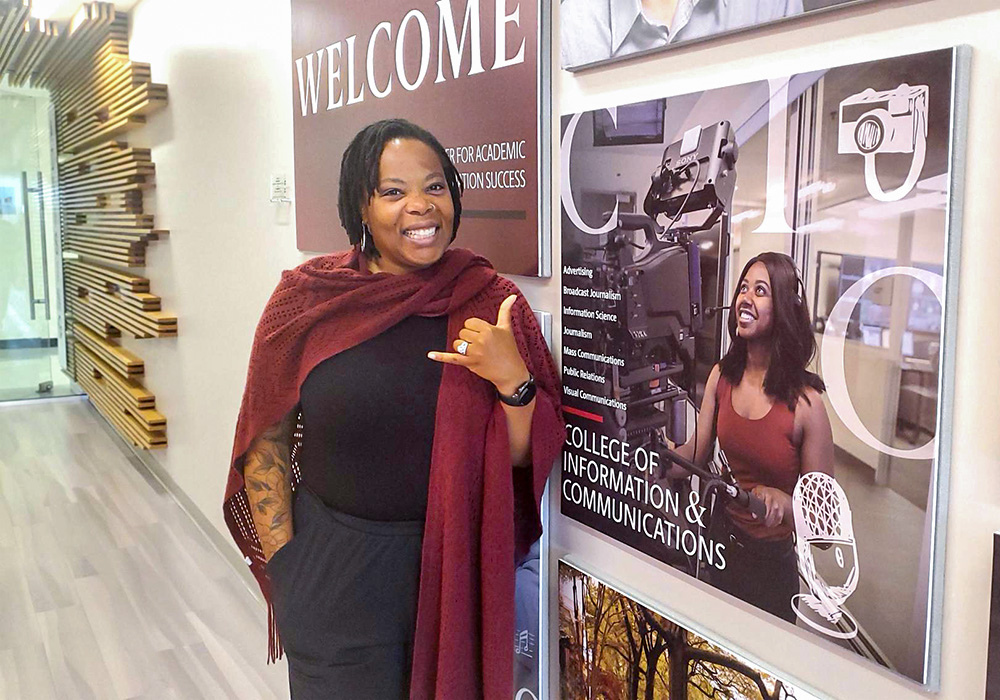
Shannon Blake-Lynch had barely made it through the hallway when she spotted three familiar faces.
All three were seniors in the College of Information and Communications. They shared a minor and were heading through their final year at South Carolina, a milestone that carried a little more weight for Blake-Lynch.
They were among the students who arrived at South Carolina around the same time she began advising in summer 2023.
“I saw them together, and I was like, ‘I watched you guys grow up,’” Blake-Lynch said. “I love my students. I love advising.”
Now in her third year as an academic advisor, Blake-Lynch is approaching a milestone of her own. Some of the first students she advised are preparing to graduate this spring.
“It’s exciting, but also sad,” she says.
Starting with a foundation
Blake-Lynch began teaching at USC’s English department in 2017. Advising gave her more time with students to get to know them beyond one class and watch their confidence grow along the way.
During orientation, she tells incoming students that their advisor can be someone they turn to throughout college. That can mean choosing courses, understanding DegreeWorks, USC's degree-audit system, or knowing who else can help.
That support starts early, when new students are figuring out where to turn for help and how to make decisions for themselves.
“Freshmen think they know what they’re doing, but literally, they just walked across that stage three months ago,” Blake-Lynch says. “If I can be that friendly face that sits in front of them and says, ‘You know what? Don’t panic. It’s going to be OK. We’re going to work through this one semester at a time until we get you across that stage.’”
Those conversations change over time, turning toward internships, careers and graduation by junior and senior year. Along the way, Blake-Lynch makes a point of knowing her students in the building, remembering when they’ve reached out and following up.
Suemy Martinez, a first-generation senior advertising student graduating this spring, has experienced that support firsthand.
“At the time, I was struggling to visualize the rest of my time at USC,” Martinez says of her first year. “I felt like I wasn’t doing enough and that I was somehow missing out on something crucial to my success. I needed guidance and someone who would listen and understand.”
Now in her final year, her uncertainty has shifted.
“I am now much more confident in myself as a student and young professional,” Martinez says. “For every question I have, she has a resource she can point me to, and that has been incredibly helpful as I make career and post-grad decisions.”
“I think being an advisor, you’re just another person in a student’s corner. You’re
just there to make sure that they’re having the best experience.”
Finding your place
Blake-Lynch now draws on what she had to figure out for herself to help students who may be navigating some of the same questions.
“I didn’t have an advisor that wanted to invest in me, unfortunately,” she says. “I had to kind of figure that out on my own, but especially as a first-generation student, I didn’t know where those resources were.”
That experience helped motivate her to start a first-generation initiative within CIC college and work with USC's First-Generation Center.
“I’m worried about making sure that you have a sense of community and that you’re finding your people,” she says.
Martinez now serves on the first-generation student advisory board Blake-Lynch started, bringing a student voice to the work.
Rebecca Boyd, undergraduate student services manager in the College of Information and Communications, says that sense of belonging stands out in Blake-Lynch’s work with first-generation students.
“If I had to sum up Shannon’s work with first-generation students it would be: ‘You belong here,’” Boyd says.
LaNaé Budden, director of USC's First-Generation Center, says first-generation students may be navigating college systems and opportunities that are new not only to them, but sometimes to their families and supporters.
“The First-Generation Center doesn’t replace services across campus. It helps students understand, access and connect with those resources,” Budden says.
Getting involved is another way students can build those connections. Blake-Lynch points students toward organizations, internships and other experiences that interest them.
Within CIC, that includes Garnet Media Group, USC's student-run media umbrella organization, where students can gain hands-on experience.
When the plan changes
When you’re planning four years ahead, not everything goes according to plan.
“I think being an advisor, you’re just another person in a student’s corner. You’re just there to make sure that they’re having the best experience.”
Blake-Lynch noticed that a senior just three courses shy of graduating had not registered for fall. When she reached out, the student shared that she had decided not to return after an Italian course she needed was full.
Blake-Lynch started looking for another option, helping the student secure a seat in an online section. She is now on track to graduate from USC this fall.
Blake-Lynch became emotional as she told the story.
“I screamed at the top of my lungs when I got the email,” Blake-Lynch said. “Because it’s not just excitement for her. It’s my excitement too. I helped a student get across that stage. That is my job.”
For Blake-Lynch, advocating for students means finding out what is possible and, when something isn't, figuring out what comes next.
“Until somebody tells me it’s a hard no, we’re going to keep working as if there’s still a chance that we can do this,” she says. “For some students, that pays off. And for other students, of course, we have to pivot.”
More than getting to graduation
“I like to say that college is where you come to figure out the person you want to be when you grow up,” Blake-Lynch says.
That growth applies to Blake-Lynch, too.
“I’ve learned a lot about myself,” she says. “I’ve learned about the kind of person that I want to be, the kind of mentor that I want to be to students.”
In spring 2027, she will try something new herself, leading her first study abroad program with a group of first-generation students in Ireland.
“I call this the baby trip that gets you used to the larger trips,” she says. “Not every student can take a month off to go to Barcelona.”
Soon, some of the first students Blake-Lynch advised will be choosing their caps and gowns. She plans to be there at commencement, cheering them on.
The plans may have changed along the way, but they figured out what came next together. Now, graduation is coming into view.