When Gina Spence talks with students about what they are learning beyond the classroom, they sometimes leave their jobs out of the conversation. They may work a retail job to support themselves without recognizing the skills they are building along the way.
She asks students how they work with others, handle conflict and balance responsibilities on the job.
“It’s an enjoyable moment to see the lightbulbs start to go off when they realize just how many skillsets they’re developing and why those lessons are so valuable,” she says.
As lead advisor and data coordinator with the University of South Carolina’s Center for Integrative and Experiential Learning (CIEL), she helps students connect everyday experiences with their classroom learning and future goals.
That work includes advising students pursuing Graduation with Leadership Distinction (GLD), a program that recognizes students for meaningful involvement and learning beyond the classroom. Part of that process is creating an ePortfolio, where students write essays connecting their experiences with classroom learning.
She also manages the program’s application system, maintains student records and mentors fellow CIEL advisors.
Her own experience as a first-generation college student shapes her approach to helping others navigate college and recognize their strengths.
Growing up in Statesboro, Georgia, Spence saw her working-class family struggle with money. School didn’t come easily to her, but she saw college as a way to build a better future.
“I usually tell people that my path to college was a little winding and not very straightforward,” she says.
During her first semester at a university in Georgia, Spence was still learning how to study and manage her time. She struggled with her grades and eventually stopped attending classes.
“I genuinely didn’t even know that you are supposed to tell people you’re dropping out or withdrawing,” she says.
The following semester, Spence started over at a technical college, studying business administrative technology. There, she met professors who helped her see strengths she didn’t even know she had.
With their encouragement, she began studying regularly and staying late in the computer lab. She went on to graduate with honors.
People are capable of so much with
the right amount of support.
“I think this was the first time that I realized that when you have people in your life who believe in you and see your potential, it makes you want to strive to do better,” she says.
Later that year, after months of health problems and confusing symptoms, Spence was diagnosed with Hodgkin lymphoma, a form of cancer.
“It radically changed how I saw myself, what I valued and my perspectives on the important things in life and the things that truly mattered,” she says.
After six months of chemotherapy, she reached remission the following summer. With a new outlook, she returned to the university where she had first enrolled to pursue a bachelor’s degree. This time, she hoped to use her medical experience to help others through social work.
She later transferred to a university in North Carolina, moving away from home for the first time.
During her senior year, a hospital internship helped Spence realize medical social work wasn’t for her. She found it difficult to separate her own medical experience from those of her patients.
The experience helped her see what mattered most to her: building meaningful relationships and helping people reach their goals.
She went on to pursue a master’s degree in social work at the same university, shifting her focus to counseling high school students.
“I found that I adored working with students, hearing their stories, being with them through their challenges and celebrating their successes together,” she says.
After graduate school and a period working in foster care and adoptions, Spence found a position with USC Connect, now CIEL. The role brought together her interest in supporting students and the technology and data skills she had developed along the way.
More than seven years later, she continues to put both to work.
Through GLD advising, Spence helps students connect what they have learned with how they can solve problems and make decisions in college and beyond.
For Gibson Darby, that support made a large project feel possible.
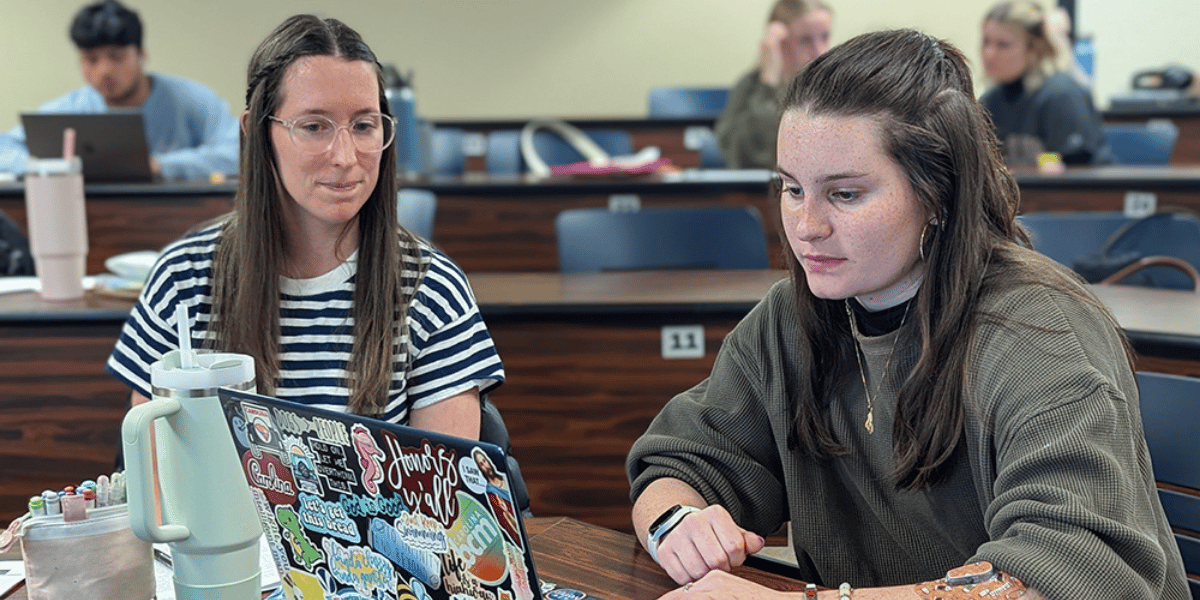
Darby, a political science major who expects to graduate in December, has worked with Spence on her ePortfolio since August. At first, she had doubts about taking on the project in her final semester.
“Rather than pushing me in one direction, Gina met me where I was and helped me recognize that it was something I could absolutely accomplish,” Darby says.
Spence helped her learn to manage her time and break the project into smaller pieces. Along the way, Darby began to see her college experiences differently.
“Through working on my ePortfolio, she has encouraged me to reflect on my experiences throughout college and recognize how much I have grown, both personally and professionally,” she says.
Spence also brings another lesson from her college years to her advising: every student’s situation is different.
She remembers learning that her out-of-state tuition bill at the university in North Carolina was higher than she expected. She knew her loans and part-time job would not cover it, so she turned to her financial aid advisor for help.
“Just ask your parents,” the advisor told her.
The suggestion upset Spence. Her parents could not help pay for college, and she was left with the same question: How would she cover the bill?
She turned to another advisor, who helped her find financial aid resources that made it possible to continue her education.
“What her response reminds me of today is that not every student has the same resources and you simply cannot make assumptions about what any student has access to,” she says, remembering the first advisor’s suggestion.
When helping students explore opportunities, Spence encourages them to consider their own interests. Research, volunteering, a job or a hobby can help them discover what they enjoy, what they value and what they want to explore next.
For those who don’t know where to start, she recommends asking someone they trust, such as a professor or GLD advisor.
“You don’t have to commit your life to the first thing you try. Trust yourself and follow where your interests take you,” she says.
Spence now offers students the encouragement her professors once gave her. She helps them see their strengths and what they can build on, sometimes starting with the jobs they might otherwise leave out of the conversation.
“People are capable of so much with the right amount of support, and that’s something I’ve experienced for myself and had the privilege of witnessing in others,” she says.