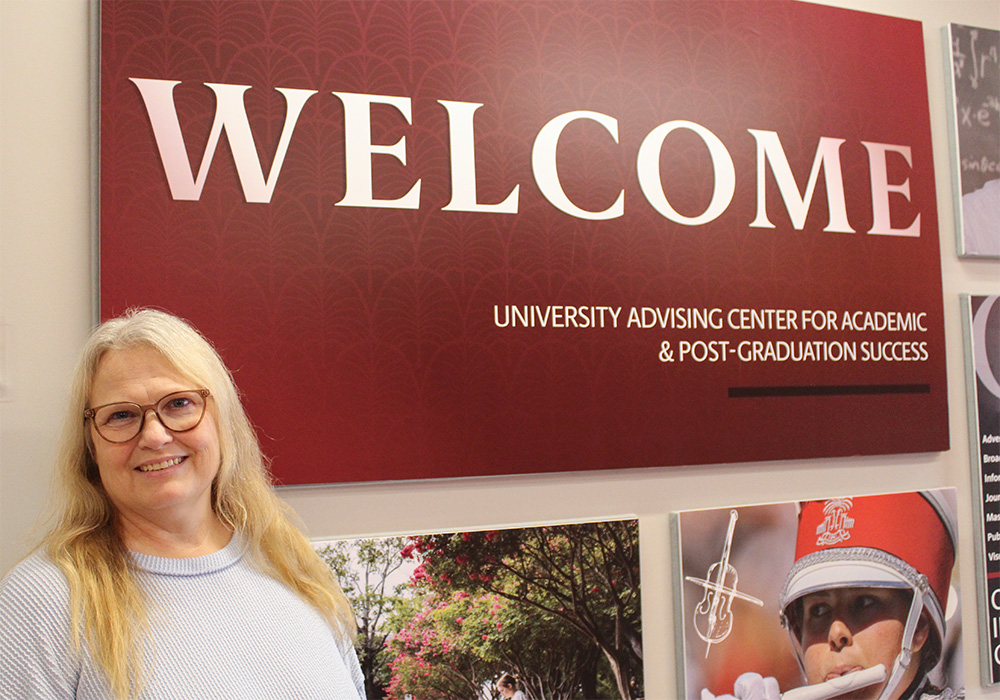
During her senior year of college, Mary Jo Schroeder spent a lot of time in the car. On weekends when she wasn’t working, she climbed into her tan, two-door 1982 Chevrolet Celebrity for the roughly 90-minute drive home to care for her mother.
Schroeder had long looked up to her mother, and the two were close. As the illness progressed, she balanced caregiving with classes and work.
“I struggled with guilt because I wasn’t there enough to take care of my mom during my senior year of college,” she says.
She considered dropping out, but her mother and aunt encouraged her to keep going. With their support, she finished her degree.
Today, Schroeder teaches University 101 and advises students across majors at the University of South Carolina. Her own college experience shapes how she listens to students and helps each one find the support they need.
A path shaped by family
The youngest of six children, Schroeder grew up on a farm in Verndale, Minnesota, where daily chores were part of life.
Hard work and caring for others were part of her family’s story.
Her mother taught in a one-room school in the 1950s, when a formal degree was not required. After raising six children, she found work she loved as a home health aide. Her father served in Korea and later worked construction and as a butcher.
Neither parent had a college degree, but both expected their children to attend college or technical college.
After high school, Schroeder attended a women’s college in St. Paul, Minnesota, where she played volleyball. Although she had friends on the team, she felt lonely and decided to transfer to a community college. The move brought her closer to her mother and let her go to school with her best friend.
There, she formed friendships she still treasures and earned her associate degree before transferring to another university in Minnesota.
She planned to complete the requirements to become a high school teacher, but her mother’s illness during her final year changed those plans. She graduated with a bachelor’s degree in geography and English.
Finding her way back to education
After graduation, Schroeder planned to study civil engineering technology. She was accepted and attended orientation, but as her mother’s health continued to decline, she put further education on hold and got a job.
She worked in several fields over the years before taking an AmeriCorps position helping fourth through eighth graders build their math skills.
“I fell back in love with the idea of working in education,” she says.
She later worked as a substitute teacher and an early childhood classroom teacher in South Dakota before joining a university there, where she pursued a master’s degree in adult and higher education administration.
When she and her husband decided to return to the Southeast to be closer to family, Schroeder applied for positions. A visit to USC for an interview helped her realize it was where she wanted to be.
“They deserve to have people on their side, cheering, consoling, counseling, and caring.”
Building connections through advising
At USC, Schroeder began working with transfer students and soon expanded her advising across several colleges. Having transferred twice herself, she understands what it can feel like to start over at a new school.
In fall 2024, she began advising about 110 first-year psychology students. The assignment was temporary, but after staying with the group for a second semester, she didn’t want to give them back.
“I am so lucky to have this group of students — they are amazing and I absolutely adore them!” she says.
Among those students is Annie Mercurio, a junior studying psychology in the McCausland College of Arts and Sciences. She also works alongside Schroeder as a University 101 peer leader.
“She has been so much more than just an advisor for me; she is someone who makes me feel seen, supported, believed in, and excited for what my future holds,” Mercurio says.
As a first-generation graduate, Schroeder understands how unfamiliar college can feel for students and their families, from finding scholarships to filling out financial aid forms.
“I do think a knowledgeable advisor is a huge help — someone who understands what it’s like to feel uneasy or intimidated by the whole college scene,” she says.
Making room to ask for help
That understanding also shapes Schroeder’s teaching.
“I like to remind my students that it’s okay to struggle with academics, homesickness, loneliness, etc. That is perfectly normal and OK! It’s also okay to ask for help!” she says.
Mercurio sees that encouragement in their University 101 classrooms.
“As her peer leader, I’ve seen how she makes students feel comfortable asking questions and reminds them that they have someone to turn to as they navigate college,” Mercurio says.
For Schroeder, asking for help and making the most of college go together.
“I really encourage my students to take advantage of all the opportunities they are afforded, and to not be too hard on themselves for being less than perfect!” she says.
Students carry more than books to class.
“All students face challenges during college, but the ones faced by first-generation students tend to be unique,” she says, “and they deserve to have people on their side, cheering, consoling, counseling, and caring.”