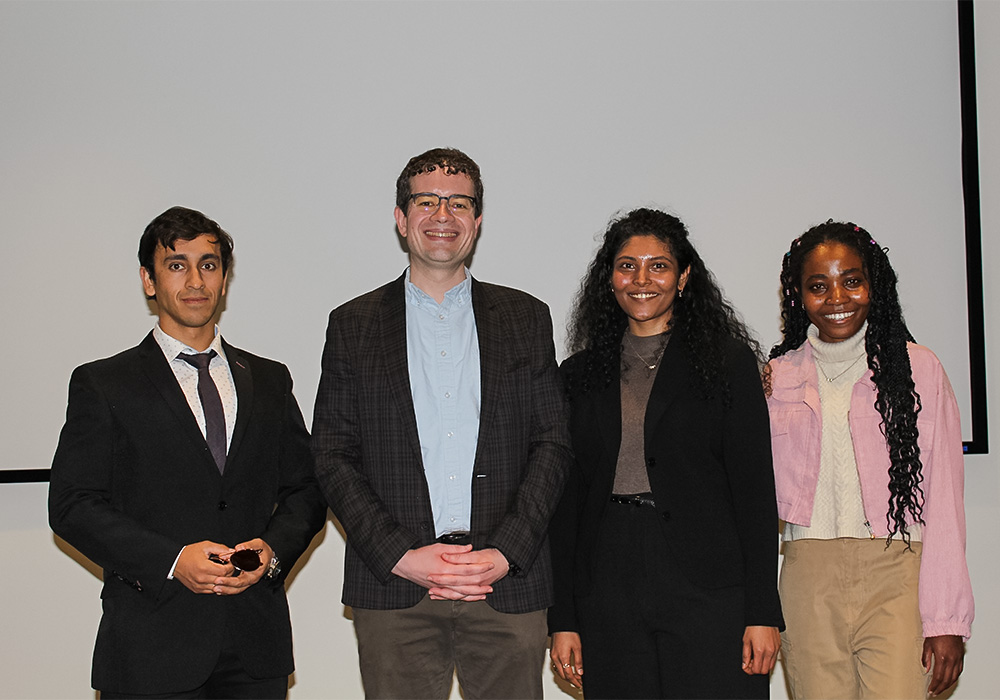
After placing third in last year’s Three Minute Thesis competition, Benedicta Nashiff almost talked herself out of competing again. She was proud of her accomplishment, but what if she returned only to do worse? Encouragement from her sister helped her find the courage to try again.
“Before the final, I prayed and let myself believe that first place was possible,” Nashiff says.
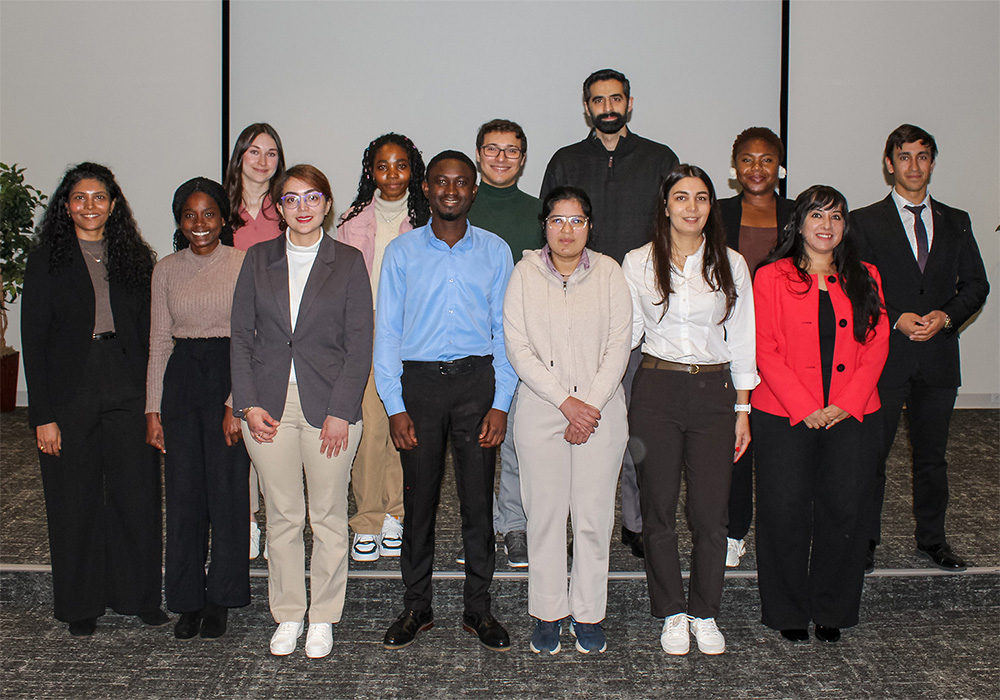
This year, the University of South Carolina graduate student took home first place. She was one of 13 finalists in this year’s competition.
Developed by the University of Queensland in Australia, Three Minute Thesis (3MT) is an international competition that challenges graduate students to explain their research and why it matters in three minutes, using one slide.
Exploring ways to improve cancer treatment
Nashiff studies drug discovery and biomedical sciences in the College of Pharmacy. She uses computer modeling to study how a drug might help weaken the stiff tissue around some tumors, potentially making it easier for chemotherapy to reach cancer cells. After the preliminary round, judges’ feedback prompted her to revise nearly half the words in her presentation before the final.
“3MT challenged me to explain a complex project in a clear and meaningful way, and it helped me see how powerful simple language and storytelling can be in connecting research to people’s lives,” Nashiff says.
She earned a $1,000 cash prize and will represent USC at the regional competition hosted by the Conference of Southern Graduate Schools. Nashiff’s experience reflects the purpose behind USC’s preparation for the competition, says Matt Klopfenstein, The Graduate School’s director of professional development.
Jon Edwards, a USC associate professor, has led a training workshop for more than a decade. The graduate school also provides information and practice sessions and more time between the preliminary round and finals so students can apply feedback and refine their presentations.
“Our goal is to use 3MT as a tool to help our grad students prepare to share the impact and significance of their work wherever their journey takes them beyond USC,” Klopfenstein says.
Mapping what lies beneath South Carolina
Ademar Fernández, a geological sciences graduate student in the McCausland College of Arts and Sciences, earned first runner-up and $500. His research examines Earth’s crust beneath South Carolina.
“By creating a map of its thickness and seismic properties, we can improve our understanding of the region and help scientists locate future earthquakes more accurately,” Fernández says.
He credits his adviser, Dan Frost, an assistant professor in the USC’s School of Earth, Ocean and Environment, with providing guidance, resources and the freedom to develop his research.
Searching for answers to a childhood movement disorder
Sravanthi Avula, a biological sciences graduate student in the McCausland College of Arts and Sciences, earned second runner-up and $250. She studies why a fever can trigger certain inherited forms of dystonia, a disorder that causes muscles to tighten and twist uncontrollably.
Her research examines a cellular alarm that normally helps fight viruses. When that alarm stays on, it can harm brain cells that help control movement. Her work explores ways to quiet it, with the hope of contributing to an effective, approved treatment for children with dystonia.
Her mentor, USC biology professor Rekha Patel, has studied alarm protein for more than two decades, giving Avula a foundation for her own research.
“She is an amazing mentor who showed me the beauty of research and the joy of answering questions that can make a real impact on people’s lives,” Avula says.
Research across disciplines
Beyond cancer treatment, Earth’s crust and movement disorders, the other 10 finalists
explored questions spanning health, technology, energy and the environment. Each received
$100.
Chinwendu Akalonu: How journalists in Africa adopt artificial intelligence.
Mehak Bhatia: Stronger, recyclable rubber.
Mahtab Ghasemi Dogaheh: Peptides: A promising approach to targeting cancer.
Mina Karami: Variation between heartbeats and its connection to attention.
Koryo Kwao: How the same protein chain can adopt two different shapes
Alireza Mashreghi: Simulating river behavior in a laboratory.
Mary Mitchell: How cannabis-related compounds affect gut bacteria in Crohn’s disease.
Sweety Ramnani: Synchronizing eye movement tracking and EEG signals in human brain.
Ebenezer Seesi: Materials for converting waste heat into electricity.
Diego Villafañe Ortiz: Cancer-related weight loss and changes in the heart.
The presentations lasted three minutes, but the work behind them continues.
“Behind each presentation is a student who has spent time asking questions, working through challenges and thinking about the bigger picture of why their work matters to the world,” says Lara Lomicka Anderson, interim dean of The Graduate School. “These finalists deserve recognition for that commitment. Bringing our university community together to celebrate their work is one way we can encourage them as they continue to grow as scholars.”
Graduate students are invited to learn more about competing in 3MT. Faculty and staff can get involved by volunteering as judges.
For more information, contact Matthew Klopfenstein at klopfenm@mailbox.sc.edu.