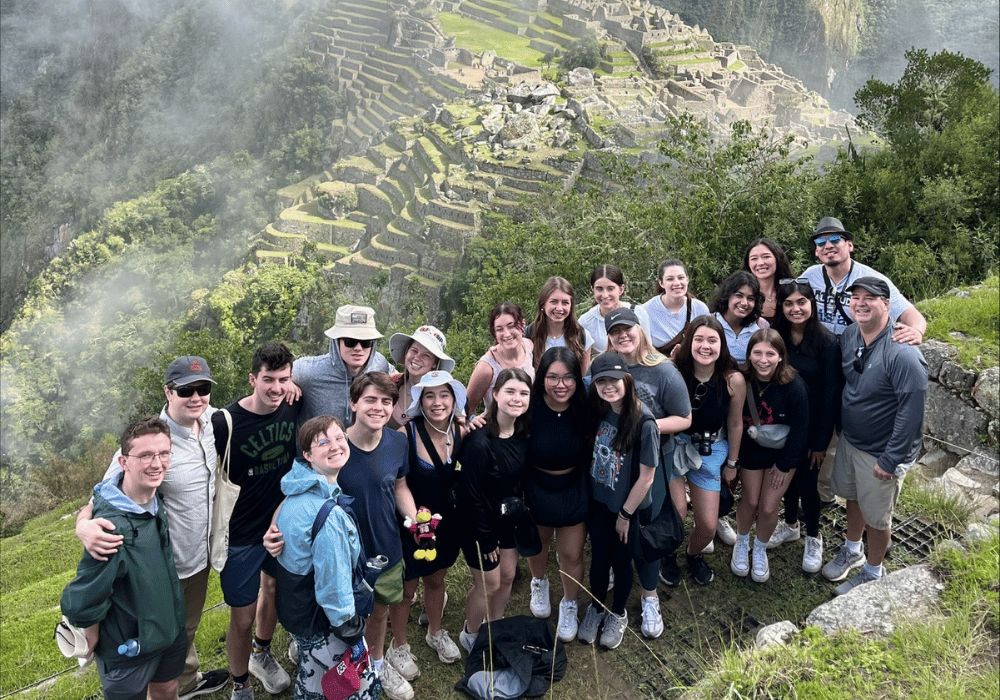
Before they ever set foot in Peru, University of South Carolina students read firsthand accounts of Cusco from the 16th and 17th centuries.
They study the rise of the Inca civilization and examine how conquest and colonization shaped Latin America.
Weeks later, they're walking those same streets.
For Matt Childs, professor and chair of the Department of History in the USC McCausland College of Arts and Sciences, that's when history begins to feel real.
"One of the keys in experiential learning is that you reflect and connect what you're learning," Childs says. "By experiencing it, you're putting that knowledge to work and developing a deeper appreciation for it."
Offered during Winter Session through GARNET and the Education Abroad Office, the interdisciplinary program allows students to earn academic credit while traveling throughout Peru, including Lima, Cusco, Lake Titicaca and Machu Picchu.
Open to students from any major, the course fulfills two Carolina Core requirements.
"It's a good way to get ahead on your coursework, and it's also a great way to see a part of the world," Childs says.
“It was incredible to connect what I had learned in the classroom about oxygen transport
with something I was actually experiencing.”
The learning continues long after class ends.
"You're traveling with the students, eating with the students and living in the same hotels," Childs says. "You learn all about them and help them face new experiences, new foods, new environments and new people. In some ways, you're introducing them to the world."
Students also find connections to their own academic interests.
For Sophia Woytowitz, a biochemistry and molecular biology major from Sparks, Maryland, that connection began with something she had studied in a biochemistry course: how hemoglobin transports oxygen through the body. She became curious about how that process is affected when less oxygen is available at higher elevations.
"Being in the Andes allowed me to experience these physiological changes firsthand," Woytowitz says. "I initially experienced shortness of breath and symptoms of altitude sickness, but over time, I could feel my body gradually acclimatizing to the environment."
The experience gave her a firsthand connection to a concept she had encountered in class.
"It was incredible to connect what I had learned in the classroom about oxygen transport with something I was actually experiencing," she says.
For some students, the experience brings a new perspective simply by being somewhere unfamiliar. Some are leaving the United States for the first time. For others, it's even their first time on an airplane.
"It isn't necessarily that students come back and completely change their major," Childs says. "But it is foundational in how they begin to think, not only about their college education and the University of South Carolina, but what their role is in the world they're becoming adults in."
For Leah Glass, an international business and marketing double major from Los Angeles, one of those moments came while visiting a community on an island in Lake Titicaca.
A young girl gravitated toward her and joined her on a boat ride, sitting in her lap as they traveled together.
"It was a reminder of how, despite the distance, these communities are so similar to our own with families and kids," Glass says. "Her life is so different from mine, but every day I can strive for that same joy that she had."
Students also experience Peru through more than one academic lens.
While Childs focuses on history, Ana Cueto, professor of Spanish in the Department of Languages, Literatures and Cultures, helps students connect language and culture to the people and places they encounter.
"Students are exposed to several languages, including Indigenous languages and Spanish, the language introduced during the Spanish conquest," Cueto says. "Every interaction becomes part of the learning experience, and being immersed in Peru inspires them to understand the language through its people, history and culture."
Cueto says those interactions extend beyond formal lessons as students connect with people and families and experience Peru's architecture, food, language and crafts.
"The program opens a window to a new world, breaks down language barriers and leaves students eager to return," Cueto says.
The experience also shaped how Sophia thinks about her future in medicine. Seeing how culture, environment and access to resources influence people's daily lives challenged her to consider healthcare from perspectives different from her own.
"As I pursue medicine, I want to carry that awareness with me by approaching patients with curiosity rather than assumptions and providing care that respects their culture, circumstances and way of life," Woytowitz says.
Students interested in Winter Session can explore available courses and opportunities
or contact the Graduation and Retention Network (GARNET) to learn more. Faculty interested in leading a Winter Session abroad experience can
also contact GARNET.