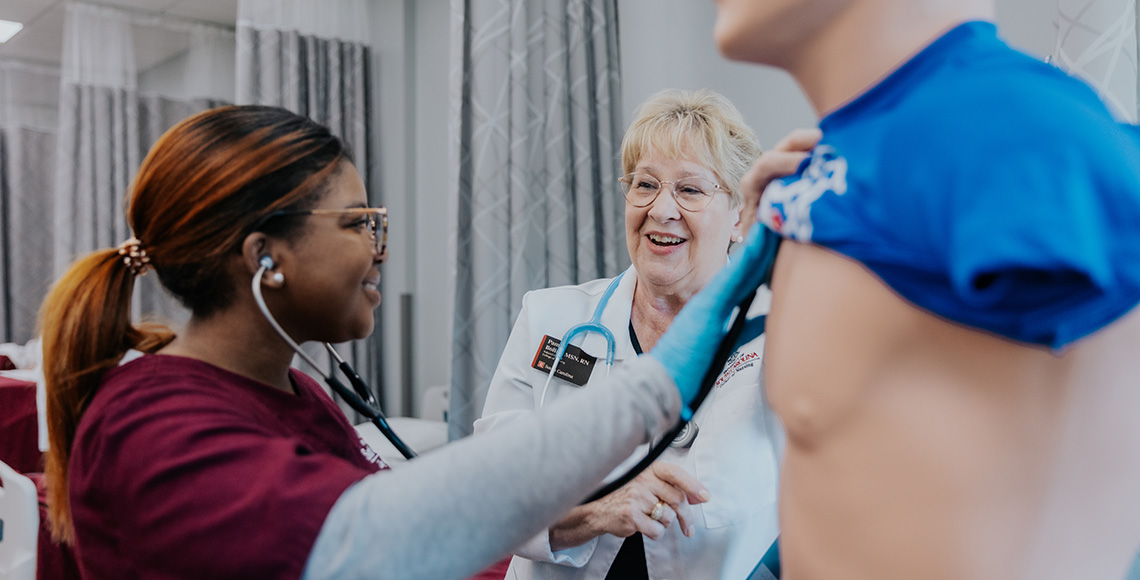
The University of South Carolina College of Nursing Center for Simulation and Experiential Learning (SAEL) was reaccredited in 2025 by the Society for Simulation in Healthcare (SSH) for Teaching and Education, reaffirming its position among the nation’s top simulation centers. SSH sets the gold standard for professional excellence and leadership, advancing simulation-based education and patient safety worldwide. Located in the Midlands, the SAEL Center is widely recognized as a national leader in simulation education, preparing highly skilled, practice-ready nurses to meet today’s complex health care demands.
“The growth and expansion of the SAEL Center has supported our ability to develop innovative, realistic, and practice-relevant experiential learning opportunities for our students,” says Robin Dawson, associate dean for academics. “By using cutting-edge simulation technologies and teaching approaches, we can prepare an even greater number of nurses ready to deliver compassionate and high-quality patient care in an increasingly complex health care landscape.”
Growth and expansion
Since earning its first SSH accreditation in 2020, SAEL has continued to elevate health care education through innovative teaching strategies and advanced simulation technologies that create transformative experiential learning opportunities. A major milestone in this growth was the expansion into a 52,000-square-foot, state-of-the-art clinical education facility. Designed to mirror real-world health care environments, the Center provides an immersive, high-impact learning experience that supports the university’s rapidly growing nursing student population and reinforces its standing as a top-ranked simulation program.
Further strengthening its national standing, USC earned an additional SSH Multi Site Program accreditation, formally recognizing the SAEL Center’s capacity to provide standardized, high-quality simulation education across multiple campuses through its partnership with USC-Lancaster. Supported by a $2.8 million Health Resources and Services Administration grant, plans are underway to renovate and rebuild the USC-Lancaster simulation center with advancements comparable to those at the Columbia campus, expanding access to high-quality simulation education across the region.
“This additional accreditation is an affirmation of our partnership strength with USC-Columbia and our shared commitment to delivering standardized, exceptional simulation education across campuses,” says Leigh Pate, director of the USCL BSN Collaborative Program. “With the support of the HRSA grant, we are not only renovating the Lancaster simulation lab to mirror the advanced capabilities of our Columbia campus, but also expanding equitable access to cutting-edge training throughout the region.”
Immersive learning
Simulation education offers realistic, immersive learning experiences that closely replicate clinical practice. At the SAEL Center, nursing students develop critical hands-on skills using high-fidelity patient simulators, robotics and advanced instructional tools while engaging in complex patient decision-making and interventions. Guided by expert clinical educators, students receive real-time feedback that strengthens clinical judgment, confidence and patient safety outcomes.
A key component of the SAEL Center is its robust standardized patient program, which provides a safe, supportive environment for students to refine communication and interpersonal skills. Standardized patients are carefully trained to portray the history, symptoms, emotions and concerns of real patients or family members. They also support Center operations by assisting with manikin operation, simulation room preparation and student feedback, further enhancing the effectiveness of each realistic learning experience.
“By incorporating standardized patients into every simulation, we create meaningful, human-centered learning experiences that prepare students for real-world clinical practice,” says Kelly Russin, Center director. “Holding a multi-site simulation accreditation at a university of this magnitude demonstrates our commitment to the highest standards in health care education.”
Faculty excellence and impact
Strategic oversight and continuous improvement are guided by the Simulation Advisory Committee, composed of college leadership, hospital system partners and student representatives. The committee plays a vital role in identifying emerging simulation needs and ensuring the Center remains aligned with industry standards and workforce expectations.
The SAEL Center also serves as a hub for faculty and staff development. More than 80 simulation educators are formally trained to facilitate simulation experiences across the college’s BSN, MEPN and NP programs. Educators are carefully matched based on simulation expertise, academic preparation and clinical practice experience. In just two years, the Center has delivered more than 100,000 learner contact hours of simulation, underscoring its scale, impact and leadership in nursing education.
"Our specially trained simulation educators, drawn from our trusted local health care partners, are the backbone of our program,” says Russin. “Their collaboration strengthens the connection between the classroom and the clinical environment, enriching every learner’s experience."
With national recognition from the SSH, the SAEL Center continues to lead in simulation-based nursing education by expanding access, advancing innovation, and preparing the next generation of nurses.
Learn more about USC Nursing's SAEL Center here.