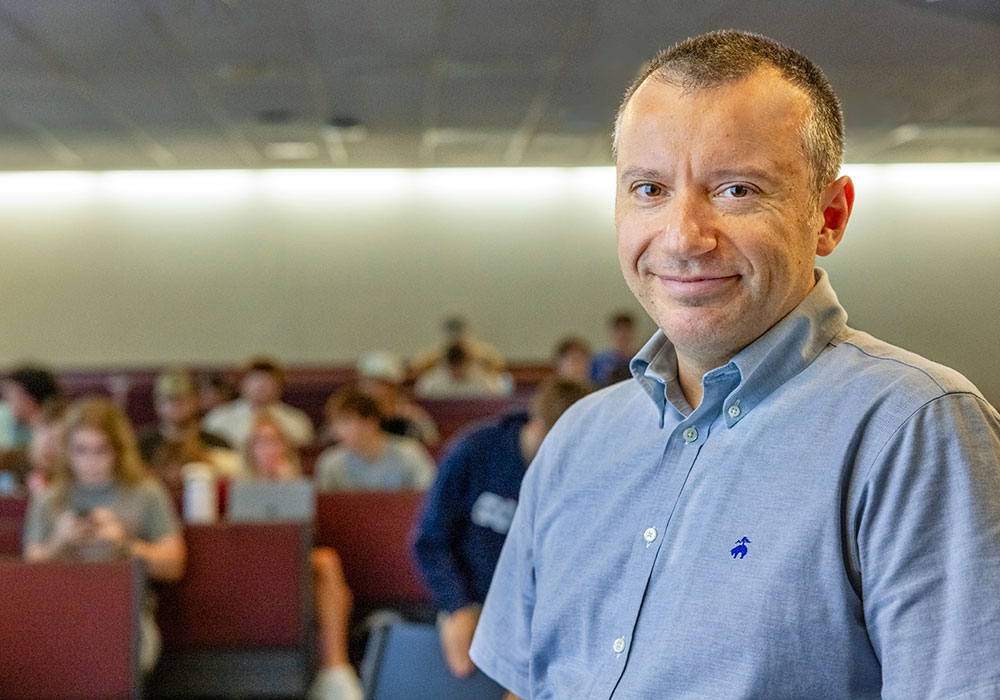
As an undergraduate during the early years of the digital era, engineering student Nikolaos Vitzilaios often visited the library at the Technical University of Crete. With little information available online — and certainly not within seconds on a mobile device — learning was a more tactile experience than it is today.
“I had to go to the library and take all the books off the shelf and manually turn pages over and over again,” Vitzilaios says. “I think that’s very important. It’s part of the process. That taught me that in order to learn you have to try a lot.”
Now an associate professor at the University of South Carolina, he still reflects on his experiences poring over library books. His own students are flooded with information, and the answer to any question is in their pockets. But knowing answers isn’t the same as solving problems.
“Our role as college educators is not really to teach you only a particular topic, especially in engineering,” he says. “It’s about teaching you a way of thinking — so, how you can find information, evaluate it and develop your own solution to the problem. It’s our responsibility to spread this knowledge.”
When he came to USC in 2017, he put those problem-solving skills to use in the Molinaroli College of Engineering and Computing, where Dean Hossein Haj-Hariri tasked Vitzilaios with developing a mechatronics course.
Mechatronics is a broad field that includes robotics, and it blends systems from mechanical, electrical and computer engineering. Demand for mechatronics engineers has increased in recent years, but teaching it requires more time than most other mechanical engineering courses.
“For this class to be successful, I was quite sure that we needed to have some lab components,” Vitzilaios says. “I mean, you cannot teach or learn mechatronics just by theory, just by working in a lecture room and seeing slides. There has to be a hands-on part for the students, and the hands-on part of a mechatronics course is working with microcontrollers.”
His solution was to develop a 4-credit-hour course that includes lectures and labs. After learning theory through slides and traditional instruction in the lectures, students apply those lessons as they build their own electronic systems. Much like library stacks, the mechatronics lab is a place where students can navigate the process of problem-solving independently.
“Our role as college educators is not really to teach you only a particular topic, especially in engineering. It’s about teaching you a way of thinking — so, how you can find information, evaluate it and develop your own solution to the problem. It’s our responsibility to spread this knowledge.”
“In engineering, you always have the fundamentals and theoretical aspects that you have to do as an engineer. You’re not expected to become a mechanic,” he says. “However, I think they really like the hands-on component. They all report that it is one of their favorite courses. They like that they have to build something with their own hands.”
The course’s popularity can be attributed to Vitzilaios’ classroom approach, too.
He is a big proponent of organization. After all, he knows his students have a lot going on, particularly since mechatronics includes time in the lab. Some are also juggling school and work. So Vitzilaios consistently provides a detailed syllabus and schedule at the beginning of each semester. That way, he says, there are no surprises, and students can plan how to manage their time.
And while his classes are highly structured, he always saves a few minutes at the end of each lecture for open discussion. This is time for students to ask questions about their coursework but it’s also a chance to pick their professor’s brain or learn more about the discipline.
“Sometimes it’s something on the news about a new robot or a new mechatronic system or a new autonomous system,” he says. “Sometimes they ask for advice about their career or how to find a job. Other times they ask about research opportunities. But I try to give this window at the end of every lecture. It’s not ‘I’m the instructor, I’m checking your knowledge.’ It’s giving them feedback and also getting their feedback on the things we learn.”
Even though he routinely receives positive teaching evaluations, he was surprised to receive the Career Influencer Award from USC’s Career Center last year. It’s one thing to know students like your classes, but it’s another thing altogether to know you’re making a difference.
“It’s really important to realize on a daily basis that every minute of what you do in the class can affect someone,” he says. “And if students report that I influenced their career and they appreciate it, it feels good. It comes with a lot of joy, but at the same time a lot of responsibility.”
Winning the Michael J. Mungo Undergraduate Teaching Award this year has reinforced those feelings. At the end of the day, though, what he most enjoys is watching students discover their strengths.
“We can have different metrics for success,” he says. “But starting with something that is completely unknown to them, seeing that they keep trying, even though in the beginning it may be very challenging for them, and in the end mastering the content — I think this is probably the best reward you can get.”