In the early months of Russia’s 2022 invasion of Ukraine, six Ukrainian soldiers went missing after an ambush. Questions lingered for their families and comrades: Were they captured? Or were they killed? And if they were killed, where were their bodies?
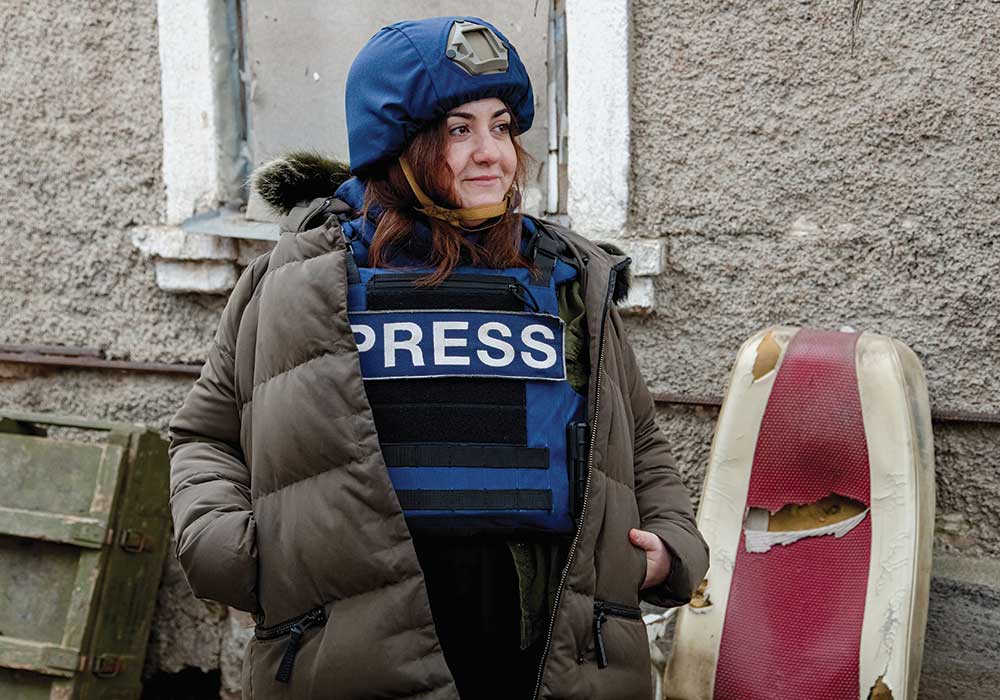
Isabelle Khurshudyan mulled over those questions, too. A reporter with The Washington Post and chief of the paper’s newly formed Ukraine bureau, she and her team chased the ambush story for months. Finally, nearly a year after arriving in Ukraine, she stood with one soldier’s widow as his body was exhumed from the cold earth.
She never finished the story.
“It felt like the straw that broke the camel’s back,” she says. “I remember sobbing for several minutes, uncontrollably, and it felt like I was crying about the whole year. I’d compartmentalized so much. Finally, the dam broke.”
Tearful breakdown aside, Khurshudyan is well-suited for war reporting. She won’t deny it.
During her three years in Ukraine, she mastered the art of getting in and out quickly, of mentally calculating the distance of incoming fire, of knowing the nearest exit route. Fluent at speaking Russian thanks to her Ukrainian-born parents and grandparents, she navigated interviews with few language barriers.
The 33-year-old reporter also had a knack for powering through, and not just near the front lines. Khurshudyan conducted countless interviews with Ukraine’s top military officials, including three tense sit-downs with President Volodymyr Zelenskyy.
She doesn’t rattle off these facts like brags. Khurshudyan will just as quickly tell you that she is haunted by the things she has seen. Nor do these facts about her career reflect narrow journalistic interests.
“When you’re based in a war zone, this becomes your normal life. Your nervous system is so elevated all the time. That’s when it becomes impossible to avoid the burnout. If you stay in that setting for so long, it will hit you at some point.”
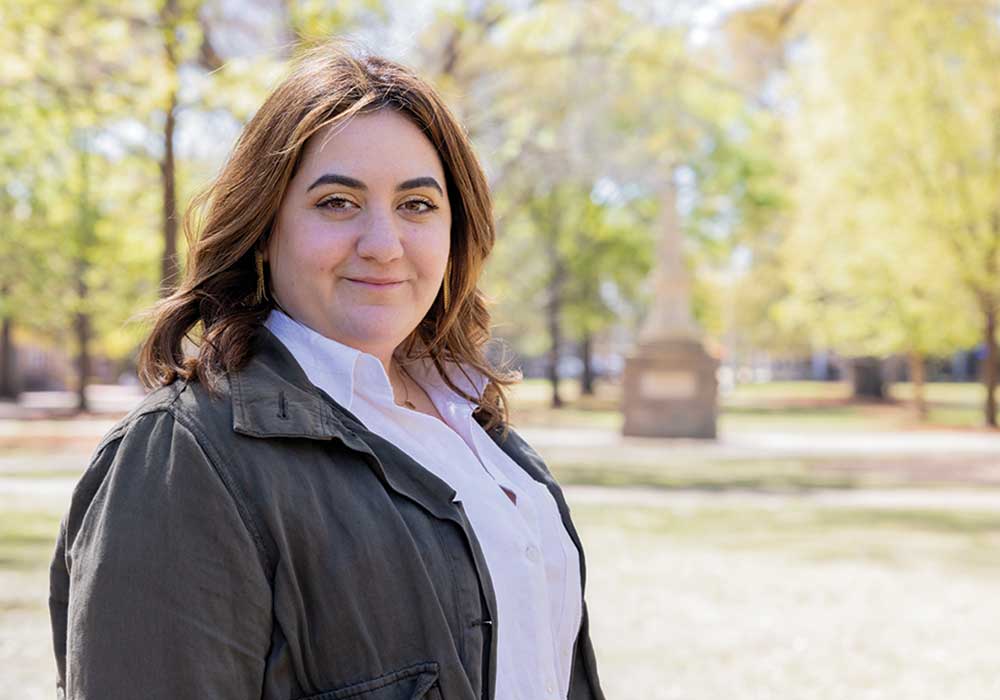
Before taking the Ukraine assignment, the 2014 University of South Carolina alumna did a two-year stint in the Post’s Moscow bureau. Before that, she spent four years as a hockey reporter covering the paper’s Washington Capitals beat. And following her return to the U.S. in early 2025, she joined CNN as the senior enterprise reporter, a position that lets her dig into new topics.
“It’s nice to be back in the United States and have a more stable schedule,” she says. “I felt like I was ready for that, and — after six years of writing about other countries — ready to write about my own. This is an important time to do that.”
But, for journalists who have spent significant stretches of time immersed in the violence and grief and uncertainty of human conflict, extricating yourself isn’t so simple as leaving.
“When you’re based in a war zone, this becomes your normal life,” she says. “Your nervous system is so elevated all the time. That’s when it becomes impossible to avoid the burnout. If you stay in that setting for so long, it will hit you at some point.”
A few weeks after coming home in February 2025, Khurshudyan received an email from a former broadcast journalist who understood foreign bureau life better than most: Charles Bierbauer, dean emeritus of USC’s College of Information and Communications.
Though he retired from USC in 2018, the dean still kept up with journalism alumni, and he and Khurshudyan had a special bond. Bierbauer was a onetime correspondent himself, having worked out of the ABC News Moscow bureau from 1977 to 1981.
“Seeing reports of attacks on Odesa,” Bierbauer wrote, using the preferred Ukrainian spelling of Khurshudyan’s ancestral home. “Hope you remain safe.”
That meant a lot to Khurshudyan, who first met Bierbauer during a high school tour of the journalism school. When she mentioned in passing that she spoke Russian, Bierbauer’s interest was piqued. A Russian speaker himself, he knew fluency could open doors.
“He mentioned working in Moscow,” Khurshudyan says. “I thought that was so cool, but
even then I never could picture myself doing something like that. I just didn’t see
it yet. I think he did see it and encouraged
me to use my native Russian more.”
At that point, though, her heart was set on sports writing. She racked up as much experience as she could during undergrad, working her way up to sports editor of The Daily Gamecock, interning with ESPN.com and freelancing for Columbia’s The State newspaper.
“I remember how hard I worked as a student journalist, how much ambition I had, how much I wanted that life for myself,” she says. “It definitely was the time where I fell in love with journalism as a whole — not just sports writing, but the act of doing journalism. I probably loved it the most when I was in school.”
And the hard work paid off. The summer after graduation, Khurshudyan landed a sports reporting internship with The Washington Post. There, her second language paid off, too.
On July 17, 2014, Malaysian Airlines Flight MH17 was shot down over eastern Ukraine, and the new intern was pulled in to help translate breaking news. Her talents caught the eye of then-executive editor Martin Baron. Two months later, the paper brought her on full time as a sportswriter.
Like many South Carolinians, she knew next to nothing about hockey. But the Capitals were a very Russian team with a Russian captain — maybe a Russian-speaking reporter could get the sorts of stories others couldn’t. Four years later, she took home the Professional Hockey Writers Association’s top beat-reporting award.
Sports writing was fun, but Khurshudyan still kicked around the idea of one day working overseas. There were reporters in the newsroom who’d been to Afghanistan, reporters based in Moscow, reporters who’d won Pulitzer Prizes.
And then there was Bierbauer. Over coffee one day in Washington, he listened intently as the young hockey reporter laid it all out — she wanted to become a foreign correspondent. The former dean offered plenty of his own experiences, but also plenty of questions.
In March 2022, two months after Khurshudyan arrived in Ukraine, Bierbauer posed another question, this time via email: “If you recall our Washington coffee shop conversation when you told me you wanted to be a foreign correspondent, what would you say if we were having that conversation today?”
Switching career paths was a good decision, she responded, though she wished she had taken more time to enjoy covering sports.
“We rarely fully appreciate our jobs until we get to the next one,” Bierbauer replied. “But note how much each job prepares us for the next.”
Khurshudyan left her job at the Post and returned to the U.S. last February in desperate need of a reset. The paper had always stressed the importance of taking time off, but resting was something she struggled with. Case in point: When the Ukrainian city of Kherson was liberated in November 2022 after eight months of Russian occupation, she cut her vacation short.
“When you’re in that kind of assignment, you’re just so in it that you want to give your all, and you feel this pressure to keep working or to push yourself even harder,” she says. “And really, the best thing sometimes is to take more rest or to know when to stop.”
Coming back to the U.S. gave her that chance to step back. It also felt like a second chance at being an American, a chance to do the things she had always wanted to do.
At the bureau, she had adopted a toy poodle — Kim Khurshudyan, a playful nod to socialite Kim Kardashian. During the first weeks back in the U.S., Khurshudyan and Kim soaked up sun amid retirees in Boca Raton, Florida, where her mother lived. She also invested in some brand-new wheels.
“The first thing I did was lease a Jeep Wrangler, the car I’ve wanted since I was 16 years old.” She laughs. “It’s like I’m having a midlife crisis.”
In many ways, her new post-Ukraine life was relaxing. But there isn’t a true off switch when you’ve come home from a war zone. One day, while visiting a shopping plaza with her mom, Khurshudyan heard a familiar buzzing in the sky.
“Somebody was flying a little drone overhead, probably to take some aerial shots,” she says. “That really freaked me out because I hadn’t heard the telltale buzzing over my head in a while.”
Drone attacks had been a terrifying and regular part of life in Ukraine. They had conditioned her to wake up at 4 or 5 a.m., when the explosions typically began, a habit that still lingers today. Now safely back home and between jobs, she wondered if she should even stay in journalism.
The feeling didn’t last. When the offer came from CNN, she was excited — and ready. After all, CNN was where Bierbauer, who died in August, wrapped up his TV news career as a White House correspondent.
There was also the feeling of responsibility. Her great-aunt, Baba Zina, is determined to stay in Odesa. It’s a sentiment she has heard time and time again from other elderly Ukrainians. Khurshudyan is similarly determined to stay in journalism, the career she set out to pursue before she even arrived at USC.
“They would say, ‘I’ve built this house. I’ve lived here my entire life. I can’t imagine starting over somewhere else,’” Khurshudyan recalls. “I kind of understand that, too.”
Top photo by Serhiy Morgunov