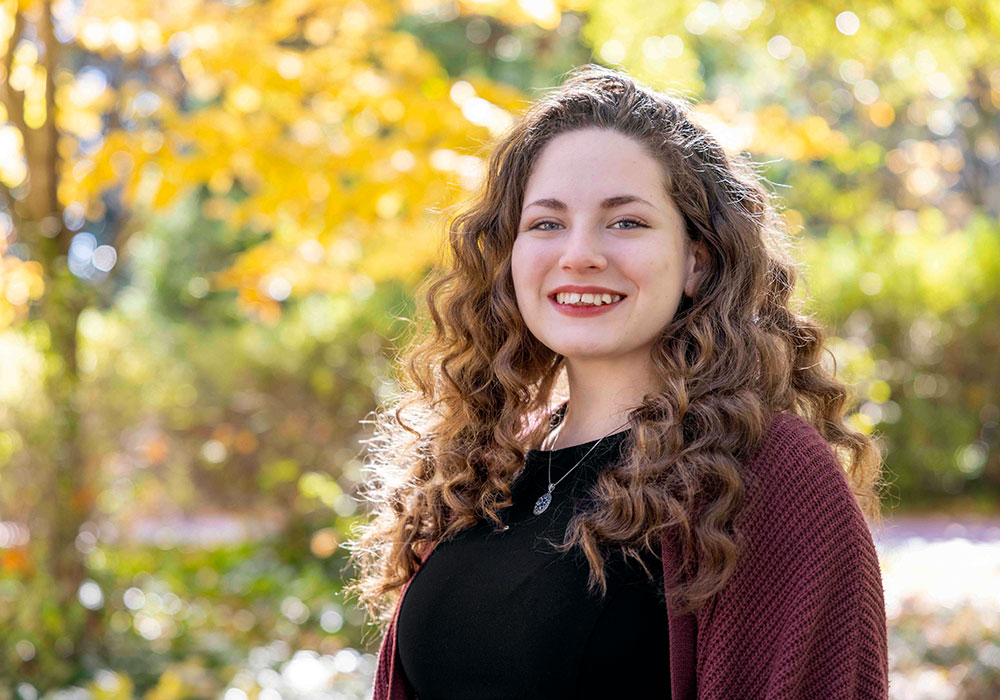
When sophomore Faith Fitzgerald came to the University of South Carolina, she wasn’t sure how or if she could merge her interests in psychology and linguistics. She thought that she would have to choose one to focus on, so she decided to study psychology. It wasn’t until she was introduced to psycholinguistics, or the study of the relationship between linguistic behavior and psychological processes, that she discovered a new path.
Fitzgerald, who is from Bartlett, Tennessee, is a Capstone Scholar and transferred into the Honors College her sophomore year. She says coming to USC has given her the opportunity to explore her academic interests while finding communities with similar interests in organizations like the Student Community for Archives, Libraries and Museums. We talked with her about her experiences at USC and how they’ve helped shape her and prepare her for the future.
Why did you want to study psychology and linguistics?
Mental health is a big deal in my family, so I was always interested in psychology, but I realized I wanted to study language in elementary school. I was in advanced classes, and we learned a lot about grammar. We did sentence trees and learned the parts of speech, and they also taught us how to read a dictionary. I was so fascinated by it that I bought my own dictionary. I feel like that was the first moment that I can really think of where I knew what I wanted to do, but coming to USC gave me the vocabulary for it. I talked with some professors to see what kind of opportunities were here, and that's when I was introduced to second language acquisition. And my interest in linguistics just kind of grew from there.
Why did you want to be a Capstone Scholar?
I learned about Capstone Scholars during my orientation. I thought it was interesting and that the building was cool, but as I researched it more, I found out that a lot of it had to do with service work. Community service was big for me in high school, and I wanted to give back to my new community. Capstone gave me that ability while also giving me student community on campus I can relate to.
They’ve pushed me to do things outside of my comfort zone and helped me with time management. We have to do a personal challenge every year in the program, and part of my challenge was getting out of my comfort zone, so I sang karaoke by myself, and everyone was just very supportive. I’ve always enjoyed singing, but I never had the platform for it, and I was very shy, so having the people in Capstone — all the ambassadors, all of my peers, all of the faculty — support me meant a lot, even though it was just like a silly little song. Now, I’m getting into more of the service aspect of it and doing civic engagement training. I’m looking forward to hopefully applying to be Capstone Fellow for the next two years.
How has transferring into the Honors College affected your experience?
I transferred into the Honors College this year, which was a big step for me. I was an honors student throughout high school, and so not being an honors student during my first year of college gave me a new, more relaxed perspective on school. I didn’t need to pour all my focus into academics. I had a chance to explore my hobbies and grow. That year of growth before going into the Honors College as a transfer student was really important for developing my own sense of identity.
The Honors College has given me a lot more opportunities to do what I want to do, like apply my interest in linguistics to what I’m studying. Also, research is supported in the Honors college, and they’ve helped me get that starting step forward into what I want to do.
How has your involvement in the Student Community for Archives, Libraries and Museums impacted you?
Being in this club has given a stronger appreciation for history and helped me with my own general civic engagement. I’ve realized that I am also a part of history, and it isn't this distant topic. It's not just something I learn in the classroom, take a test on and then leave. It’s always happening, and there are ways that we can contribute to it.
I feel like the preservation aspect of history is important, especially now being in a digital age, like how do we translate this digital data? How do we preserve the physical? Do we try to digitize more? There’s a lot of nuances and conflicts, and I feel like being in this club has helped me appreciate it more and become more aware of what’s going on behind the scenes. I’m more aware of the language that people use to talk about history and how easy it is to make an exhibit biased. It’s so important to have the facts, and sometimes presenting those facts can be emotionally charged, but that’s still a story that needs to be told.
What do you hope to do after graduation?
Education is a very important to me because I'm a first-gen student, so after I graduate, I would like to get a master’s. I’m looking into educational psychology, library science or linguistics programs. After that, I want to pursue a Ph.D. I want to prove to myself that I can do it and also make my parents proud. And eventually, I would like to work in a university setting, teaching and doing research.
How has your time at USC impacted you?
It’s helped me a lot with my communication skills. I have met so many different people with different experiences, backgrounds and perspectives, and USC definitely helped me develop ways to navigate those differences and also find common ground. It’s also helped me get out of my comfort zone. I came to the university very shy, very withdrawn. I would just do my work and that was it, and I feel like now I'm challenging myself and taking more risks.