Chris Horn: This is the sound of the Left Bank Big Band, the premier ensemble of the University of South Carolina’s Jazz Studies Program in the School of Music.
I sat in on this rehearsal just a week before the band flew to Europe to perform at jazz festivals in France and Italy, where their high-octane sets received plenty of applause.
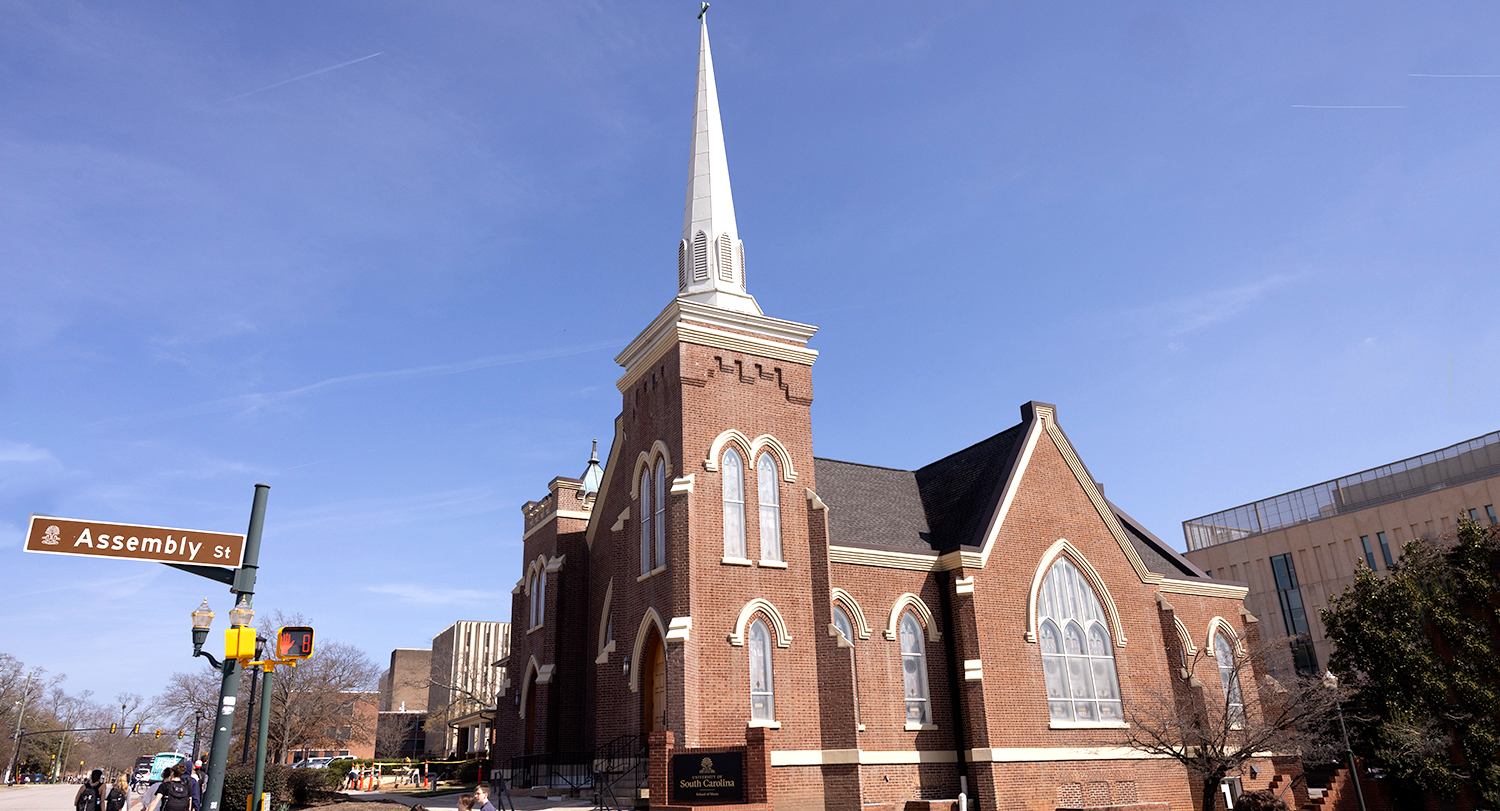
I’m Chris Horn, and today on Remembering the Days, we’re talking a little about jazz but mainly about the new venue for USC’s jazz program, located near the School of Music building on Assembly Street. How the university acquired the new home for jazz studies is actually a story about two former foes who buried the hatchet and found a way forward.
Here’s the background. In 1921, the Greene Street United Methodist Church in Columbia was built on the corner of Assembly and Greene streets. It looks out over what is now the Carolina Coliseum and the Moore School of Business, but 100 years ago that area was called Ward One, a neighborhood of houses and businesses.
Fast forward to the 1960s, and enrollment at USC is skyrocketing, the result of the first wave of Baby Boomers heading to college. The university — like many others across the country — needed more land for dormitories and academic buildings. We’ve done a couple of episodes about USC’s campus expansion in the ’60s and ’70s — how the university worked with the City of Columbia to acquire large swaths of land through urban renewal projects that ultimately displaced hundreds of families and small businesses, and several churches.
And that brings us back to Greene Street United Methodist Church. When the City of Columbia drew up plans to basically bulldoze much of Ward One where USC would build the Carolina Coliseum, it included the Greene Street church on the demolition plan. The church was located on the block where USC was planning a new building for its School of Law.
Church members, led by their pastor, C. Murray Yarborough, protested mightily. “We exist to serve the university community,” Yarborough said. Bumper stickers with the slogan “Save Green Street Methodist Church” started appearing around town. City of Columbia officials refused to make an exception for the white congregation, just as they had turned down pleas from Black churches in the area that were earmarked for eviction, including Union Baptist, St. Luke Baptist, Jones Memorial AME Zion and Antioch Baptist.
But Greene Street Methodist refused to give up. “Greene Street Church has become a symbol for little people everywhere who need to know that just because something is little, it does not have to be blotted from the face of the earth,” the church’s pastor told a news reporter.
A lawsuit was filed, and while USC’s Board of Trustees reconsidered the issue in 1969, they didn’t back down, issuing a statement that the land in question was considered of prime importance to the growth and continuity of community service by the University of South Carolina.
Ultimately, federal authorities who were involved in the urban renewal project said they were OK with removing Greene Street Methodist Church from the demolition list if USC officials would agree. Not long after, the university’s trustees relented. The university’s law center was soon built, taking up the entire block bordered by South Main, Greene, Assembly and Devine streets, except for the southeast corner of Greene and Assembly, where the church continued to go about its routine of weekly worship and charitable service.
One can only imagine that feelings between the church and the university were raw in the aftermath of that 1960s confrontation. But time often has a way of healing wounds, or at least making a way for fresh dialogue. Decades later, in 2005, Tayloe Harding became dean of the School of Music at USC.
New leadership at the church prompted a conversation with the music school. Here’s Tayloe Harding.
Tayloe Harding: “In 2007, we had kind of a perfect storm of the right clergy over there, an eagerness on the part of the parishioners to have a partnership with the music school that would provide them not only some music in their building, but also a person who could run their choir, who was on a graduate assistantship here. And if we could do that and locate a piano over there from our inventory, then they’d give us unlimited use of the space. And as a result, we had a bunch of concerts in there. The 2008-09 and 2009-10 years, we had a bunch of concerts over there.”
Chris Horn: That arrangement worked nicely for the church — they got a choirmaster and a nice piano — and the School of Music got some much-needed space for small audience concerts. But the congregation of Greene Street Methodist Church was dwindling, and in 2020, the first year of the COVID pandemic, the church’s remaining members made the decision to sell the 99-year-old building to the University of South Carolina Foundation, a separate entity from USC that acquires land and other assets to benefit the university.
Tayloe Harding: “The church was not going to sell to the university. The church wanted to sell the property to the foundation if we could structure a deal that would allow them to use it, once it was renovated, for worship on Sundays. And so we struck a deal that would allow them to do it five years from the time after the renovation is completely done. And the renovation, of course, cost way more than our original estimates indicated it would, and those estimates rae seven or eight years old, so we know what that looks like, and it’s taken longer to get to that point.
But the congregation, which is in the 20s number of people, have merged with Main Street Methodist and have become Columbia Methodist now, and they still want to have an opportunity to worship in there on Sundays when it’s ready. And they know that the deal with the foundation is five years, but as long as I’m dean, I can’t imagine that we would ever say, 'Your five years is up. You need to be out’ We don’t use it on Sundays all that much anyway. To me, this is sort of a model for partnering with downtown churches, for urban institutions, where those church congregations are dwindling and the church or its bigger conference or convention, as it were, make decisions about what to do with their property. That could be a really nice public-private partnership.”
Chris Horn: So, the university and the church, which had been on rather unfriendly terms more than 50 years ago, have become partners. Greene Street Methodist Church, now Columbia Methodist Church, can look forward to using its former building without the headache and expense of ownership. And the popular jazz studies program in the School of Music has its own home on campus.
Tayloe Harding: “They knew that if we were going to keep primarily the windows, which are sacred, of course, and we would never, ever touch the windows, and the beautiful layout of the woodwork inside and the amazing, traditional light fixtures that are in there, they know that the essence of that — and of course the pews — they know that the essence of that room is not really going to change all that much, regardless of the music. We had them at an event in March. We invited congregants to this jazz event, a celebration of the life of Quincy Jones and his music, to an event there. And they were super excited, especially about what they saw in their Sunday school building that we had done so far.”
Chris Horn: One final footnote to the story: I mentioned earlier that several other churches in the former Ward One and Wheeler Hill neighborhoods lost their properties in the urban renewal projects that allowed USC to expand its campus. Besides Greene Street Methodist, there was another church that was slated for demolition but still stands today. St. James AME Church, founded in 1871, survived the university’s expansion into the Wheeler Hill neighborhood and remains an active congregation. A clause in the church’s 1871 deed stated that the land was to be used exclusively for an AME church, a restriction that helped St. James AME retain its property while much of the Wheeler Hill neighborhood was demolished.
That’s all for this episode. On the next Remembering the Days, Evan Faulkenbury explores the history of the chemistry department — one of USC’s oldest academic units. That’s next on Remembering the Days.