On Jan. 29, 2025, a U.S. Army helicopter collided with American Airlines Flight 5342 as the plane descended toward Ronald Reagan Washington National Airport. What should have been a routine flight into the nation’s capital ended with a mass casualty event.
In the immediate aftermath, first responders rushed to the scene, hoping to find survivors amidst the wreckage in the cold Potomac. Moments like these are what first responders train for. Others train for what happens after, when first responders need help grappling with what they have seen.
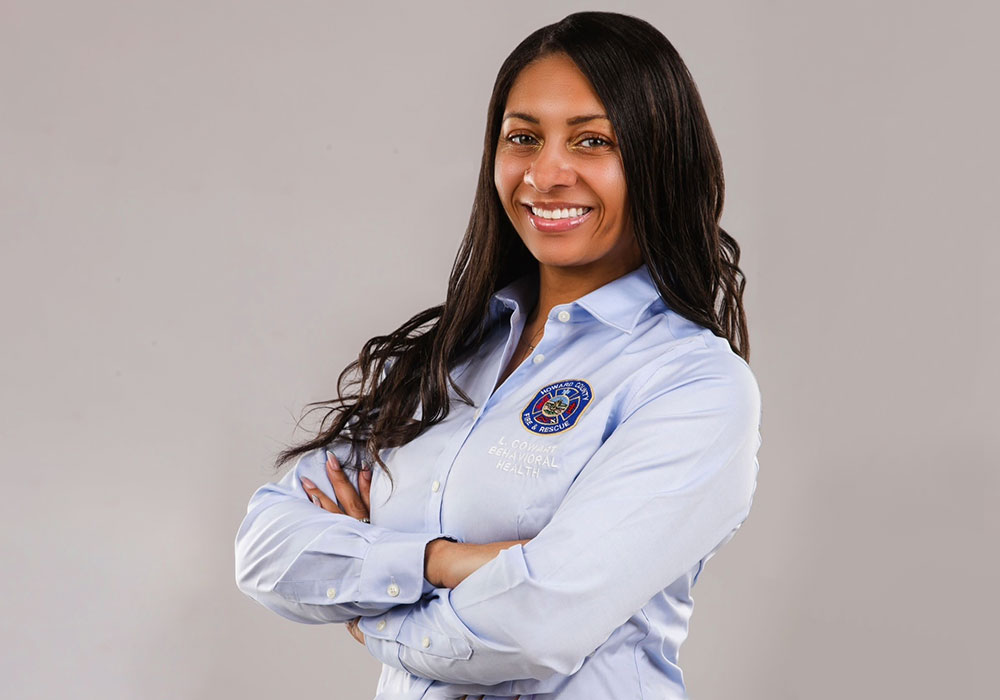
That includes LaQuita “Keke” Cowart-Drayton, a 2013 University of South Carolina College of Social Work alumna. Cowart-Drayton is the behavioral health coordinator with Maryland’s Howard County Department of Fire and Rescue Services. Her expertise was critical in the wake of the collision as she filled in for her D.C. counterpart to coordinate voluntary services for District of Columbia Fire Department members.
“The firefighters who responded aren’t necessarily going to be healed overnight. They saw a lot of gruesome things, and we talked about a lot of difficult moments in that process,” she says. “But I think they’re better off today and will be better off long term because of the work that we did with them in the days, weeks and months after.”
Being a light for vulnerable people during times of crisis is what drives the profession. It was modeled to Cowart-Drayton throughout childhood by her mother, a lead disability service worker who often volunteered with nonprofits in the family’s New London, Connecticut, community.
“My mom always instilled in me the importance of giving back,” she says. “Even when it came to the holidays, when we’d go through toys, clothes and things we no longer needed or used, and we'd give those things away. My mom was a teen mom, so we didn’t have this wealth of things to give back, but it was still one of her core values. Helping people, showing up and being supportive became important to who I am because of that.”
The desire to serve piqued her interest in the Master of Social Work program. The degree’s versatility sold it. After working with athletes in college, which often included tutoring and connecting them with mental health resources, she pivoted to clinical work, where she provided case management services and therapy to people with severe persistent mental illness. When she needed a change three years ago, she shifted to her current job in fire and rescue.
“You can do anything with social work,” she says. “You can be a therapist or work in a school. You can work with athletes. You can work with first responders. You’re not limited, so there’s no room to get bored. I was able to career switch without having to go back to school, get in more debt, or having to get another certification, and that's the true beauty of social work to me.”
Accreditation, proximity to family and affordability were top of mind when choosing a program, and it made USC an easy choice. The university admitted her to its Advanced Standing MSW program, an accelerated option for students who meet exemplary criteria, including already having a bachelor’s in social work. An 11-month program instead of two years would mean less student loan debt and the ability to serve the community faster. Additionally, the College of Social Work awarded her a paid graduate assistantship to further offset the cost of her degree, and she was inducted into the Phi Alpha National Honor Society for social workers.
“I think USC did a really good job of giving us the correct classes but also giving us real life experience to advocate for what’s right, what could be better.”
USC was enormous compared to the small, historically Black university she attended for undergrad, but it was something she wanted to experience. She recognized that there was value in learning to navigate a large campus, and studying at both an HBCU and a primarily white institution would deepen her understanding of the real world.
What she came away with was the foundation she needed to better advocate for others.
She chose the macro/mezzo social work track, which focuses on systemic issues, large-scale change and addressing the needs of larger organizations through advocacy, policy change and research.
“Taking the policy class kind of taught us how to deep dive into specific issues, how to dissect them and where to stick your points when advocating to improve quality of life for a group of people,” she says. “I think USC did a really good job of giving us the correct classes and also giving us real life experience to advocate for what’s right and what could be better for any specific group of people.”
Today, those lessons resonate in Cowart-Drayton’s efforts to ensure her department’s firefighters have access to mental health support. On a typical day, she might arrive at the fire station early to meet with a firefighter grappling with loss or burnout or PTSD. She makes sure there are programs in place to meet their specific needs, and she trains other behavioral health care providers on how to better serve this population.
Quantifying a social worker’s impact can be difficult because so much of what they do is kept private, particularly in the behavioral health sphere where seeking treatment is often stigmatized.
But Cowart-Drayton knows the work she does is meaningful. In 2025, she was named the Maryland National Association of Social Workers Macro Social Worker of the Year. The recognition is a reminder of what can be achieved when people work together for the greater good.
“One of my favorite sayings is, 'Always use your candle to light others.' If I use my candle to light yours, my candle is not going to go out. I’m going to light your candle every time,” she says. “I think a lot of times people feel like if they light someone else's candle, that automatically is going to dim their flame. It’s not. You can share the knowledge. You can share the resources. You can share the things you have access to and what you've learned. They'll still be amazing to you, but they'll also be amazing to someone else.”