Transcript
Welcome to Remembering the Days, where we explore the stories and talk with the people who are part of the rich history of the University of South Carolina. I’m Evan Faulkenbury.
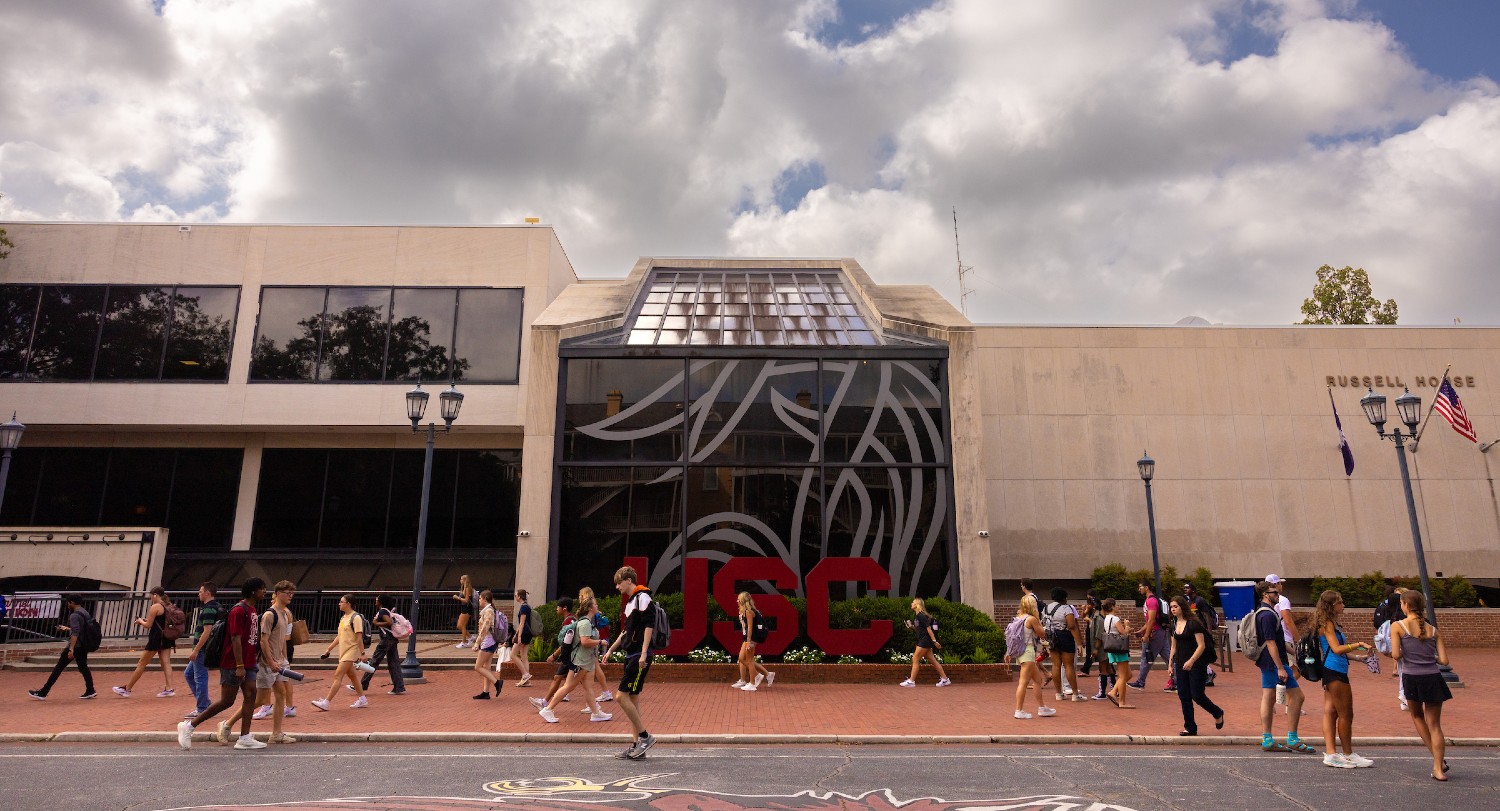
Today we’re exploring the history of the Russell House — Carolina’s 70-year-old, beloved student union building. We’ll start with a story about M&M’s.
Glenn German: “But I told you at the ballroom, down the hall, we had R.E.M., we had the Ramones. And the Ramones, it was funny, it was my first experience with a contract rider. You know, bands have things that they demand in order ... So the Ramones had a thing, and maybe a lot of people did this, but they had a thing that they needed a bowl of M&M’s, but with no green ones … I’m dead serious. And these were all the things that you were contractually obligated to give them. They weren’t expensive demands, but I think they were just screwing around with whoever. …”
Evan Faulkenbury: That’s Glenn German sharing memories with me as we walked around the Russell House recently. Glenn was USC’s student body president in 1985. Ever since he had arrived on campus, he had been heavily involved in campus activities. He lived in Preston College, and, as he told me, he could be out of his bed and in the Russell House in 45 seconds.
Glenn’s biggest love was film, and he also told me that he must’ve seen 400 movies in the Russell House Theater during his undergraduate days. After college, he became a writer and producer in Hollywood. At USC, when he wasn’t sorting out green M&M’s to keep the Ramones happy, he was in the Russell House. He shared another memory as we walked around the ballroom.
Glenn German: “One of the things I did when I was the cinematic arts chairman was that we watched Arthur in here. We had a projector back there and projected and had these round tables exactly like this. And your admission price got you a bottle of champagne for the table. And we just sat in here and got hammered and watched Arthur. It was a different time. The drinking age was 18, so it was a different time. But this was a special space. And then, I remember my summer after I was elected Student Government president, I came here for all the orientations and spoke to the incoming students and stuff, which was great. So a lot of ballroom experiences. Wow, this is really special. I’ve just not been in here forever.”
Evan Faulkenbury: Students at Carolina tend to spend a lot of time in the Russell House. Architects and university leaders designed it that way.
In late 1951, USC appointed Donald Stuart Russell as president. Russell was a seasoned lawyer and administrator serving in Washington, D.C., during the Franklin Roosevelt and Harry Truman presidencies. He was forward-looking, a leader molded by his time in government to embrace science, engineering and the future if America was to win the Cold War. He wanted to make USC more modern, too.
Plans for a student union went back to at least 1938. Aside from mixed-use academic buildings, residence halls and libraries, there was no student-centered space on campus. An earlier plan called for a student union building where the McCutchen House now stands on the Horseshoe with a façade that would blend in with nearby historic buildings. But that didn’t fit Russell’s vision of a modern university.
Listen to Harry Lesesne, who wrote the book on USC entering the modern age:
Harry Lesesne: “Stepping over Greene Street was — that close to the Horseshoe — was probably a pretty momentous move for expanding the campus anyway. They were building on the old fields. You can see that conversation coming, and then Russell was all about the future. He was about building, and to have a modern building, made a statement for him, I believe. And I think, again, his wife’s involvement in that showed how personal it was for them — that he was about leading the university into this new era. His first building that was his, that wasn’t a carryover from the previous administration, that being a modern building, I think did make a statement about where he was taking the university.”
Evan Faulkenbury: Working with President Russell, local architects proposed a modern structure not on the Horseshoe, but a block away on what was then Melton Field, where the earliest Gamecock football games were played. It would be unlike any other building on campus — straight lines, geometric, large, functional — mid-century modern, embracing the future.
Well, not everyone liked it. Not even Donald Russell’s wife, Virginia. Nor did several members of the Board of Trustees, who ultimately would make the final decision on the student union. Russell hired a consultant to convince the board that the Carolina Student House, as they originally called it, would be architecturally appropriate for USC’s campus. This consultant appealed to the future: “As the South converts to an industrial economy varying greatly from the earlier agricultural economy so well expressed by the colonial [architectural style on campus], the opportunity arises for fresh and valid architectural expression.”
That did it, sort of. The trustees approved the plans with a narrow 7-5 vote. The slim majority understood that if USC wanted to grow and be a leader and join the modern age, its buildings needed to reflect that mindset. USC needed “fresh and valid” space on campus for students to feel comfortable, to gather and to make their own.
When the student union building was finished in 1955, students liked it so much they petitioned to have it named for Donald and Virginia Russell. According to the Gamecock newspaper, “We vote the Russells the most popular people at the University, and the student union as the most popular building. What could be better than to bestow the name of the first upon the second, thus uniting our most prized possessions?” The governor approved, and the Russells’ portraits still hang on the walls of the Russell House.
That’s the building’s origin story, but what makes the Russell House such a special, nostalgic place on campus is its reputation as USC’s hub for students. Carmela Carr, who served in Russell House’s leadership from 1992 to 2007, put it this way:
Carmela Carr: “The whole goal was to make the Russell House feel like a destination. You wanted to go there because it was a comfortable place to be. They talk about student unions as being the living room. So it’s really, how can you make it feel like a place? And that’s one of the things I think the university does so well. Even though it’s a large school, everybody on campus has the ability to make it feel like a welcoming, small place. One of the things I loved and still love about Carolina is the welcoming and small feel that it has, even though we’re a large school.”
Evan Faulkenbury: I spoke with several people who were instrumental at different points in time to the Russell House’s development, and I got some good stories to share.
Jerry Brewer was USC’s longtime associate vice president for student affairs, and the Russell House was under his leadership. He told me about one time in the early 1980s that involved students camping out for Carolina-Clemson football tickets outside the Russell House. What ensued was an impromptu middle-of-the-night pep rally and an irate garbage truck driver:
Jerry Brewer: “Great battles about student tickets, athletic tickets, particularly football tickets but basketball tickets, too. Early, early on when I was assistant to the dean of students, we got a call from the police. We were actually playing cards one Sunday evening, and the dean of students at the time got a call from the police, ‘There’s several hundred students camping out at the Russell House. We need y’all to come over here.’
The police had already closed Greene Street off because of the amount of students were over there. But the whole area, all around the Russell House, down Bull Street toward the Women’s Quad, across the street by the observatory, there were just students everywhere. Pup tents were going up, they were doing campfires. … But one of the best moments was — everybody was in a good mood and just civil — the band showed up. Three or four o’clock in the morning, the Carolina Band showed up — and it wasn’t all the band, but it was a good chunk of them — and started playing. Had an impromptu pep rally in the middle of the night and middle of the morning.”
The party was still going when a garbage truck showed up for its early morning pickup to empty the Russell House’s dumpsters.
Jerry Brewer: “The guy that wanted to empty the dumpsters behind the Russell House came up Greene Street, tried to take a left on Bull Street to go — Greene Street was open back then and Bull Street — and about that time there was just students everywhere. He started honking his horn and doing that. Well, then the students decided to help him. So they started throwing all of their cans and bottles ... well, toward the trash truck. And of course it ticked that guy off. So we ended up having to get the police to escort the guy to back out of Bull Street and then down Greene Street to Pickens Street to leave. Because the students were like, ‘Yeah, we’re just trying to empty the trash.’ You're like, ‘Oh, that’s a student mentality.’ And then the next morning as the sun rose, students lined up. They lined up, came out of the front entrance on Greene Street to the Russell House, went down toward Thomas Cooper Library, went all the way out. The line ended at Bates House because at that point there was a ramp that went all the way, elevated ramp. It went all the way to Bates House, and the students stood in line and got tickets for the Clemson-Carolina game.”
Evan Faulkenbury: Another favorite memory several people shared with me was about the Golden Spur. This may be hard to believe for some, but there used to be a fully functioning bar, huge kegs and all, in the Russell House called the Golden Spur. It sold alcohol up until 1984 when South Carolina and many other states complied with federal law raising the legal drinking age from 18 to 21. The Golden Spur was on the second floor tucked into the corner where now there is additional seating and bathrooms next to the dining area. There was even a small stage, and bands and comedians would perform there. Craig Ness talked to me about when his father, David Ness, was the Russell House director starting in 1972, and he helped open the Golden Spur:
Craig Ness: “He would tell stories about going down to Five Points, getting the beer and wine, and then rolling it up the ramp and then opening the Golden Spur.”
Evan Faulkenbury: So just imagine that long, winding ramp we’ve all walked up to get to the Russell House’s second floor … kegs of beer pushed along to the campus bar, the Golden Spur. Or, maybe don’t think about it for too long. You might start to get thirsty. But fortunately, there is a new Golden Spur restaurant and bar on Lincoln Street that pays homage to the original in the Russell House.
One last story. Stephen Brown was involved in just about everything when he was a student from 1991 to 1995: the lecture committee, the music committee, Student Government, Homecoming, the Gamecock newspaper and so on. But his real love was the movie committee, working with others within the Carolina Program Union (now Carolina Productions) to choose the slate of films to be shown in the theater for each upcoming semester.
Stephen Brown: “We did Jaws in the P.E center in inner tubes. We always did Rocky Horror in the ballroom. We loved programming the cult movies because there was a certain kind of crowd that would definitely come at midnight to see movies, come really late. ... That was always the most fun deliberation in the cinematic arts committee. We programmed a few controversial things. We did The Last Temptation of Christ by Martin Scorsese, which had basically barely played in theaters in South Carolina. You can imagine how controversial that was in the Bible Belt. And we were like, ‘What’s a Scorsese movie that's hardly been seen?’ And we were always looking for these sort of, ‘Hey, there’s a lost Disney movie, Black Cauldron, that never came out. It didn’t do well again. We’ve got to bring The Black Cauldron.’ And so it was almost like we were trying to bring movies that you couldn’t see anywhere else.”
Evan Faulkenbury: For Stephen Brown, it’s not just the memory of the Russell House but about how his time spent working and volunteering at the Russell House laid the groundwork for the rest of his life. Stephen is now president of Cookerly Public Relations, based in Atlanta, and he credits his career in part to his time at the Russell House:
Stephen Brown: “My job nowadays in Atlanta is in public relations, and it’s truly to create relationships, create connections and find ways to get different audiences to be interested in the products that I launch. So it was uncanny that in my Russell House days, I was involved in projects that were to bring movies and music and lectures and activities to campus where we were truly doing the exact same thing.
“We were pinpointing different stakeholders and different audiences and trying to attract them because we wanted to have as many people come to our events as humanly possible. It was great if you could actually sell out something like the ballroom at the Russell House, or you could get every seat in the Russell House Theater filled. And so that was always our goal, to not have those seats go empty. And the same thing goes for me nowadays in PR. I’m even involved in arts activities where it’s the exact same thing.”
Evan Faulkenbury: Stephen’s story is evidence that the original vision of the Russell House has paid off. USC built a modern and original space on campus for students to grow, to be themselves and to gain new opportunities. That was true in 1955, and it remains true in 2026 and on into the future.
On the next episode we take a close look at the history of softball at Carolina. Our teams have had a lot of success over the years, and the story of women playing softball here goes back a surprisingly long way. That’s next time on Remembering the Days.