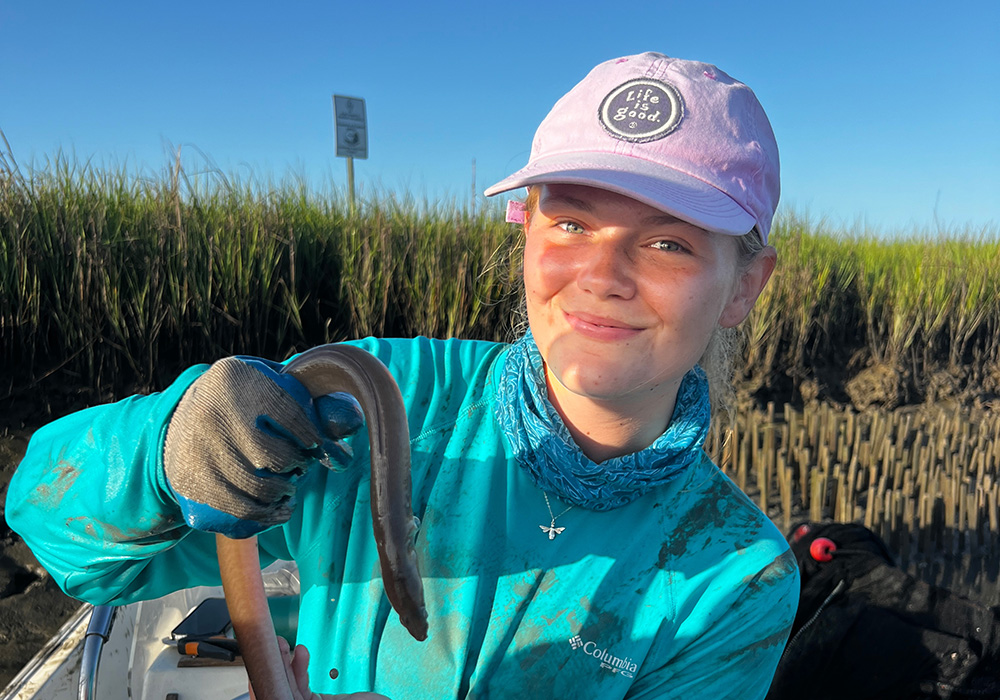
Kayla Thompson is not afraid to truly immerse herself in a learning experience, even when it gets a little grimy. The University of South Carolina’s 19th Udall Scholar, Thompson is completely at home working knee-deep in coastal pluff mud or faceplanting on the roughshod turf of a rugby pitch.
A junior in the McCausland College of Arts and Sciences majoring in environmental science, Thompson is a first-generation college student with a passion for issues surrounding social and environmental equity. Raised by a single father in Surfside Beach, she can’t say enough about the influence he had on her.
“My dad really spent a lot of time during my childhood teaching me the importance of being outside and being an environmental steward, because that’s how he was raised,” she says. “Another lesson he taught me was caring for other people, recognizing differences and helping others when they are in need.”
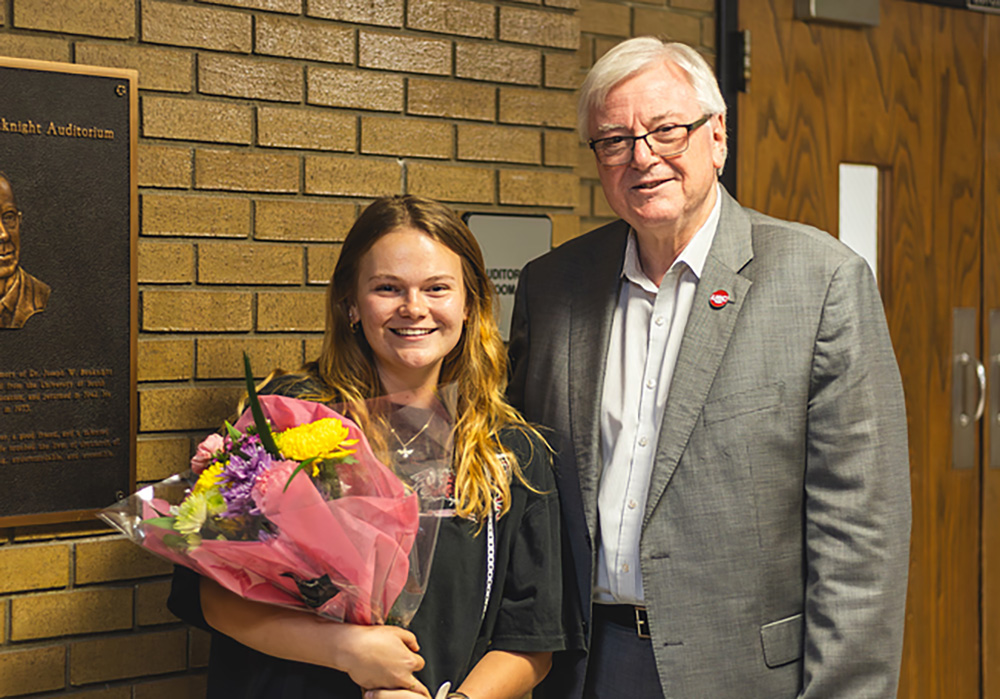
The Udall Scholarship is awarded to college sophomores and juniors for leadership and public service related to the environment or Native American nations. The careers of its namesakes, Morris K. Udall (former U.S. representative from Arizona) and Stewart L. Udall (former congressman and Secretary of the Interior under John F. Kennedy), had significant impact on the stewardship of public lands and natural resources.
For two summers, Thompson worked as an undergraduate research assistant at Baruch Institute helping investigate the durability and applicability of plastic-free geotextiles in aquaculture, water quality protection and coastal restoration.
“In my preliminary research, I learned that a lot of artificial oyster reefs used some type of plastic substrate to help the oysters colonize,” she explains. The team tested about eight different geotextile materials in the estuary and monitored artificial oyster reefs to see how they endured all weather conditions, as well as high and low tides, over time.
“It was a very fieldwork-heavy job, but I love being outside and doing that kind of thing,” Thompson says.
Through this leadership experience, I have learned how community engagement and coalition-building can translate passion into action.
Thompson joined the USC Women’s Rugby Team as a freshman and has been hooked on the sport ever since. In fact, she just completed her term as president and match secretary for the team. That role involved coordinating numerous community service opportunities.
“I knew coming to USC I wanted something to keep me a little bit more disciplined and fit,” she says. “I found a home on the Women’s Rugby Team. I’ve played for three years and plan to play the rest of my senior year as well. I feel like I’ve made a family for life.”
Thompson also served as program coordinator for the Environmental Justice Team in Sustainable Carolina, the student branch of the USC Office of Sustainability. In that capacity, she co-hosted the Equalitree podcast. In addition, she was a representative at the South Carolina Conservation Coalition’s Annual Lobby Day at the Statehouse, where she advocated about the importance of sustainable development.
“Through this leadership experience, I have learned how community engagement and coalition-building can translate passion into action,” she says.
Thompson’s efforts have not gone unnoticed. In April, she received the Harris Pastides and Patricia-Moore Pastides Student Sustainability Award, which is presented to a rising senior who has made an outstanding impact in sustainability through scholarship, leadership and engagement.
Though she had not even been born yet when her benefactors were making their mark on the world, Thompson knows who the Udall brothers are and what they championed. She says receiving this scholarship inspires her to do more to affect positive change.
“I think they were continuously challenging norms, especially in regard to environmental policies, regulations and things of that sort, even social justice,” she says.
After graduation, Thompson says she will pursue a graduate degree in environmental policy so she can translate scientific knowledge into justice-centered solutions.
Students applying for national fellowships work closely with faculty on our campus committees. This year's Udall Committee was chaired by Greg Carbone (Geography), and included Kelly Fleming (Environmental Health Sciences), David Fuente (Earth, Ocean and Environment) and Conor Harrison (Geography).
Those seeking national scholarships are assisted by National Fellowships and Scholar Programs. For more information, visit the National Fellowships and Scholar Programs webpage or call 803-777-0958.