Everyone likes having options, and college students are no exception. In the past few years, the University of South Carolina’s College of Information and Communications has developed new academic programs to give students more choices and better prepare them to work with emerging technologies.
What are these new programs, and how are they different from the college’s other offerings? Several students from the CIC’s newest degree programs share why they chose their programs and how they hope to use their degrees after graduation.
Jordan Richardson
B.A. in Communication
People skills come naturally for Jordan Richardson. The junior served as 2025-26 student body vice president, a job that involves managing student government’s event planning, outreach and social media efforts.
But Richardson’s mass communications major didn’t feel quite right.

“I’m more of the social media side of communications versus journalism,” he says.
After meeting with his advisor, he learned about the CIC’s new communication major. This program examines how people communicate with each other — rather than how the media communicates with people — through a social sciences perspective. It’s housed in the CIC’s new academic unit, Information and Communication Studies, which prepares students for careers that require expertise from both disciplines.
Courses cover topics including persuasion, negotiation and how to communicate both interpersonally and within a team.
Richardson would like to eventually be a communications director. He can see himself managing a large company’s social media and developing marketing strategies. Seeing how his classes mirrored his work as vice president confirmed he is on the right track.
“It almost felt like an internship,” he says, “getting that experience of running a social media platform and analyzing the analytics. On the programming side, I interacted with students on a daily basis and talked about what they want to see on campus. The major was absolutely perfect for my position.”
Nick Hill
M.S. in Information Security and Cyber Leadership
As crime evolves, so do criminal investigators like Nick Hill.
Hill, who works with USC’s Division of Law Enforcement and Safety, says it’s not uncommon to investigate cybercrimes — think gift card scams or sextortion. Even investigating petty crimes, such as the theft of a laptop, often involve understanding GPS data, WiFi logs and other types of digital evidence.
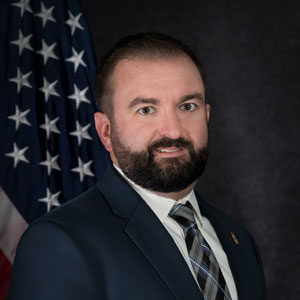
“So many of our cases now have a cyber nexus or involve digital forensics,” he says. “As I worked those cases and kind of learned on my own, I decided that continuing my education in that field would be beneficial for the job I’m doing now and also potentially open up opportunities post law enforcement.”
That decision led him to the master’s degree program in information security and cyber leadership. Juggling classes and a family can be difficult, so he liked that the CIC’s program was fully online.
“It’s all asynchronous,” he says. “I have three children, and working as a police investigator, my schedule is just all over the place. I needed that flexibility.”
The degree isn’t just for people wanting to work in cybersecurity. Hill says he’s learned plenty of skills that are applicable to his everyday work, including data visualization and creating databases.
For students who are curious about the program but not sure they want to commit to a full master’s degree, the CIC also offers a graduate certificate.
“I started with the graduate certificate knowing full well that I was going to go on to get the master’s,” Hill says. “You aren’t wasting any time doing the certificate first. It gives you a taste of it before you go full-on into the master’s.”
Will Maddux
B.A. in Sports Media
Houston native Will Maddux ended up at USC’s School of Journalism and Mass Communications after looking at a lot of other universities. A big baseball fan, Maddux wanted a degree that could turn his interest into a career. The CIC’s new sports media major stood out.
“I want to work in baseball. What that looks like, I don’t quite know yet,” says the freshman, who is also enrolled in the Honors College. “I think that’s one of the reasons I chose sports media — it allows you to gain a lot of different skills and learn about so many jobs in the sports world.”

Why was USC the clear choice? Maddux took note of the diverse opportunities available to students who want to explore the world of NCAA Division I sports. That can mean participating in student media through USC’s Garnet Media Group or landing an internship with an athletic team. In his first year, Maddux has written sports stories for The Daily Gamecock.
“When I was trying to decide on a school, I felt like at South Carolina, I could get the most hands-on experience as soon as I got here,” he says. “I didn’t feel the same way about other schools.”
Students who want to become sports reporters are still steered toward journalism or broadcast journalism majors to build the specific skills and portfolios needed for careers on the sideline. The journalism school also offers a sports media minor and concentration. But for students like Maddux, who dreams about one day directing in-house content creation for the Houston Astros, the sports media major is an innovative pathway to other sports careers.
“For students coming here, I would say don’t be discouraged by the fact that sports media is a nontraditional major,” he says. “Be encouraged by the fact that it’s up and coming, that a lot of schools around the country are trying to replicate this. It is growing rather than declining.”
Katie Altman and Laila Conway
B.S. in Information Science specialization tracks
Information science is a well-established major within the CIC’s School of Information Science. For years, the program has prepared students for a broad range of careers that involve organizing, analyzing and managing data within organizations. That career spectrum includes everything from becoming a data analyst to launching a tech startup.

Many students appreciate the major’s versatility. But for those who want to explore a specific area of interest, the program now offers unofficial specialization tracks to give students a course roadmap for developing their skills further.
Tracks are AI and data analytics, UX (user experience) design, information integrity, data and information for social good, organizational leadership, and cybersecurity. A childhood and youth studies track — for students considering a career in libraries — is also in the works.
Junior Katie Altman is double-majoring in visual communications and information science. The combination is popular among CIC students because gathering and presenting data visually go hand in hand. Thanks to courses in the AI and data analytics track, Altman feels prepared to hit the ground running.
“I have really enjoyed working with the programs like R, Qualtrics and Tableau,” Altman says. “The iSchool does a really good job of giving us career-level access to programs that will be used in these fields. I have enjoyed playing around with them, learning them and then also using them in class and to make projects for my portfolio.”
Senior information science major Laila Conway says the Battling Misinformation, Deepfakes and Conspiracy Theories course offered as part of the information integrity track has altered how she sees the world.
“There’s an information ecosystem. Disinformation, misinformation and mal information are like pollution,” she says. “People are susceptible to believe it, and as much as we can blame them as individuals, we have to blame the ecosystem as a whole.”
Conway isn’t sure what she wants to do after graduation yet. She is considering sticking around for a master’s in library and information science but says her major’s versatility lends itself to myriad pathways, even for students who focus on specific tracks.
“Once you see that everything is connected and how information is disseminated and who are the information gatekeepers, you can’t really unsee it,” Conway says. “Information science majors can go into these different fields with that lens of, ‘How can we make this more accessible? How can we make this easy for everyone to understand? How are we making sure it is clear and unbiased?’”