Welcome to Remembering the Days, where we explore the stories and talk with the people who are part of the rich history of the University of South Carolina. I’m Evan Faulkenbury.
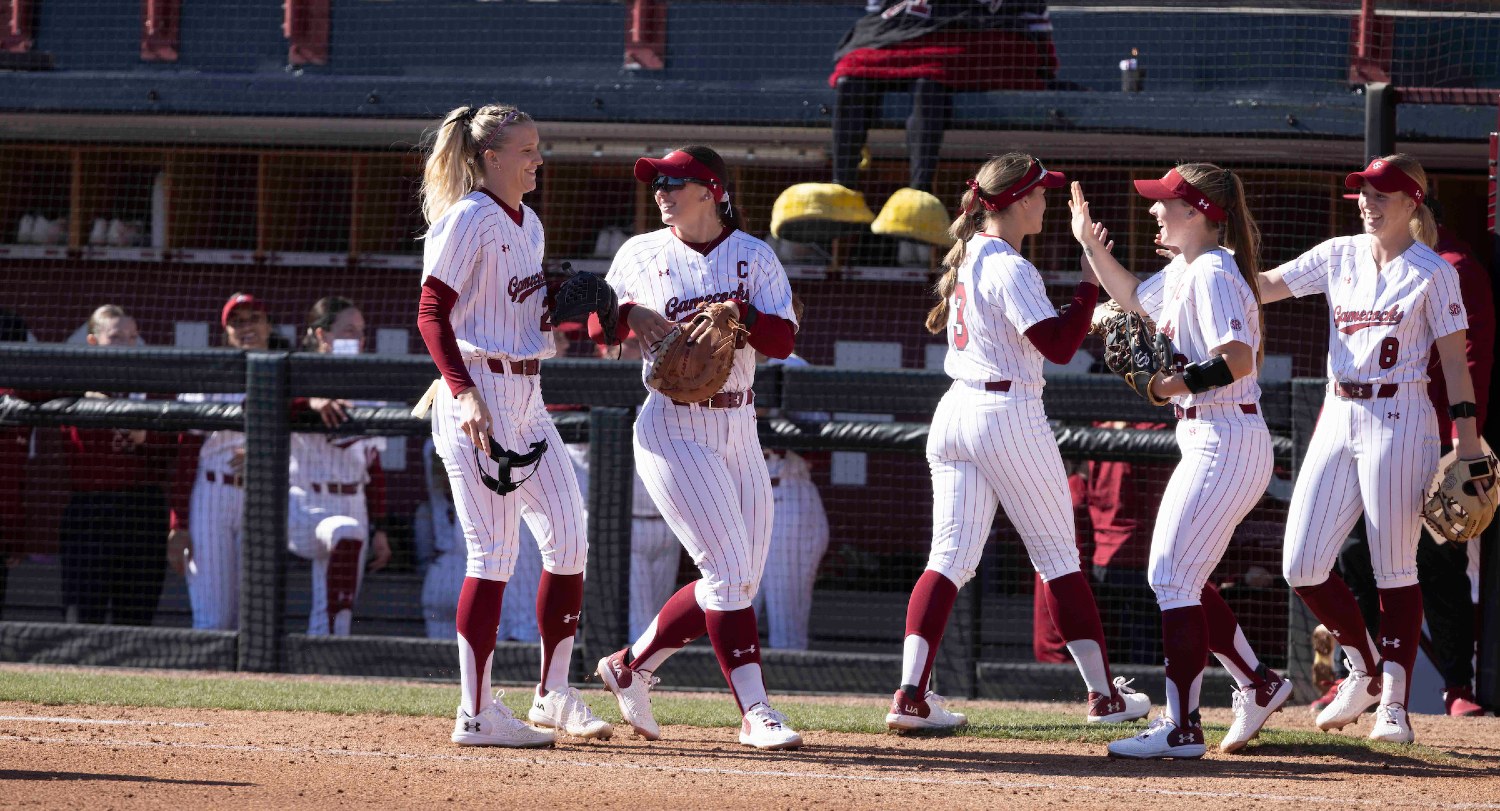
Today, we’re exploring the history of softball at Carolina. If you’re a dyed-in-the-wool Gamecock, you know we had a pretty great season last year under new head coach Ashley Chastain Woodard. Our success on the field builds on a rich tradition that stretches back to 1974. And our current players are part of that legacy. I asked Lexi Winters, a senior catcher who came to Gamecock softball games when she was a kid, what tradition is most meaningful for her:
Lexi Winters: “I mean, I feel like the most obvious one is definitely the alma mater, at the end of the games, how we all stand at home plate and we kind of lock arms and sway. I mean, I remember watching all the teams do it when I was 10, 11 years old. I tried to learn the lyrics when I was growing up.
“There’s pictures of me when I was a bat girl, lined up with the team doing it. It’s just that moment after a game, win or loss, doesn't matter. It’s just always coming back to the plate, and I think even deeper into it, it’s home plate, and our motto, I guess, is ‘Welcome home,’ so I feel like it all helps connect to each other, but I just think it’s a great symbol of being together, united at home plate in front of all of our fans.”
Evan Faulkenbury: Carolina softball feels rich in tradition today because of the players and coaches who put, literally, their blood, sweat and tears into the program. The modern era began in 1974, but before we get there, I want to share what softball looked like before then, stretching all the way back to 1936 when softball was only for men at Carolina.
That year, as explained in the September 25, 1936, edition of The Gamecock student newspaper, the men’s physical education director, Jack Crawford, ordered softball equipment for his morning classes to “play softball as a relief from stereotype setting-up exercises. This will add to the enjoyment of the gym classes considerably.” I wonder what gym class was like before this? And on that same newspaper page, a section detailed what co-ed sports were available for women on campus at this time, namely, tennis, basketball and “skating parties.” No softball for women; not yet, anyway.
Year after year, The Gamecock newspaper and annual Garnet and Black yearbooks shared the successes of men’s intramural softball, often organized around fraternity competitions. Things began to change after World War II around 1946, when Katherine Wallace, who helped lead the Women’s Athletic Association on campus, challenged faculty members to a softball game against undergraduate co-eds on Davis Field, around where the Thomas Cooper Library’s fountain is today. The faculty won, but Wallace, who The Gamecock reporter wrote had the “classiest fielding of the day,” caught a long fly ball hit by then-USC President Norman Smith.
Only two years later, in 1948, there was an established women’s softball tournament playing annually on Davis Field in the spring. And by 1966, women in sororities and residence halls competed against each other in intramural softball, and in 1971, the campus formalized a women’s softball league within Student Affairs. And then, the biggest change of all occurred: the signing into law of Title IX of the Educational Amendments of 1972.
Title IX meant that any school that received federal funding — like USC — could not discriminate on the basis of sex. Carolina’s leaders launched a study on how best to implement these changes, and in January 1974, women’s sports moved into the Athletic Department alongside men. You can learn more about Title IX’s impact on USC in episode 49, which is entitled “Fair Play: the 50th anniversary of Title IX.”
The 1973-74 academic year was USC’s first adhering to Title IX, and it was the inaugural year for the South Carolina Gamecocks softball team.
Their coach was Pam Backhaus, who had played club basketball at Kansas State University. After graduating and teaching for a few years, she wanted to complete her master’s degree. She nearly joined the University of Tennessee before she heard from Carolina with an offer she couldn’t refuse: Come here and earn your degree, and you can also coach.
Coach Backhaus was the first coach of the women’s softball and basketball teams during that 1973-74 year. They had a new athletic director for women, Helen Timmerman, who worked hard to establish the programs. And Backhaus had the support of coaches from the men’s teams who wanted to see the new programs for women succeed, too.
On the phone, I asked Coach Backhaus, who now lives in Oklahoma, what starting the softball team was like:
Pam Backhaus: “I remember calling for tryouts because we wanted to get more girls involved. I needed to call for tryouts because we didn’t really have an established team to spring from. And so it was a lot of my students from my P.E. classes that came out to those first tryouts, and a lot of them knew each other. And so we were a very tight group from the very beginning. They were excited because there wasn’t any place else for them to do it. You know, they had to wait until summer until they went home and played. So they were really excited to have some place to play where they can wear a Carolina uniform, and for that matter, even have uniforms. And, of course, there were no scholarships or anything, so it really was just kind of like ‘Y’all come, and we’re going to play softball.’ So it was very kind of loosey-goosey at the beginning. But then those girls, they got serious very quick, and they wanted to win, and they worked hard.”
Evan Faulkenbury: They had to buy their own shoes, drive themselves to games, and work with what donated equipment they could scrounge together, but this very first team knew they had something special. So special, in fact, that they began with an ambitious goal:
Pam Backhaus: “But the one thing that I remember more than anything was the girls mentioned to me as we started putting a team together that they said they wanted to go to the World Series. Right out of the box, they wanted to go to the World Series. And I said, ‘Well, we have to win our first game.’ And so we started coming up with our goals for each game. And the girls were so cooperative about who played what position. And one of the things that I remember that we also did was we had practices where everybody played somebody else’s position, just so we could be ready in case somebody got injured or whatever. And that was one of the things that they really enjoyed doing.”
Evan Faulkenbury: All that practice paid off, and in their first season, they went 7-3 and earned an invitation to the World Series in Omaha, Nebraska. They arrived excited and ready to play, relying on the strength of one of their pitchers:
Pam Backhaus: “I learned that I was not a very good softball coach, because like I said, I want to get back to my pitcher. She was amazing. She had a fast pitch that was a sinker. It would get right up to the plate and then would go down. And she was the best at that. Well, nobody could hit her the whole season long. We had a great time not having to ever be worried about it. My fielders were standing out there with their hands on their hips thinking ‘no one’s going to hit this ball.’”
Evan Faulkenbury: Now, I think Coach Backhaus is being a little harsh on herself. Carolina lost their first game at the 1974 College World Series and were eliminated after their opponent figured out they could bunt effectively against this pitcher. The Gamecocks lost, but their memories endured.
Pam Backhaus: “We just played softball. That’s all we did. And if we had to go change to another field, or if we had to move practice to another time, or if we had to drive to a game — whatever we did — I think that’s my longest and dearest memory is just how resilient and determined we were to play softball, whatever we had to do to do it. And I think that’s a tribute to the girls, who all they got out of it was a chance to play softball. And that was fine. That was all they needed, you know, at the time.”
Evan Faulkenbury: If you want to learn more about the 1973-74 year in women’s sports at USC, you should also check out the 2022 project by Dr. Christian Anderson’s History of Higher Education in America class, working with USC Libraries Department of Oral History. They interviewed about two dozen people who pioneered women’s sports at Carolina after Title IX.
Coach Backhaus graduated and moved on after the first year, but over the next decade a series of coaches worked with Carolina’s softball team, and they became a powerhouse, going back to Omaha during the 1983 season. And then, in 1987, Joyce Compton took over the team. She would lead the Gamecocks as their coach for the next 24 years until 2010, when she retired. She’s still involved and goes to most home games.
I sat with Coach Compton behind home plate in the stands at the Carolina Softball Stadium at Beckham Field. It’s a wonderful ballpark, opened in 2013 near the same spot as the previous softball field. Coach Compton talked with me about her background before coming here in 1987. She coached at the University of Missouri before the opportunity here opened up, and after 24 years and 951 victories, she now has her name and jersey honored on the outfield wall. I asked about her most special memory.
Joyce Compton: “Obviously ’97 has got to be the top of the bucket there because that was just the first year in the [SEC] conference, winning a tournament in a regular season, having the best player in the country pitch for us. Just the team camaraderie that year was off the charts. And that happens when you’re winning, let’s face it. It’s a heck of a lot easier when you’re winning. I’ve always been a very competitive person, so to break down different years or different teams or different games, it’s just so hard. But pretty much every win, do I remember them all? Not really. Do I remember the tournaments? Yeah. Do I remember being down in Florida State at a regional and winning the regionals, going out to World Series? I remember that kind of stuff. You know, I think the thing that probably disappointed me the most was not being able to bring a championship back, especially in ’97 because we had the team to do it, and we just didn’t play well at the World Series.”
Evan Faulkenbury: The team’s first year in the SEC, Carolina softball had a great year and went to the World Series, though it didn’t end with a national championship. I asked if the memories from that year are still more positive than negative:
Joyce Compton: “I mean, there’s always going to be that ‘Aw,’ but yeah, I mean ’97, just the enjoyment that we had as a team throughout the year. We had some travel issues getting out to Arkansas, but just kind of how the team rolled with the punches and some teams would’ve probably bitten each other’s head off, but they just enjoyed being with each other. And that, to me, makes it a great team is when you can walk away and said, ‘Yeah, maybe we didn’t do what we wanted to do.’ But a lot of those kids, they stay in touch with each other all the time.”
Evan Faulkenbury: And that kind of camaraderie and connection to seasons past has been a key part of Carolina softball’s newest head coach, Ashley Chastain Woodard. Her high school softball coach was Tina Plew, who was on that 1997 Gamecock team that went to the World Series. After one year at Columbus State, she transferred to South Carolina and played four years starting in 2009. She got into coaching, and from 2020 to 2024, Coach Ash (as Lexi Winters called her and I suspect the team calls her) led the Charlotte 49ers before getting the call to return to Columbia.
And so I asked Coach Ash an obvious question, perhaps: why did you come back?
Ashley Woodard: “This place is my heart. It’s my passion. I grew up here. The transition that you go through in your undergrad to grad school and just who you become, this is where I’ve always wanted to be. I think typically, as a coach, you get one chance in your career to coach at your alma mater, if ever, so it’s just really special and really rare to be able to come back and lead the program that transformed you, that you got to wear the uniform. So when Coach Tanner gave me that opportunity last summer in 2024, my now husband at the time, Robert, who was a baseball coach and understands just the kind of magnitude of being able to lead your alma mater, I mean, he looked at me, and he said, ‘There's no way that you’re turning this down. You have to lead your alma mater.’ So it’s a professional dream for me. I mean, this is the only place I ever want to be, I ever want to coach. Living my dream every day, walking through the doors and leading the program.”
Evan Faulkenbury: We talked for a long time about her first season here, the expectations, the competitiveness playing in the SEC, her role as a mentor as well as a coach, and her pride at having her team collectively earn a 3.7 GPA last year. And she also makes sure her players know they are part of a rich tradition that will be part of their lives forever. Softball at Carolina is more than X’s and O’s and wins and losses.
Ashley Woodard: “Our program is very historic. It’s a very old program. It dates way back into the ’70s, and so we have generations of women that have come and played for this program. So I think as a recruit or as a current athlete on the team, you step into an instant community, and it is a family feel, it’s a family aspect. There’s a ton of alumni that still live in the area that come back to almost every single game here at Beckham Field, so it’s just a special community. We’ve had so many teams and so many coaches and players that have come through this community and this program. When you walk into the program and you get to experience it, there’s a lot of connection, and those people come back and support us. Our alumni weekends are a big deal and highly attended. I mean, last year we had over 75 alumni come back with their family, their spouses, their kids — some of them have grandkids now — of just being able to pass along just the pride that they had when they wore the uniform, and now they pass that on to our current team. So it's just a special bond between the whole community of Gamecock softball, and it is very historic.”
Evan Faulkenbury: So there you have it: the history of softball at Carolina. The games do matter, and so do the memories that last long after the final out. I’m looking forward to cheering on the team this season, and I hope to see some listeners at the ballpark.
That’s it for this season of Remembering the Days. But don’t worry, Chris Horn and myself will be back for an all-new season in fall 2026, when we’ll be sharing stories about Henrie Monteith Treadwell and USC’s desegregation in 1963, the origins of USC’s School of Medicine and the epic story of the 1975 Bowling Club champions, and other stories as well. Until then, go Gamecocks, and forever to thee!