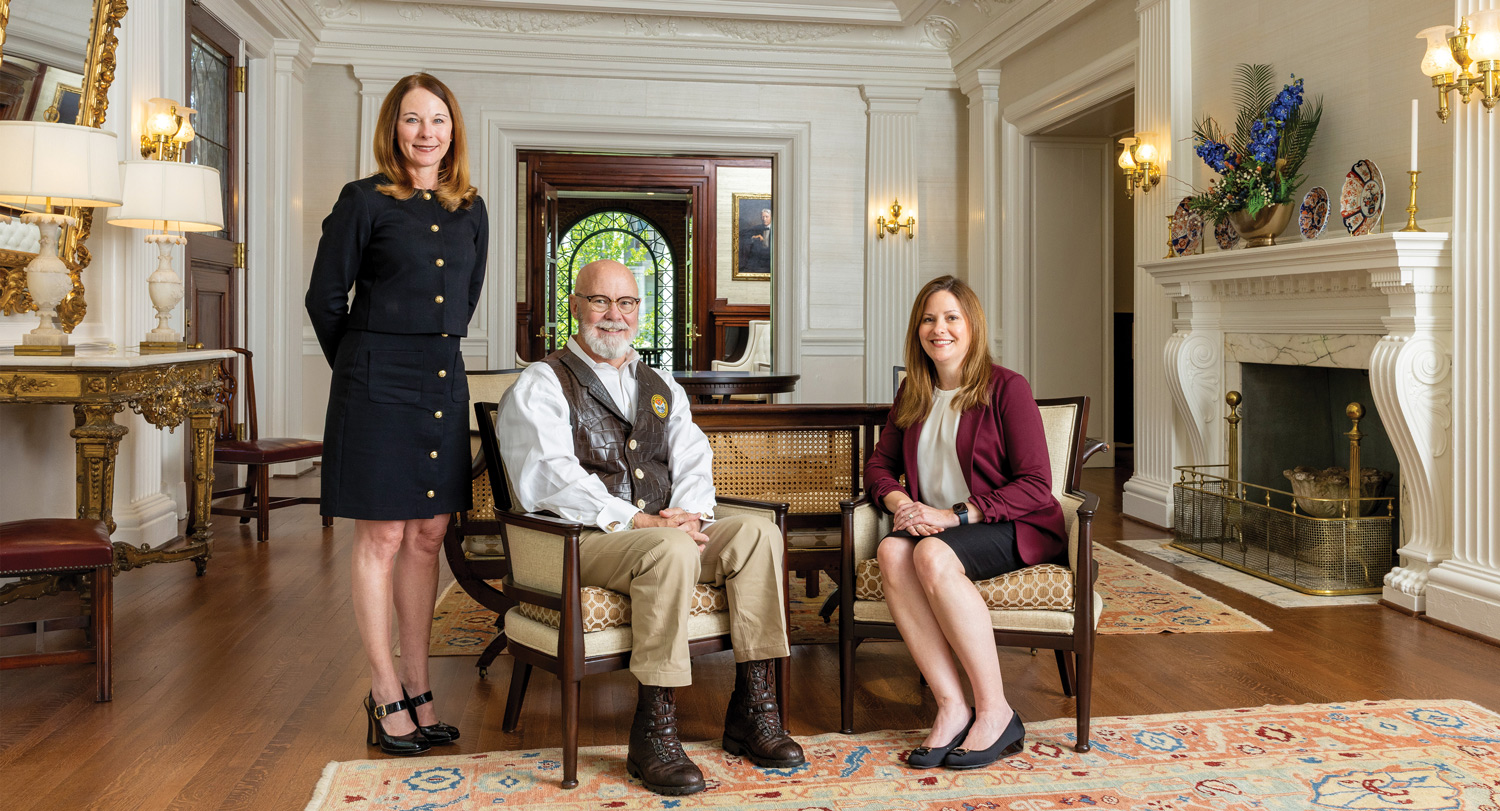
After graduating in different decades, practicing in different specialties and following different career paths, three USC Rice Law alumni arrived at the same place: South Carolina state government.
Emily Farr, Dolly Garfield and Thomas Mullikin are among several alumni serving South Carolina’s residents by leading state agencies. They help make South Carolina a safer place to work and live, expand the accessibility of higher education and protect the state’s natural resources.
“The University of South Carolina School of Law has a long history of preparing leaders who understand that public service begins with a deep respect for the rule of law. There is no other way,” says Gov. Henry McMaster. “Our state is unique in the role the law and lawyers have played in its creation. Those same principles and traditions will continue to guide and strengthen our progress today and for generations to come.”
Farr is director of the S.C. Department of Labor, Licensing and Regulation; Garfield is executive director of the South Carolina Education Lottery and Mullikin serves as director of the Department of Natural Resources.
All three say they are honored to serve in their current jobs even though none expected to lead a state agency after graduation. Still, the skills and experiences they gained at the University of South Carolina — such as critical thinking and problem solving — are valuable in many careers and situations.
“Law school definitely prepared me to be quick on my feet,” Garfield says. “We have to solve problems under pressure, identify challenges and practice tough conversations.”
Farr and Mullikin add that the law school academic program and responsibilities teach time management and priority setting. All three value the connections they made at USC, which have provided support throughout their careers.
“As South Carolina’s flagship law school, we have an obligation to graduate lawyers who will serve our state,” says William Hubbard, dean of the USC Rice School of Law. “Tom, Dolly and Emily exemplify the kind of lawyer leaders we seek to develop to advance the citizens of South Carolina. These three leaders demonstrate the commitment to public service that is an essential part of our law school mission.”
Making a safe place to work and live
Emily Farr, ’03 law, calls South Carolina home, so when she decided to attend law school after completing a political science degree in North Carolina, USC was a natural choice to build a foundation for a career in the Palmetto State.
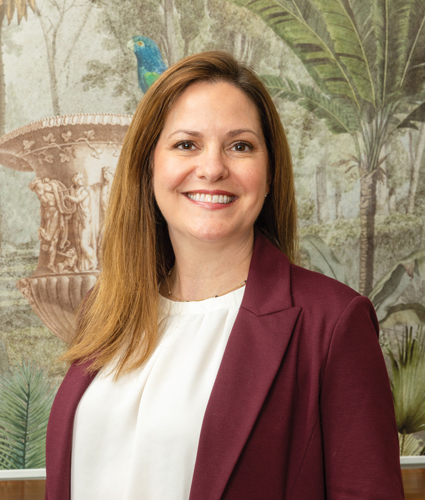
Before serving in state government, Farr practiced at Haynesworth Sinkler Boyd in Columbia, focusing first on consumer financial litigation and later transitioning to employment law. In 2016 she was appointed interim director of Labor, Licensing and Regulation and expected to serve two years or less. The next year, Farr was confirmed as director and is now in her 10th year with the agency.
While Farr says people may not necessarily know what Labor, Licensing and Regulation does, she knows that their work is making an impact.
“I would argue that our agency touches the lives of everybody in South Carolina every day because of how our programs work to make our state a safe place to work and live,” she says.
Labor, Licensing and Regulation is composed of three main divisions: State Fire, including the Office of State Fire Marshal, the S.C. Fire Academy and emergency response; Professional and Occupational Licensing; and Labor, which focuses on workplace safety. The agency also inspects amusement rides and elevators for public safety; ensures compliance with state wage, child labor and immigration laws; and investigates complaints against licensees.
“Our largest division — Professional and Occupational Licensing — is probably the one most people think about when they think about LLR,” Farr says. “More than 40 licensing boards ensure professionals from doctors and nurses to contractors, engineers and accountants have the proper training, background and continuing education to safely serve South Carolinians.”
Farr also touts the reputation of the S.C. Fire Academy. People come from all over the U.S. and internationally to train at the 200-acre campus, equipped with state-of-the-art firefighting props. In addition, during a state emergency, LLR leads the state's firefighting and search-and-rescue functions.
“The opportunities I’ve had for learning and growth at LLR have been an amazing experience,” Farr says.
More than 40 licensing boards ensure professionals from doctors and nurses to contractors, engineers and accountants have the proper training, background and continuing education to safely serve South Carolinians.
Her goals as director have been to improve communication and transparency within the agency, to build better relationships among the divisions and to streamline license and complaint processing through more accurate data tracking and AI.
“The School of Law at USC put me on the course to reach this point in my career. Public service can be a difficult and thankless job, and I admire the hardworking, intelligent people, including fellow USC alums, at our agency and in other roles who choose to give back to our state,” she says.
Enhancing education for S.C. students
When Dolly Garfield, ’94 psychology, ’97 law, entered USC in the fall of 1990, she planned to become a school psychologist. After serving as a page at the State House, she fell in love with the legislative process.
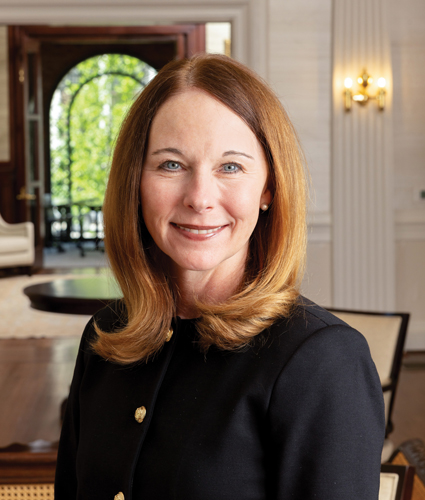
“I was that nerd who would skip parties and volunteer to stay all night when they were debating the budget,” she says.
After completing a psychology degree, Garfield decided to attend law school while continuing to work at the State House. She may have stayed there as a legislative staff attorney had she not taken a leave of absence to work on a case with prominent South Carolina defense attorney Jack Swerling, ’73 law.
Garfield’s father, the late John R. Justice, ’65 bachelor’s, ’67 law, had served as the elected circuit solicitor in their hometown of Chester, South Carolina, but Garfield didn’t consider that as a career path until her stint in Swerling’s office. She eventually served 19 years as an assistant solicitor in the Fifth Circuit Solicitor’s Office.
After two decades of working on violent crimes — many that occurred near her Columbia neighborhood — Garfield decided to crack the door to other opportunities. She reconnected with her boss from her legislative days, who was serving as general counsel for the S.C. Education Lottery. When he was appointed to head the agency, Garfield came on board as the lottery’s general counsel in 2016 and became executive director in 2023.
January 2027 will mark the 25th anniversary of selling the first lottery ticket in South Carolina. Since 2002, the lottery has funded more than 2.8 million college scholarships for South Carolina’s students. In fiscal year 2025, more than $545 million was deposited into the Education Lottery Account. This marked the fifth straight transfer of more than half-a-billion dollars by the lottery in support of higher education scholarships and grants, K-12 public education programs and community education programs throughout the state.
Garfield, whose daughter is a freshman at USC and a lottery scholarship recipient, says, “One of my main goals is to keep our lottery growing by focusing on how we can attract newer players and strengthening relationships with retailers. Until last summer, lottery sales were cash only, which was starting to cripple us because so many people don’t carry cash.”
In 2025, the state legislature passed a proviso to allow debit card purchases, which has already increased sales. The Lottery Commission estimates that allowing debit card sales could increase the $545 million in revenue by about $52 million. Garfield also is proud of the passage of a state law prohibiting the disclosure of winner information, which she says helps protect those who receive cash prizes.
“Our next step is hopefully to allow lottery ticket sales through vending machines,” Garfield says. “That is common throughout the country. We’re the only state that does not allow it.”
Preserving natural and cultural resources
For someone who says the only reason he went to college was to convince his wife to marry him, Thomas Mullikin, ’82 political science, ’86 law, has used his education and experience to the fullest.
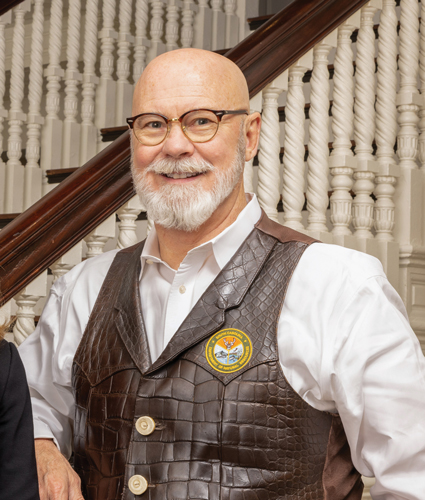
Appointed in 2025 as director of the S.C. Department of Natural Resources, the Camden native is a senior environmental attorney, retired senior military officer, author, professor and award-winning documentarian. He also earned a Ph.D. in organizational leadership, writing his dissertation on ecological theology.
His environmental and energy law practice has taken him to every continent on earth, where he has represented multinational corporate clients and the United Nations. His practice also established a nonprofit to serve communities adjacent to their projects.
“I was a guy who would have been happy working construction, but my wife said she wouldn't marry me unless I went to college. So, I did, and I never could have imagined the doors Carolina opened for me,” says Mullikin, who has been married to wife Virginia Ann, also a USC law graduate, for 44 years.
His undergraduate degree is in political science, but he also went through the pre-med curriculum at USC. The science classes provided a foundation for his interest in environmental law, which was reinforced when he worked with S.C. Sen. Ernest Hollings, including service on a National Oceanic and Atmospheric Administration subcommittee.
As an avid outdoorsman, he has completed scuba dives in every ocean and climbed mountains on every continent. He also leads South Carolina 7, an annual 30-day trek across South Carolina.
As director of DNR, Mullikin leads one of the nation’s most comprehensive state conservation agencies, which protects and stewards South Carolina’s land, water, wildlife and cultural heritage. It seems a natural transition based on his global work advancing environmental conservation.
“Having traveled to every continent, I think South Carolina is one of the most beautiful places on Earth,” he says. “I came over here to create a progressive organization united by the principle that environmental stewardship and economic vitality are not competing interests. Decisions we make in the next two to five years will impact what the state looks like for the next couple hundred years.”
Mullikin highlights accomplishments such as integrating resources, creating centralized strategic communications, breaking down barriers and improving training for law enforcement officers. He also says the agency is taking an aggressive approach to protecting the state’s natural resources.
“I can’t imagine a more important mission, because our family loves this state,” says Mullikin, who is the recipient of both the Order of the Palmetto, South Carolina’s highest award presented by the governor, and the Algernon Sydney Sullivan Award, USC’s highest alumni honor.
“I can’t talk about my life without talking about the significance of USC and how much it means to me. South Carolina graduates are as good as lawyers anywhere in the world. They’re bright, they’re talented and they apply themselves. If you’re a USC law student, set your goals high because the world can be yours.”
