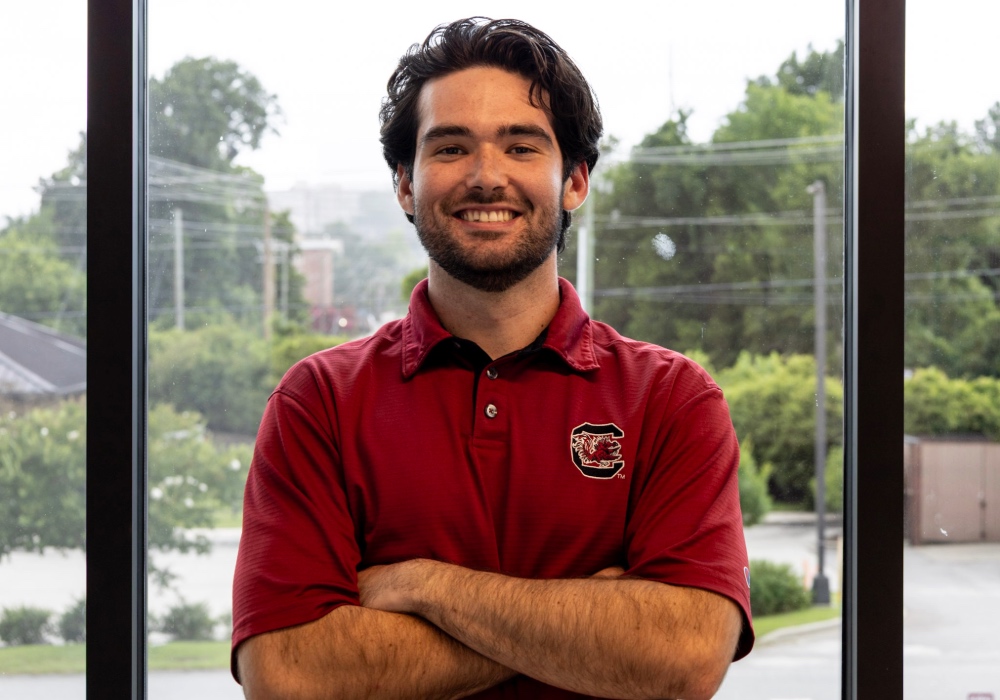
For University of South Carolina alumnus Michael Carson, what began as a senior capstone project has evolved into a paid internship with USC Facilities, where he’s helping develop artificial intelligence tools that make it easier for maintenance teams to organize information and identify trends for improving campus operations.
Carson, who graduated in May 2026 with a bachelor’s degree in computer science, initially planned to pursue a career in cybersecurity. Facilities management wasn’t even on his radar.
“I had no idea there was even a connection between facilities and computer science,” Carson says.
That perspective changed during his senior year when he and four classmates — Tony Lin, Julius Parker, Stephen Spear and Lance Kimani — took on a capstone project where his class in the Molinaroli College of Engineering and Computing partnered with the university’s facilities department.
The group was tasked to explore how artificial intelligence could be integrated with the facilities department’s computerized maintenance management system.
The goal was simple: simplify reporting and unlock more meaningful insights from maintenance data. At the time, managers often spent hours compiling reports on completed work, outstanding issues and daily emergencies.
Carson and his classmates focused on making large volumes of maintenance data easier to access and understand. They developed a platform that uses artificial intelligence to analyze maintenance information and generate customized reports.
“From a facilities perspective, we have large amounts of data. The data is constantly coming in, so it allows us to synthesize that data really, really quickly. It's 60 seconds for us versus in the past it would have taken me about an hour.”
The system can identify which buildings generate the most maintenance requests, highlight common repair issues and uncover trends that might otherwise go unnoticed. It can also recommend preventative maintenance strategies by identifying recurring equipment problems and the potential causes of those failures.
After graduating, Carson was offered a paid summer internship with USC Facilities, giving him the opportunity to continue refining and expanding the project beyond the classroom. Since then, he has enhanced the platform by developing an AI-powered chatbot that allows users to ask questions and receive responses drawn from existing maintenance records.
Looking ahead, Carson is exploring how other analytical tools might be applied to facilities data in the future.
One area of interest involves examining historical maintenance records alongside weather information to better understand how environmental conditions may influence campus operations. While still in the exploratory stage, this work could help identify recurring patterns and provide additional context for understanding maintenance activity across campus.
“I think the light bulb turned on that it's way more than just IT,” Schiff says. “There’s a lot of technical stuff in facilities that people don’t see behind the scenes.”
USC Facilities is also exploring additional applications for artificial intelligence, including construction insights, fault detection and energy analysis. The department collects information from more than 560,000 building automation data points across campus and sees AI as a tool for turning that information into action.
What began as a class assignment has evolved into a practical tool that helps USC Facilities better understand its operations, make more informed decisions and plan for the future and a perfect example of cross-departmental partnerships that enhance the student experience.
“We’ve found that we have students here that have a lot of knowledge and value to us,” Schiff says, “and so we’re continuing to grow this program slowly, but with intention around innovation.”