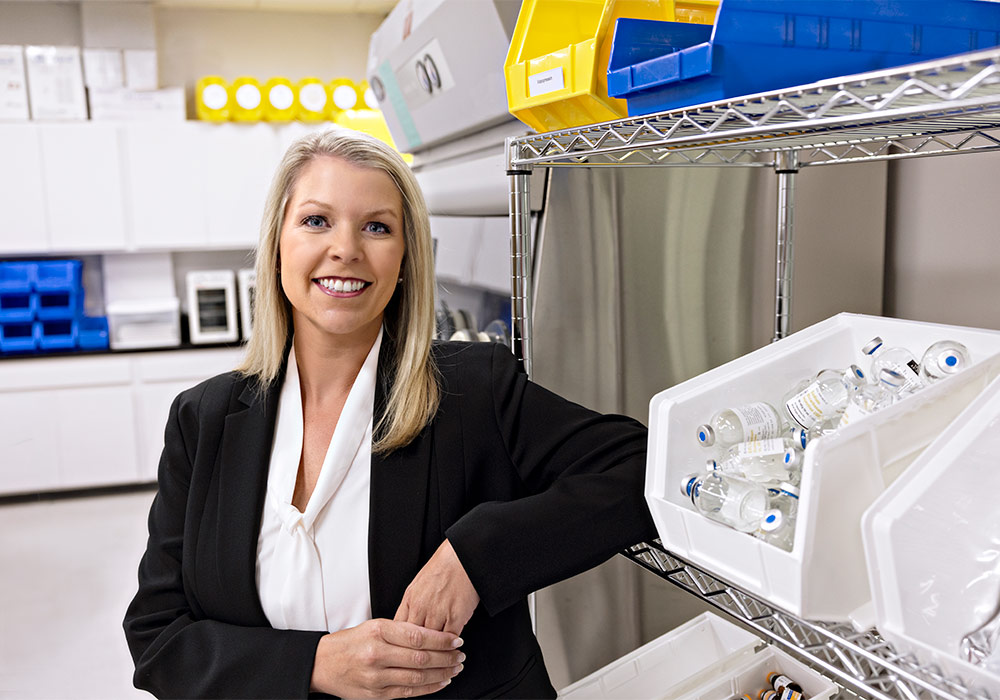
Caroline Asbill grew up in a family of educators. Her mother spent decades in early childhood education and administration, and Asbill was often with her at school after the students went home. She knew the sacrifice and the selflessness her mother poured into her students, and the experience gave her a great appreciation for teachers.
But she also grew up knowing she was interested in the sciences and pursuing a career in the medical field.
At the University of South Carolina, she’s been able to marry both of those interests. As a full-time professional track faculty member in the College of Pharmacy and a staff pharmacist at Prisma Health Richland, she’s combined her love of teaching with the practice of pharmacy. She was chosen as the university’s 2026 Clinical Practice Teaching Award recipient.
“Teaching is, at its core, a relationship — a shared journey of discovery, humility and growth,” Asbill says. “Each day I have the privilege of walking alongside my students as they find their voice, define their purpose and prepare to serve others with integrity and compassion. That, to me, is the true essence of teaching in clinical practice.”
Asbill grew up in Lexington, South Carolina, and earned her undergraduate degree in exercise science from USC. She knew she wanted to pursue a career in the medical field, but was unsure of her path until she met and shadowed Kathy Quarles Moore, a pharmacist who has become a mentor.
“Teaching is, at its core, a relationship, a shared journey of discovery, humility and growth."
At that time, Moore, who now is a clinical associate professor at USC, worked at an independent community pharmacy in Asbill’s hometown.
“I appreciated what she did for the community,” Asbill says. “I could just see how much people trusted her and those genuine, authentic relationships that she was able to build within the community setting. She knew her patients by name. She knew about their families. And I just really liked that connection that she had. I said that day I want to be like her when I grow up because she is an amazing human being and she makes this look like such a meaningful profession.”
Asbill returned to USC, earned her Pharm.D. degree in 2016 and started her career in retail pharmacy before switching to hospital pharmacy work. In 2019, she also began teaching in the Department of Clinical Pharmacy and Outcomes Sciences.
She splits her days between teaching at USC and working at Prisma Health Richland, where she works in areas including the sterile compounding lab, the operating room pharmacy and the central unit dose operations area.
“I think staying involved in practice helps me bring current, relevant information back to the students and enhances the learning experience,” she says. “And because I work in a variety of areas (at Prisma) it helps to diversify what I'm seeing to bring back to my students. What is clinically important? What are new things, new trends, new procedures, new regulations? You’re bringing all that back into the classroom. Creating immersive, hands-on learning experiences that closely mirror real-world pharmacy practice is essential in helping students build confidence, competence and professional readiness.”
In the classroom, the core of her teaching philosophy revolves around the need for connection as she works to humanize the educational experience.
“I want students to feel like they are in a safe place where they can ask questions, where we can talk about things, where we can make mistakes, where I really get to know them. When they have that safe space and where they can feel seen and heard and ask the questions, I just really think they do a better job of actually absorbing the information and then learning those skills beyond just the material. The humility, the compassion, the ability to connect authentically — those kinds of things that I think will carry them far.
“I just want these students to become professionals who really understand the responsibility, but also the privilege that they have of being able to care for their patients and being a pharmacist.”