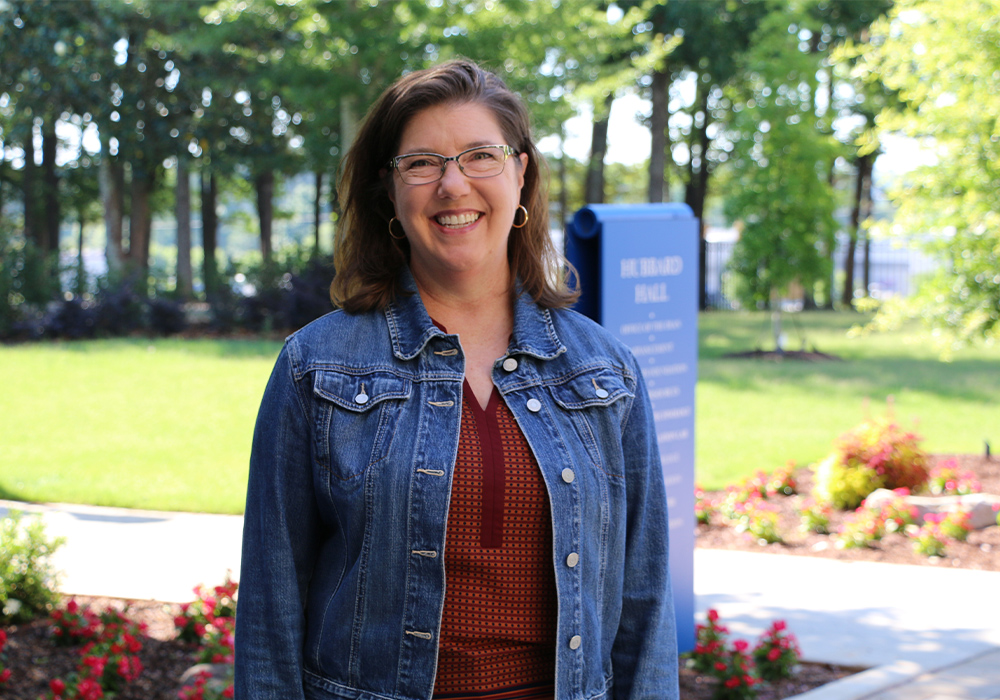
After earning a bachelor’s degree in English from Wake Forest University in 1991 and a master’s in English from Appalachian State University in ‘93, Amy Gerald got some “regular” jobs. “I was in communications,” says the assistant professor at USC Lancaster. “I created newsletters, edited a trade magazine and wrote press releases.”
But she wanted to teach, so Gerald earned a doctorate in English from UNC Greensboro and got a teaching position at Winthrop University. She spent 10 years there, earned tenure ... then gave it up for a spousal move to Texas.
Gerald’s time in Texas was limited: the couple realized on a 114-degree day in July that they wanted to live in a less-punishing climate, so they moved to Asheville, North Carolina.
She still had the teaching bug, so Gerald looked for another position. Meanwhile, she did contract work for corporations in and around Charlotte: doing research, performing surveys and focus group interviews, compiling reports and writing literature reviews. Those non-teaching experiences informed her classroom approach. “It’s been a long and winding road,” she says. “I feel my past experiences coming together here at USCL, especially with my business writing class. It just melded together all my private sector work with my training and experience as a teacher.”
Gerald’s efforts have been recognized with a 2026 Garnet Apple Award for Teaching Innovation from USC’s Center for Teaching Excellence. Below, she shares more about giving real-world experiences to her students.
Experiential learning from day one
My classroom is not one where you sit back and listen. Students are involved with each other and with the world outside the classroom. I have them interview and observe people in their community. And they are a little afraid of asking people questions and talking to people. And I just say, “I was, too, when I was your age. I had to learn how to do this, and it’s such an important skill. Besides, people like to talk about themselves!” I feel like it’s even harder for students now because they’re so used to the world of their screens. They don’t want to look up, they don’t want to interact, and so it’s even more important to create these opportunities for them.
In English 101 and 102, we do exercises in observation. I take them to our Native American Studies Center, and they have to describe a piece of pottery and fill a whole page. How do you fill an entire page describing a brown pot? They keep coming to me with half-filled pages trying to turn it in and leave, and I say, “No, go back. Look at it again. What different colors are there? It’s not just brown. Look at the different shades. Have you looked at the size and shape? And what kind of details has the creator put on the pot?” They go back, try again and see something they didn’t see before. These assignments turn into brilliant little pieces and give them such faith in their abilities.
Community-connected projects
I didn’t anticipate the business writing class when I began teaching at USCL. They just said, “Hey, do you want to do it?” And I said, “Sure, why not?” As I was creating the class, I fell back on my training in rhetoric. If you understand the rhetorical situation in any writing or communication situation, you will do just fine as long as you can adapt. Who is your audience? What do they want? In a business situation, they may want a brief executive summary, whereas if you’re writing an academic paper, you’re often stretching out your descriptions. Students are used to that “stretching” approach, and all of the sudden I’m telling them to cut, cut, cut, ruthlessly. But then they get it.
The biggest aspect of that class is project-based learning. Students spend the first half of the semester learning all of the business writing concepts and strategies, and then we apply it. And so we partner with, generally, an area nonprofit. We’ve worked with the Lancaster Promise Neighborhood — that’s a federally funded program to put life back into neglected parts of town. Another is the Pink Ribbon Gals Foundation. They help pay for breast cancer-related items like wigs, bras and compression garments that insurance might not cover. And then last year we worked with Magnolia Memory Care. They are starting a pilot program in Lancaster providing support services to the care providers of people with Alzheimer’s and other dementias.
“At the beginning of the semester, they’re nervous. But at the end, they’re appreciative. ... Along the way, they realize they didn’t need to panic.”
I divide my class into teams of four or five students. The company walks away with free help with their documents, and the university develops a relationship with a community partner. But the students get the most out of it. They have a real-life company with a real-life business problem that they are being asked to solve, and they can put that on their resume. They present their final products to that company at the end of the semester, and also to some faculty and staff and Chamber of Commerce members. They’re all so worried about it initially, but we practice, and we work, and we revise, and we revise some more. And they realize that this is just teamwork, and it happens over time.
It’s not a one-and-done kind of thing. There’s never a perfect final product. There are always revisions that can be made. That takes the pressure off a little bit. They learn to work with each other and hold each other accountable. I’ve tried to roll into that one project all of the pedagogical methods that I have learned and developed: collaborative and process theories, rhetorical theory and experiential learning.
At the beginning of the semester, they’re nervous. But at the end, they’re appreciative. They feel supported, not just left to their own devices. Along the way, they realize they didn’t need to panic. They’re going to be OK. Most of the students in that business writing class want to be business owners, maybe transfer to USC Columbia and get into business school. So I think they really are glad to have that experience.