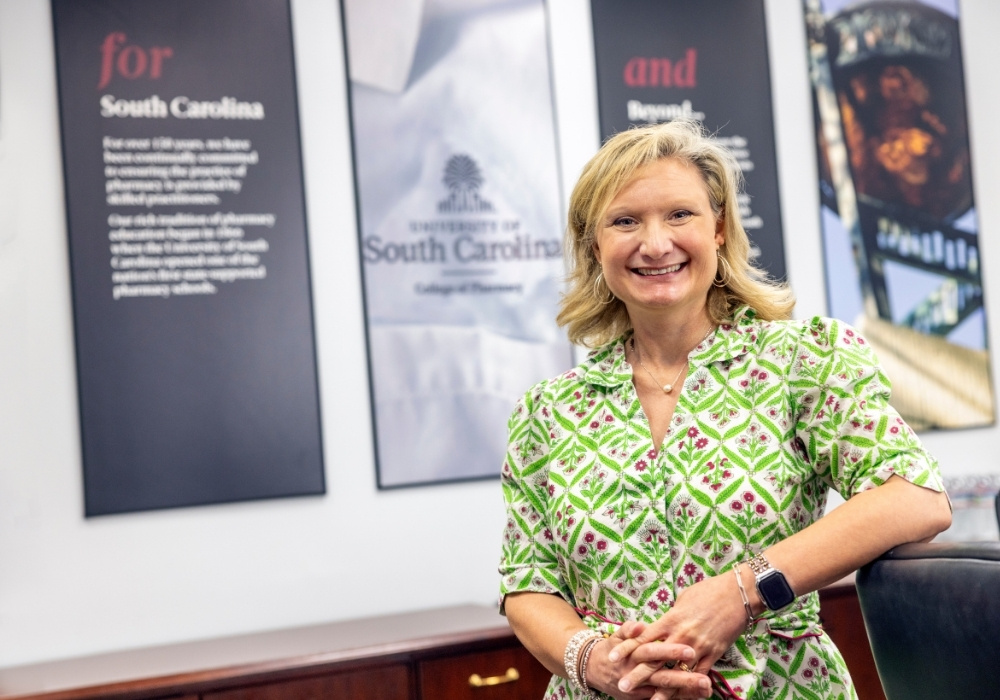
Before she was a professor of clinical pharmacy and outcome sciences in the University of South Carolina College of Pharmacy, Betsy Blake was a family medicine pharmacist in Charleston. Before that, she was a pharmacy resident and primary care pharmacy resident at MUSC, following patients from inpatient service to discharge and tracking outpatient medications.
But before any of that, Blake was a little girl in smalltown South Carolina watching her dad fill prescriptions at the local independent pharmacy. “I grew up helping him deliver medications around town, and if the boys didn’t show up to the soda fountain, I had to dip ice cream,” she says. “And I wasn’t tall enough to do it.”
Mostly, though, she watched her father, asked questions and fell in love with the profession. She credits her mother, a high school geometry teacher, for her complementary interest in classroom education. She credits her time training pharmacy residents over the years for opening her eyes to the possibility of a dual career.
Blake has been at USC’s College of Pharmacy since 2006 and specializes in diabetes treatment, including continuous glucose monitoring, and testing protocols for anticoagulation levels. She also still practices part time and says that sharing her experience with the next generation brings everything full circle.
She has also been recognized by USC’s Center for Teaching Excellence with a 2026 Garnet Apple Award, owing in large part to the way she scaffolds content, increasing the complexity of the material and her expectations of her Pharm.D. students at each level.
“I get to take what I'm doing in the practice and bring it back to the classroom, then watch the students learn and build a relationship with them.”
In the fall semester of the second year, for example, she goes deep on the diagnosis, prevention and treatment of venous thromboembolism, a serious medical condition that causes blood clots deep in a patient’s vein. The next semester, Blake reinforces that material with an in-depth lecture on the pharmacokinetic parameters affecting anticoagulation use and dosing. From there, she can move students to a lab simulation for assessment of anticoagulation use and patient counseling in an outpatient setting.
Then, in their fourth year, Pharm.D. students are ready for experiential learning in clinical settings with real patients.
It’s an intense regimen that builds over a four-year program, but the stakes are high. So are the rewards.
“I get to take what I’m doing in the practice and bring it back to the classroom, then watch the students learn and build a relationship with them,” says Blake. “I tell them, ‘You’re going to be my pharmacist one day, and you’re going to be my colleague. And I’ve also got to trust that one day you can take care of me.’”
Blake teaches future pharmacists from their first year in the program through their fourth-year rotations. To break down complicated but critical material, she guides them through hypothetical case studies, from diagnosis to prescription and prevention. As an example of her approach, she explained how she introduces first-year students to venous thromboembolism, its diagnosis and treatment, and a patient named Bob.
What about Bob?
Blake: At the beginning of the first course, if I mention venous thromboembolism, students have no idea what that is. I have to show them — something has happened in the body that has affected multiple aspects of the clotting cascade. Was there trauma? Is it that the person has defects in their clotting system? Or is there some sort of flow problem? If blood sits in your body, it pools and it increases likelihood of clot. This is called Virchow’s triad, and I have to explain this.
I start off with a case scenario. I start off with Bob. When my daughter was little, she always wanted to know everybody’s names when we talked. All boys became Bob. All girls became Sally. Now, when my students graduate, they know there’s Bob, there’s Sally and then sometimes George pops up, too. But there’s always Bob.
So we walk through a case scenario: “Bob’s got these symptoms. What does that mean?” We’ll talk through what a venous thromboembolism is, but then I’ll say, “All right, but how do we diagnose it? What are we going to do? What choices can we make? How do we monitor it? What are we going to prescribe and how long does Bob need to be on it? And oh, by the way, Bob had an orthopedic procedure, and that increases your risk of a clot by 80 percent. What could we have done to prevent it in the first place? What do the guidelines say that we could do?”
We incorporate the guidelines, the patient care, the drug therapy recommendations, the monitoring and the follow-up. And then I’ll ask them, “What do you do if something goes wrong? What happens if they start bleeding? How do you fix that?”
We also have an interactive class response system called Top Hat. The case studies really help, but I'll throw in Top Hat questions where the students have to decide, “What am I doing next?” I watch to see how they pick their answers. If they’re picking multiple answers that aren’t right, I have to stop and ask, “OK, why? Where did I not get this right? How did they miss that part?” I am with them for four hours for this content because there are so many variations. There’s the IV formulations, the oral formulations, Warfarin that you have to monitor. We do in-class case questions where it’s free response, but we also do the audience response where they have to log in so I can see what percent got it right, what got it wrong. And then we go over it: “Why is it right? Why is it wrong? Let’s back up a step. What did we miss in this part?” That way I can assess them as we go.
I’m known for talking too fast, so I use my slides to slow myself down, but I go through my complete lectures each time, and each hour has its own focus. The students have their objective for that hour. They know what’s happening in that hour. They’re not going to get a lecture packet for four hours. That’s overwhelming. I break it down so they can focus. But then I also go through at the end of every year and ask myself, “What can I take away? What am I going into too deep that’s not necessary anymore? Because there’s always new things to cover. There are new guidelines out now for venous thrombosis and the blood clots in your lungs. There’s a whole new diagnostic criteria and classification system. How much do our students need to know if they’re pharmacists? What do they need to know now that we didn’t know before?