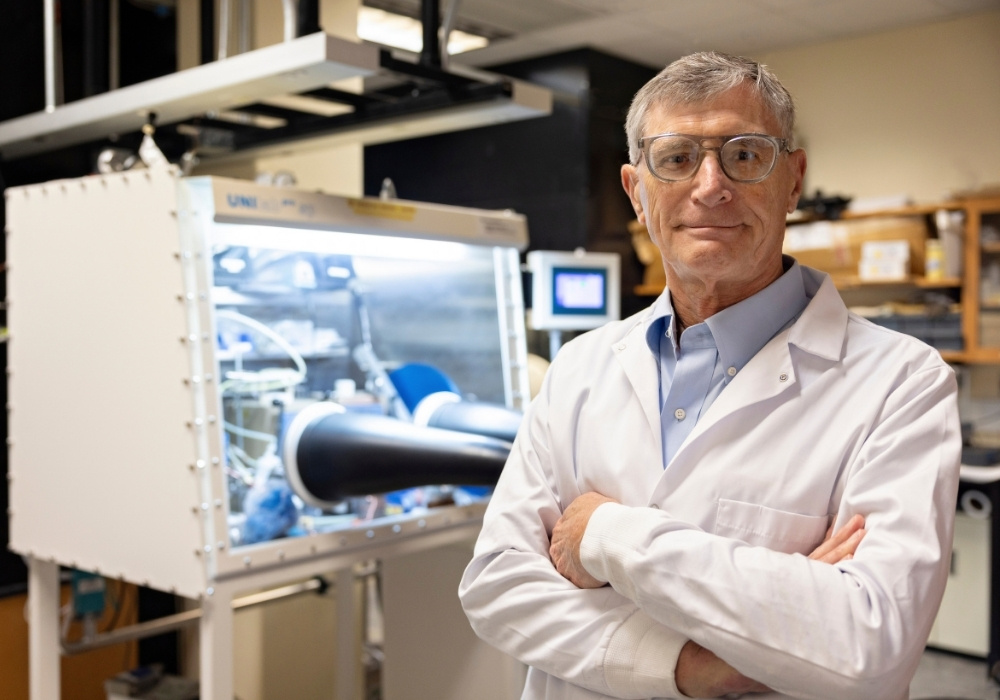
If you want to build, operate or regulate a molten salt nuclear reactor, your path runs straight through the University of South Carolina — and, specifically, the office of Ted Besmann.
Unlike traditional commercial nuclear reactors, which use solid fuel rods and cool them with water, molten salt reactors dissolve the uranium into liquid fuel. The difference is important: Molten salt reactors offer potential safety benefits and can be smaller than traditional reactors, an advantage for increasing power generation incrementally.
Besmann — director of the General Atomics Center for Transformational Nuclear Technologies at the Molinaroli College of Engineering and Computing — is the man behind an international database that tracks chemical information about salt mixtures that could be used in future molten salt reactors. The database is used by virtually everyone involved with the technology: reactor developers, safety regulators, national laboratories and university researchers.
The current solid-fuel technology works — it’s generating almost 20 percent of electricity in the United States and almost 70 percent in France. But it comes with challenges, too. To understand the potential benefits of molten salt reactors, you first need to understand the issues the reactors are intended to address.
It all comes down to heat, safety and economic efficiency.
Traditional commercial reactors are powered by solid fuel: ceramic pellets of uranium oxide that are stacked inside metal rods in a reactor. “Under the right conditions, the uranium in the ceramic pellets fissions — and fissioning creates heat,” explains Besmann, who is also the General Atomics Smart State Chair for the Development of Transformational Nuclear Technologies. “They’re sitting in this pressure vessel. Water flows up past the rods and heats up. The water makes steam. Steam turns a turbine, and we get electricity. That’s our commercial nuclear reactor since the 1950s.”
The challenge comes with the pressure it takes to keep water in liquid form rather than letting it boil prematurely.
“When you have a reactor cooled with water, to make it sufficiently efficient it has to be at something like 500 degrees Fahrenheit,” Besmann says. “Water boils at 212 degrees, so how do you get water at 500 degrees? You pressurize it like a pressure cooker — with these big steel vessels with thick walls. And when that fails, you have Fukushima.”
(In 2011, a major earthquake initiated a tsunami that impacted the Fukushima Daiichi Nuclear Power Plant, leading to meltdowns of three of the station’s six reactors.)
An old idea revived: Molten salt reactors aim to meet the moment
Molten salt reactors change the equation entirely.
“The folks at the Oak Ridge Laboratory in Tennessee had this idea in the late 1960s and early 1970s that we could build a more efficient reactor with significant safety advantages by making the fuel itself liquid,” Besmann says. “Instead of solid fuel, let’s make the fuel liquid, pump it around a loop — and in part of the loop, we will have conditions such that fission can take place and heat is generated.”
By making the fuel into a salt-uranium liquid mixture with a boiling point much higher than that of water, a molten salt reactor can run at much higher heats with no risk of a meltdown. Ultimately, the salt-uranium mixture passes through a heat exchanger and transfers its heat to nonradioactive material circulating in a second loop. From there, the mechanics are similar to a traditional plant: water is boiled into steam, steam powers a turbine and the turbine turns a generator.
If this idea is 50-plus years old, why is it just now being brought to life? After all, there is only one molten salt reactor in the world, an experimental reactor in China. Besmann estimates that it will be 2035 before we see commercial molten salt reactors operating in the United States.
Essentially, it comes down to timing. The modern conversation around molten salt reactors has been happening for about 15 years, and in the past decade investment in nuclear energy in general has drastically increased as countries and utilities seek to diversify away from a reliance on fossil fuels. Then came data centers, which are increasing the need for utility companies to scale up power generation.
Against that favorable backdrop, molten salt reactors offer economic efficiency. Like small modular reactors, molten salt reactors can be deployed incrementally rather than necessitating massive investments in a single plant that may generate more power than is currently needed. An average solid-fuel reactor generates 500 to 1,500 megawatts, whereas a molten salt reactor might generate anywhere from 50 to 500 megawatts.
“The idea is that you could build these smaller reactors — and if you need more power, then you add another one,” Besmann says. “That attracts the attention of utility companies because you don’t have to bet the corporation on one construction project.”
USC finding its place in the nuclear energy landscape
With the international database Besmann is developing and managing with his team of researchers and students — as well as creating an updated molten salt fuels roadmap for the Department of Energy — USC sits at the center of an emerging nuclear technology. To Besmann, it’s all part of the broader expertise the university is developing in nuclear materials.
USC has specialized equipment to measure the thermodynamic and chemical properties of materials involved in molten salt reactors, equipment that is crucial to building and maintaining the database. That equipment and the expertise in using it are making USC a destination for nuclear materials R&D.
“We now offer a service,” Besmann says. “People can get samples done for a fee. Hardly anybody else can do that.”
Even national laboratories are sending some samples to USC.
“They probably could do it themselves if they had a lot more time and a lot more money,” he says. But USC is faster and less expensive.