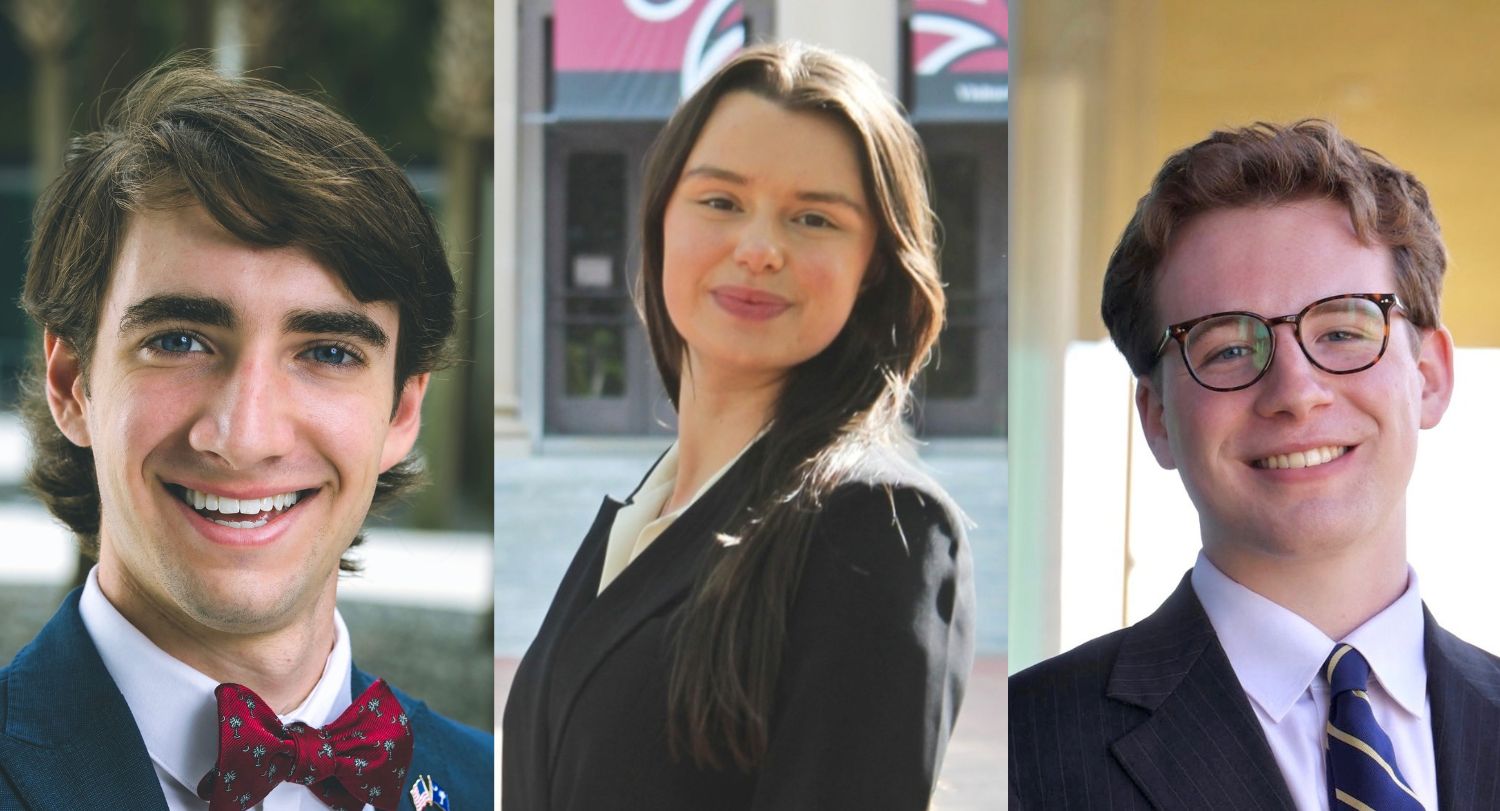
In a world where political discussion can quickly turn unhealthy, students at USC are working to create a space with healthy, student-centered discourse. Seek First S.C. is an event in which students have the opportunity to ask substantive questions, engage directly with candidates and elected leaders, and see civil discourse modeled across political differences. We spoke to Grace Cosby, Elijah Butcher and Jackson Clapp, co-organizers of the event, in order to learn more.
How did your involvement in Seek First S.C. start?
Cosby: Seek First S.C. is a continuation of a project I originally started in high school to create opportunities for young people to engage directly with political leaders and develop a deeper understanding of civic life. Last spring, I reached out to the Center for American Civic Leadership and Public Discourse and to my two co-organizers about bringing that vision to USC. Since then, the three of us have worked throughout the summer and fall to reimagine Seek First for a collegiate setting and bring together students, elected officials, candidates and scholars for thoughtful conversations about politics, public service and civil discourse.
Butcher: Grace reached out to me in May with the pitch, and we began planning over the summer.
Clapp: As co-organizer of Seek First S.C., I have led all outreach efforts with prospective speakers and invited guests. Concurrently with my studies at USC, I have worked at statewide organizations, such as the Electric Cooperatives of South Carolina, the South Carolina Department of Insurance and most recently the South Carolina Policy Council, where I have gained hands-on experience coordinating outreach and efforts in the public and private sector. I am also actively involved in the Francis Lieber Undergraduate Forum of the Center for American Civic Leadership and Public Discourse. After being presented with an idea to have this kind of event on campus, I thought it would be a great chance to use what I’ve learned professionally to help put together a really great forum. This often looked like scheduling and meeting with elected officials in their office or over the phone, multiple times throughout the planning process, while making a pitch of the event and later maintaining the relationships I had built with speakers and their staffs. At times, it may have been like “herding cats,” as one senator suggested I put it, but I have thoroughly enjoyed working with Elijah Butcher, my co-organizer, and Craig Parks, director of public affairs and advocacy for the university, in order to bring some seriously impressive individuals to speak to and with the student body.
Does this tie into your major or career goals? What skills, experiences and opportunities have you received from being involved with this event that may help inform your postgraduate plans?
Cosby: Seek First S.C. is closely connected to my long-term goal of becoming a professor. One of the things that draws me to academia is the opportunity to create spaces where people can learn from one another, ask difficult questions and disagree thoughtfully. Organizing this event has allowed me to begin practicing those values outside of the traditional classroom. It has also taught me an incredible amount about turning an idea into something tangible. I have developed organizational and leadership skills through coordinating speakers, programming, logistics and outreach, while also building relationships with scholars, public officials, community leaders and students. Those experiences have strengthened my ability to communicate and collaborate with people who bring very different perspectives to the table — skills I know will be valuable as I pursue graduate study and, ultimately, a career in academia.
Butcher: Yes! I plan to go to law school, but believe civic engagement is deeply essential to not only the legal system, but our entire political system. I hope and plan to entrench myself in civic engagement throughout my life.
Clapp: Absolutely. The skills I have learned from working with, and learning from, Elijah and Grace, as well as the candidates, officials and leaders I have worked with, will be carried with me in all future endeavors. I am deeply passionate about civic responsibility as a necessary part of humanistic study and practice, so to be able to take those passions and channel them into such an event has been very cool, to say the least. Chief among all, I would say planning this event has created exposure to situations in which schedules and priorities were differing and competing. I have gained tremendous experience through meeting and speaking with each elected official as their personal insights stand to offer countless insights into any career. As I plan to pursue a career that emphasizes civic intentionality, the actual substance of Seek First S.C. is entirely pertinent not only to that intention, but to the situation we as people face in political and social discourse.
How does this event improve the campus climate/culture and uplift bipartisanism?
Cosby, Butcher, and Clapp: The name of our organization comes from “seek first to understand.” It features speakers from both sides of the aisle, including in conversation with one another. Specifically, we have Republican and Democrat state senators in conversation together, giving evidence that it is possible to be friends across the aisle. All of our speakers will be focusing on civil discourse from different angles, rather than promoting a specific political agenda or view. This event is not a chance for people to campaign or push for a policy change; rather it is to encourage thoughtful and multifaceted dialogue. We hope to provide a welcome and calm, refreshing place to campus where people who disagree can do so and learn to do so with grace and understanding.
What are some key goals this event hopes to accomplish? What do you hope students take away from this event? What do you hope the greater university and community take away from this event?
Cosby, Butcher, and Clapp: As mentioned above, we are free and able to disagree with grace and understanding, still be friends and learn from one another. Politics is not just — and should not just be — ad hominem attacks, senseless comments on the nature of broad people groups or strict polarization among party lines. Democratic systems function best when people learn to disagree well. Rather than looking for ways to disagree, we hope to encourage students to look for ways to understand why the other side believes what they do. The motto of the Honors College is “Sapere Aude,” or “dare to learn.” We hope by observing these speakers and asking thoughtful questions, they can learn and seek the why behind others’ beliefs.
Clearly, this is an important event to you, and we live in rather polarized times. Why is this kind of event important now? And what role do students have in getting the country past this moment?
Cosby, Butcher, and Clapp: For a long time now, we have been living in a nation where Republicans and Democrats can’t even be neighbors, friends or fellow congregants. They can’t work together, and our most vocal leaders continuously cast wide criticisms upon all on the opposing side. Congress rarely reaches across the aisle. Horrendous and sad situations that go viral on the internet show division between men and women, rather than uniting us together over the protection of the vulnerable and the storied value in due process. These divisions should not inflame us, but sadden and encourage us to seek change. Learning how to engage civilly is essential to raising a generation that looks past differences in labels, ideologies and immutable characteristics and seeks first to understand and learn from others.
How do you perceive the current climate on campus regarding free-speech and politics?
Cosby, Butcher, and Clapp: It is our goal with Seek First to be the “more speech” that Justice Louis Brandeis spoke of. The answer to speech that society finds repugnant is to combat it with virtuous and uniting rhetoric. We hope to make progress at restoring students’ hope in campus politics and civil discourse through this event.
Seek First S.C. will be held Saturday, Oct. 10, 2026, in the Close-Hipp University Conference Center. This year’s program will feature CEO of South Carolina Policy Council Robert Cathcart, S.C. Senator Russell Ott, S.C. Senator Sean Bennett, candidate for S.C. superintendent Sylvia Wright, S.C. Representative Heather Bauer, USC professor Dr. Mary Nickel, and attorney and professor Joel Collins. Event details and registration.