
About one in five University of South Carolina students are first-generation college students, meaning their parents did not complete a bachelor’s degree.
These students bring valuable strengths and perspectives to campus, while navigating financial pressures, cultural transitions and institutional systems that can create barriers to their success.
To support these roughly 7,400 first-gen students in their success, USC opened the First-Generation Center in 2024. The university also offers small classes and a tight community in the TRIO program and has a First-Gen Living and Learning Community in Maxcy residence hall.
USC is also one of 32 institutions recognized as FirstGen Forward Network Champions, an exclusive group of institutions recognized as national leaders in advancing first-generation student success.
“Our first-gen students here at USC — they’re very ambitious. They want to go out and make a difference for themselves and their families,” says LaNaé Budden, director of USC’s First-Generation Center. “The support we provide focuses on helping students navigate the college experience. We also offer community-building events to foster a sense of belonging and create opportunities for students to expand their social capital. Through collaborations with campus partners, we provide embedded mental health counseling, career-focused initiatives, and academic support to help students thrive.”
She says another focus of the center is fostering connections between students and faculty, with faculty serving as mentors, participating in networking dinners and connecting students to research opportunities that support their academic and personal growth.
As part of First-Generation College Students Week Nov. 8-14, we introduce you to four first-gen Gamecocks.
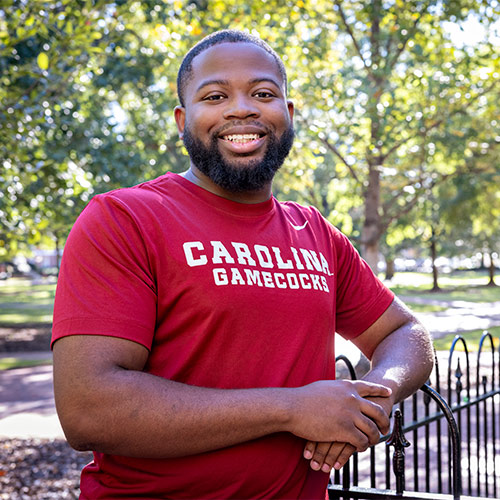
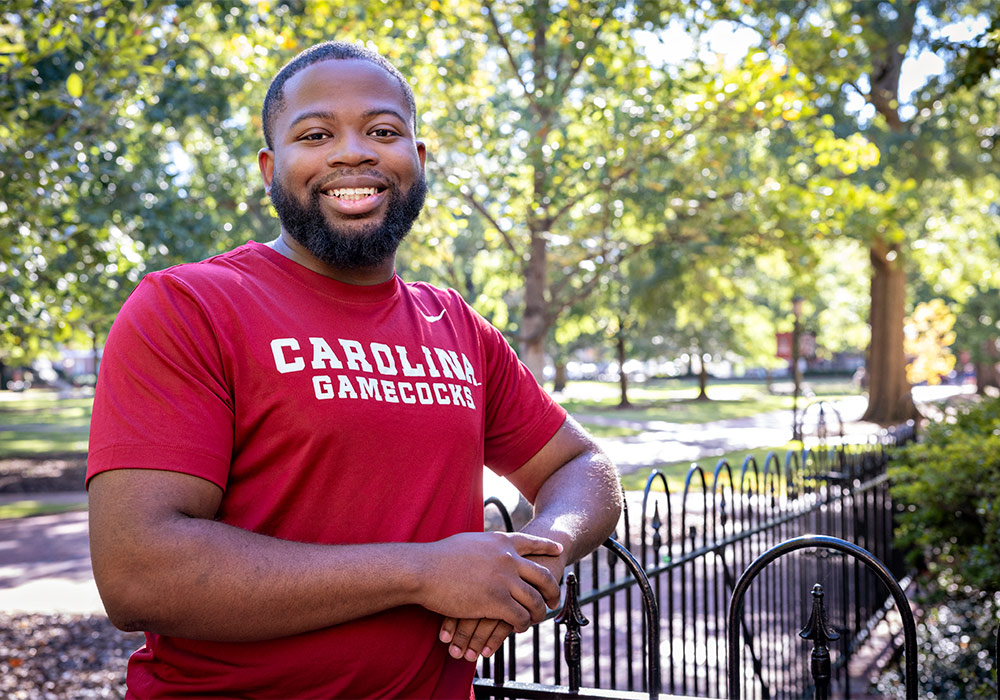
Last summer, senior exercise science major Zyon Parham participated in the Ronald E. McNair undergraduate research program, with his work looking at how representation affects the career aspirations of young Black men.
It was a topic that hit close to home.
“When I was growing up, I really thought that going to college would be on the same level as me saying, ‘Oh, I want to go to the moon one day.’ It was so far-fetched to me,” he says. “Growing up where I’m from, nobody around me even remotely got close to going or graduating.”
He says most of those around him, primarily the young men, had the mindset, “’I want to play in the NBA. I want to play in the NFL.’ People where I'm from don’t say, ‘OK, I can make my dreams come true by going to college.’”
Growing up, Parham moved back and forth several times between Myrtle Beach and Charlotte. He was in high school in Charlotte when COVID-19 hit, and he switched to remote learning. When his family moved back to Myrtle Beach, his mother wanted him to remain in virtual school for safety reasons. He exceled in the virtual academy, earning all A’s his junior and senior years of high school.
When he was a senior in high school, a family friend who was a student at USC and involved in the TRIO program talked to Parham and his parents about the benefits of the program for first-generation college students.
“And that’s really how I ended up taking my tour and choosing to go here,” he says.
When he got to USC most students he met had higher high school GPAs, and he felt like he had imposter syndrome. He wondered, “Do I deserve to be here?” Because he did not have a traditional high school experience, he felt he had missed out on much of the social aspect. And he didn’t know a soul on the USC campus.
“So I was like, OK, I have to put myself out there and make friends and really assimilate into campus. And I think TRIO really helped me do that a lot. I’ve had a very close bond with the faculty there and our advisors. It really feels like a family,” he says. “Everybody in that program has been in our shoes. They have a passion to help. And it’s more than just a job for them.”
At USC, he has interned with the strength and conditioning programs for the women’s basketball and the track and field teams. He plans to go to graduate school and eventually physical therapy school.
As the first person in his extended family to go to college, Parham understand the role first-gen students play — in their own family and beyond.
“You’re the first piece to breaking down the barrier that may be holding your family back,” he says. “In my case, I am the first grandson, the first son, the first cousin to go and graduate from college. And so now my little sister, my little brothers, my little cousins, they’re now looking up to me and they’re seeing that’s something that they can accomplish. Just me being able to do it will allow everybody else that comes after me to know they are able to do that.”
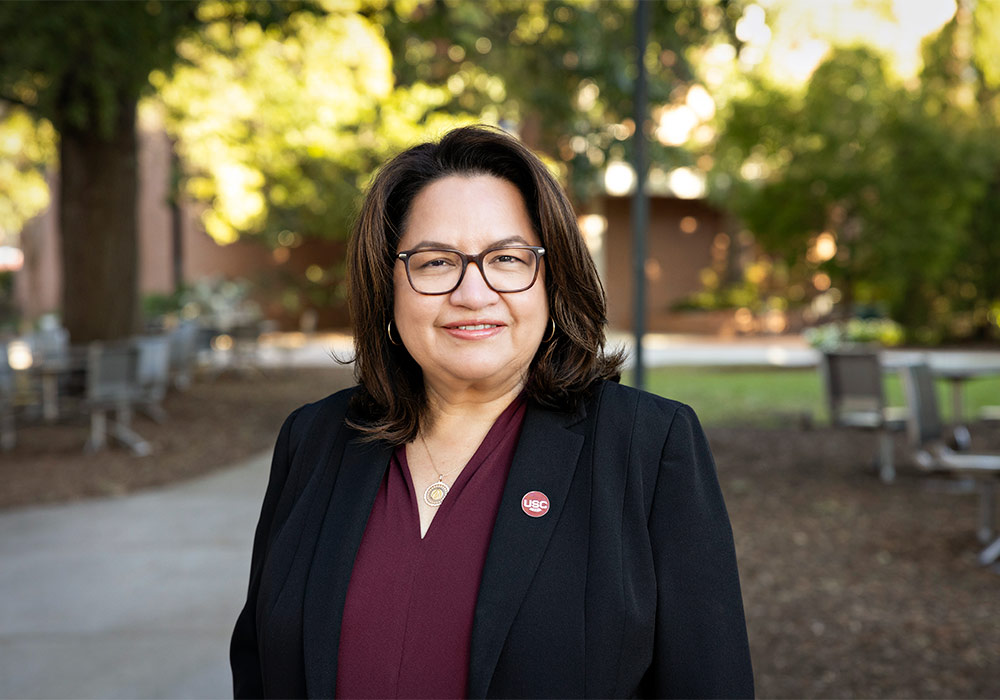
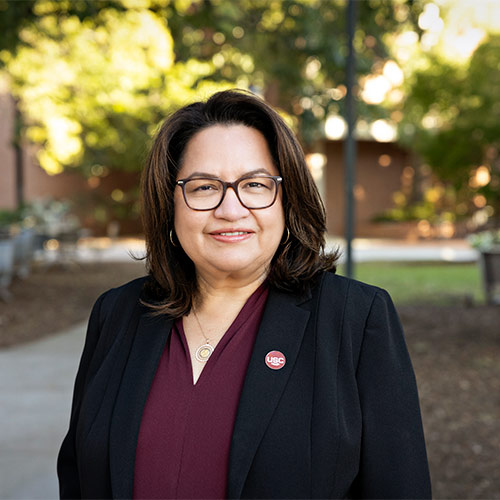
It was just a small postcard that arrived in the mail from Miami Dade Community College, but it would alter the direction of Silvia Patricia Rios Husain’s life.
Born in Nicaragua, Rios Husain’s parents immigrated to the U.S. during the unrest in her home country in the 1970s. And while she says her parents were supportive of her getting a college education, they were unsure how higher education worked in the U.S. She and her siblings had to navigate the system on their own.
In her senior year of high school, she was considering joining the military when the community college postcard arrived, saying she qualified for a $2,000 scholarship because she was in the top 10 percent of her high school class.
“So that’s how I started,” says Rios Husain, who is now associate vice president for student success in the Division of Student Affairs and Academic Support. “I went to the community college, got my associate degree, and then transferred to the University of Florida. It was that little piece of information that told me there was another possibility for me.”
She started college as a civil engineering major, but wearing a hard hat on a field trip convinced her that wasn’t for her. “This is how 18- or 19-year-olds make decisions, right? I did not like the feel of a hard hat and what it did to my hair. So, I changed to psychology.”
In retrospect, she knew it was about more than a hard hat; she knew she was being pulled to something more in line with her interests. So, she majored in psychology and then pursued a master’s and specialist degree in mental health counseling at UF. She worked as a counselor at a community college, and was later persuaded by a colleague to consider the doctoral program at the University of Texas at Austin.
“And I was like, ‘Me? I don’t think I’m Ph.D. material.’”
The University of Texas thought otherwise and accepted her into the program with a scholarship that offered in-state tuition. Her goal was to land a position of leadership at a community college, remembering how much that experience helped her as a young student.
“If it wasn’t for that little note that I got in the mail, god knows what my life would have been. So that was my goal. I never thought I would do anything else. When you strip every title from me, I’m not just a vice president of student success, I’m not just a mom or a wife or a sister or a daughter. I think at my core, I’m three things: I’m a helper, I’m a problem solver and I’m a leader. I don’t know that I could define that when I was younger — that comes with wisdom.”
She spent 12 years as vice president of student affairs at Gaston College, a community college in North Carolina. For the past nearly seven years, she’s been at USC, known to her students as Dr. SP. Her portfolio includes the University 101 program, the National Resource Center for the First-Year Experience and Students in Transition, the Student Success Center, the Career Center and the Carolina Experience.
“When I interviewed here, I could almost touch this culture of care for students that I had not experienced as a student myself at big, flagship institutions,” she says. “Interviewing at the University of South Carolina, it felt more holistic. And that was one of the things that really attracted me to the job.”
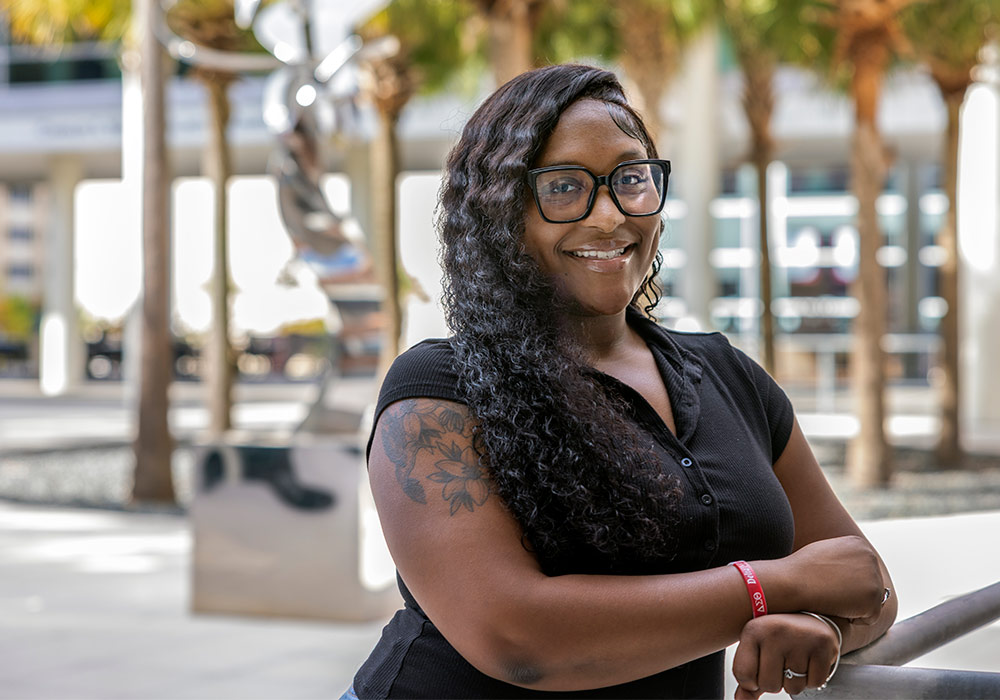
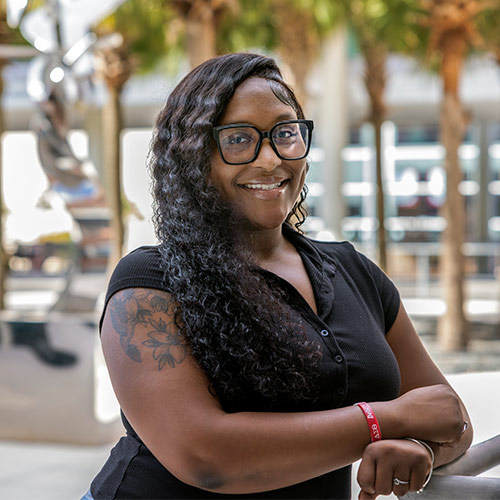
Kenadee Allen, a business major in the South Carolina Honors College, says her status as a first-generation student is a big part of what motivates her on campus.
“You hear talk about people being silver spoon fed? I say that I was plastic spoon fed,” says Allen, a junior from Anderson, South Carolina. “My parents helped me, but I knew that not having a degree kind of hindered them from having the lifestyle that they might have wanted. So, I always knew I wanted to do what they regret not doing, which is going off to college.”
Allen knew from an early age she would pursue a college education, partly because she loved — and excelled — in school. And she also always knew she loved math.
“That was my thing. Numbers have always made sense to me,” she says. “That’s part of the reason why I added on accounting to my major. Me and math, we get along.”
Two of her older sisters went to USC, playing a large role in Allen’s decision to become a Gamecock. But she worked hard to achieve something her siblings didn’t — a spot in the prestigious South Carolina Honors College.
“I applied to Honors just because my goal in life was always to beat my older sister,” she says with a laugh. “I applied to Honors so if I made it, I could say, “I got into Honors and you didn’t.’”
While she said she was shocked when she was accepted, she says being in the Honors College has been a big part of her USC experience.
“Being able to have the feel of a big university at USC but also be a part of the Honors College in that small community is definitely wonderful,” she says. “My experience at USC as a whole has been really great. I’ve always felt very supported in a lot of different ways academically and personally.”
She admits she was nervous coming in as a first-gen freshman and a business major. “But I always tell everybody I never felt any sharp elbows at USC,” Allen says. “I've always been helped with anything that I needed help with, especially being first-gen.”
She says those connections have made all the difference in her college experience.
“Whether it’s in first-gen or Honors or USC in general, just having those people around me that support me. People like Dr. (LaNaé) Budden, she’s done nothing but support me and help me with different opportunities that I’ve had.”
A junior, Allen is an Honors College ambassador and is president of the Black Honors Caucus. She is on track to graduate a semester early, expecting to finish in December 2027. She also graduated from high school a year ahead of her class.
“My grades were always really good in high school because I knew I wanted scholarships,” she says. “I didn’t want to burden my parents with student loans and trying to figure out those things. So being first-gen definitely has motivated me and driven me to be the best version of myself possible so that, when the time comes and I have kids, that I'm able to give my kids the life that I know my parents wish that I could have had. A college degree really helps with that.”
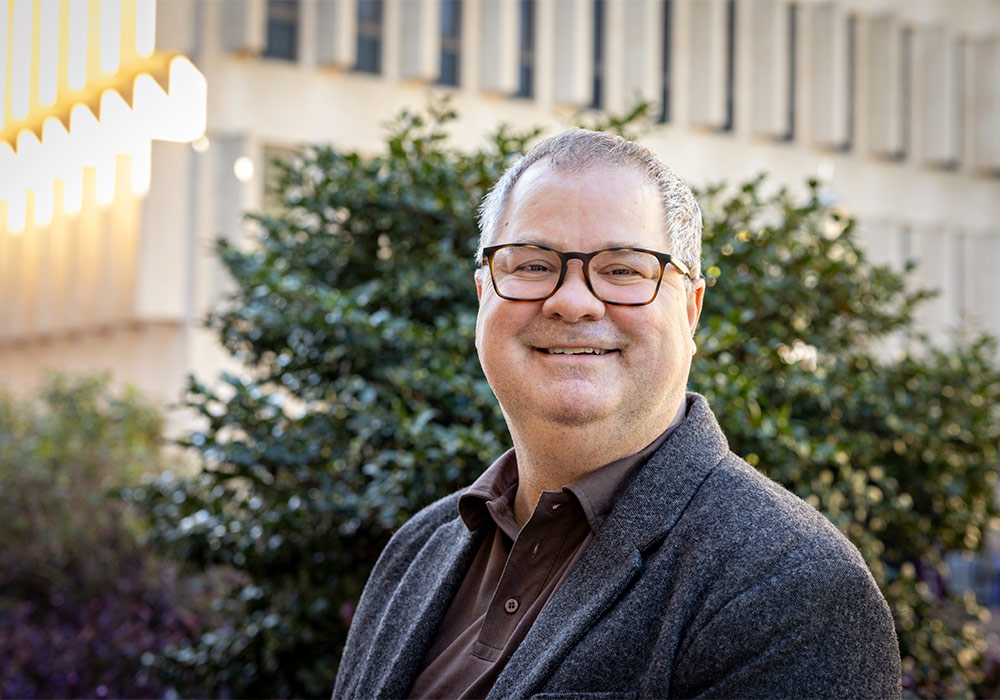
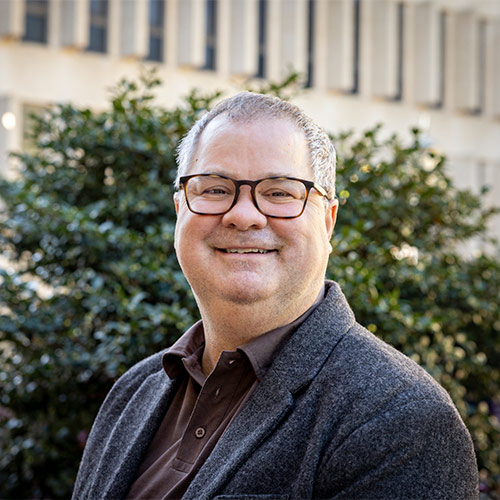
Matt Childs grew up in Michigan during the recession of the 1980s, a time when plants were closing and the economy was sagging. The town where he grew up had once been home to four factories, but all were shutting down. Even as a teenager, he realized it was quickly becoming an economically depressed area.
It was a tough time to be thinking about college, especially for a first-generation college student.
“My parents were overall just intimidated by the cost,” says Childs, now a professor and chair of the USC history department. “Even something like filling out the FAFSA form, as a young kid when I was 17 or 18, I could just tell how that made my parents feel uncomfortable.”
But he says it didn’t discourage him. He was accepted and attended Central Michigan University. It wasn’t always easy. He took out loans, he worked as a welder during the summer and worked jobs during the school year on campus.
And he sought out professors for advice and help navigating college life — something he now encourages his own students to do. He realized the importance of making that connection after getting back his first college exam and seeing a grade of 38. In retrospect, he said it was the best thing that happened to him.
“It was like, “OK, what do I have to do to correct this?’ And then that really forced me to be so disciplined,” Childs says. “We didn’t have this student university experience like you have here now. But I lived in the library, I got a job in the library, I studied in the library. I only slept in my dorm because it wasn’t an environment conducive to academic performance.”
He also talked to the professor — who happened to be in the history department.
“He encouraged me,” Childs says. “I didn’t have history as a declared major then, but I think it was more the kindness of that professor in that moment that made me think about ‘How can I do well in this course?’ And then I started doing well and I gravitated toward a major where I was getting good grades, and then it took off from there.”
Childs earned a master’s degree at UCLA, a doctorate at the University of Texas and taught at Florida State before arriving at USC in 2008. He is a historian of Latin America, and publishes in English, Spanish and Portuguese. The travel bug hit on a study abroad experience as an undergraduate student in 1992 when he went to Venezuela.
“I really wanted to study abroad. And then I found out how expensive it was, but I didn't give up. I went for any and all scholarships and was able to make it happen,” he says. “It was the first time I was ever on a plane when I was leaving the country to go to another country. That was just an amazing thing, to get on a plane and all of the sudden you wake up in an entirely different country, different sounds, different smells, different tastes, different way of life. It was literally like getting transported to another world. And that trip to Venezuela is really what put me on the path where I am now.”
He said he got addicted to the experiences of traveling to other countries, something he participates in now as a professor leading study away trips. He will take students to Peru over winter break.
During his undergraduate years, Childs says there was a greater number of first-gen students, but there wasn’t as much of a focus on helping them succeed. He says he applauds USC for creating the first-gen student center and placing attention on how each student navigates the university.
“One thing I always tell first-generation college students is students need to learn how to advocate for themselves for what they need. Faculty, staff, institutions, we can prod and push, but we can’t do it for them. And that’s part of whether they’re first generation or not, this kind of very instrumental years of growth from 18 to 25, where you go from being a teenager to a young adult with all those responsibilities.”