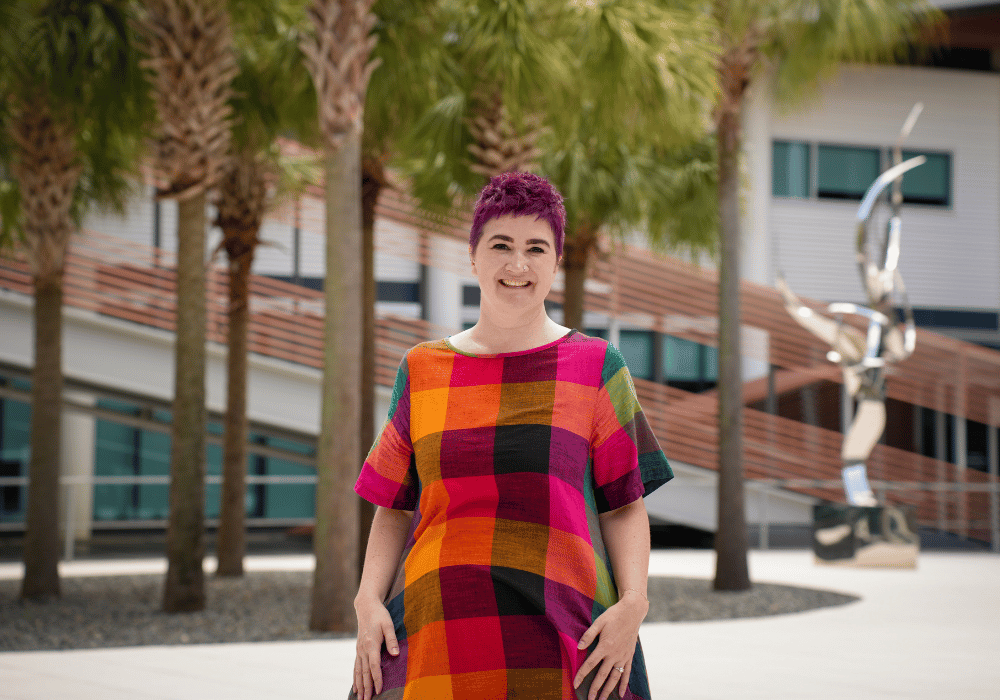
Andy Goss, an Honors College student studying accounting and finance in the Darla Moore School of Business, came to Amanda Heinsman with an ambitious plan.
During his first year at the University of South Carolina, Goss realized he might be able to graduate in three years while adding finance as a second major. Heinsman, who advised Goss in the DMSB, helped him map the courses needed to pursue it.
“She has made it a point to be very thorough when it comes to making sure I understand my academic coursework requirements,” Goss says. “Now, I am confident in making my own decisions, but I still like to run them by her to make sure it is the right choice for me.”
Before becoming an advisor, Heinsman spent nine years teaching. She brings that experience to advising, where she sees herself as an educator and mentor.
“I want them to learn how to navigate the university,” Heinsman says. “This is your degree, this is your major, this is your thing, and you should understand what it is you're doing there.”
Heinsman provides structure, helps students understand requirements and catches things they may overlook. She also encourages them to explore their options so they can feel confident in the choices they make.
For students considering international business, that can mean thinking about whether they want to work with international companies, continue studying another language or spend significant time abroad.
“It's nice when people find their fit and are doing things that aren't just because it's another gold star, but because it's something that they're genuinely interested in and want to pursue,” she says.
Conversations about majors and courses can quickly turn to a bigger question: What do you want to do while you're here?
Heinsman has seen students take interests beyond the classroom, from a student who made jewelry and turned that experience into an internship and job opportunity to students who explored barbecue judging and mountain climbing.
Sarina Patel, a business student from Lexington who lives off campus, worried that she might miss out on parts of the college experience and opportunities to connect with other students.
“It's nice when people find their fit … because it's something that they're genuinely interested in and want to pursue.”
Patel says Heinsman acknowledged the concern and pointed her toward opportunities to connect. That helped set the stage, Patel says, for the relationships she developed throughout college.
“Every meeting I had with Amanda, I was doubtful and unsure about what I wanted to do, and she always encouraged me to try new things out,” Patel says.
Heinsman draws on an education concept called “productive struggle” — supporting students without removing every challenge.
“Just telling someone no, figure it out isn't productive because there's nothing they can do with that information,” Heinsman says. “But scaffolding and saying like, ‘Hey, here's where you can find that. Let me know if you run into a problem and you truly can't find that’ ... is a huge part of learning.”
That process isn't always easy for students.
“Just because you feel like something was hard or unenjoyable doesn't mean that the learning wasn't successful,” Heinsman says.
For Heinsman, giving students room to work through those moments reflects her confidence in what they're capable of doing.
“It does matter that they develop self-confidence, that they develop resilience,” Heinsman says. “Those skills don't happen with just hand-holding. So there needs to be some amount of like, ‘I believe that you can find this.’”
Sometimes the next step is another advisor.
Keith Martin, director of the Office of Exploratory Advising & Academic Coaching, works with students who are considering whether another academic path might be a better fit. Advisors like Heinsman can connect students with his office when those questions arise.
A referral doesn't end the relationship with a student's college-based advisor. Martin says exploratory and college-based advisors can refer students back and forth as their needs change while keeping the primary advisor informed.
Exploring another major doesn't always result in a change.
“There are multiple benefits that a student can receive by engaging in the major change process, even if ultimately they end up deciding that their existing major is the best fit,” Martin says.
Students may compare majors and related careers, consider their strengths and interests and ask practical questions such as how long it might take to enter another major or whether a change could affect their expected graduation date.
Exploratory advisors help students understand those options “so that they can make a truly informed decision,” Martin says.
Editor’s note: Since this story reported, Amanda Heinsman has transitioned from the Darla Moore School of Business to an advising role in the Arnold School of Public Health.