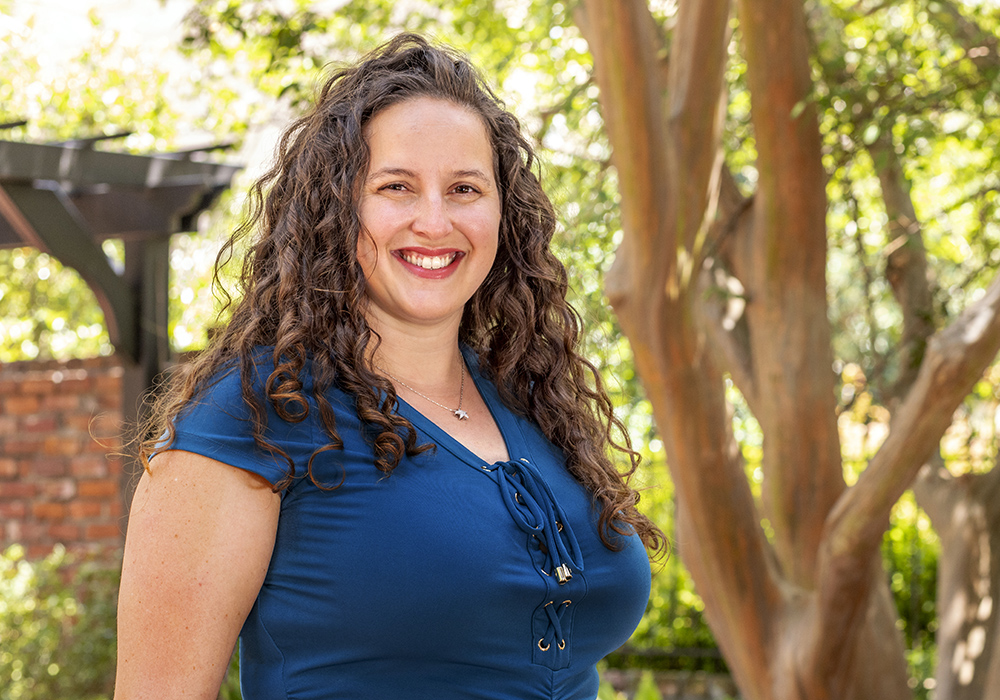
Marine biologist Eilea Knotts knows what makes a good science experiment: failure. She believes that sometimes failing can lead to a major breakthrough.
She brings this philosophy into her classrooms at the University of South Carolina. As a lab coordinator and biology instructor, she encourages her students not to be afraid to fail, as long as they learn from their setbacks and keep going. She says failure is a part of learning, and it’s not supposed to be comfortable.
“It’s like when we’re learning to walk: We stand, and then we fall. Our parents are clapping. We stand again, then take two steps. We fall. The entire time, everyone’s saying, ‘Yeah, yeah! Keep going!’ That’s what the classroom should be,” she says.
To create this atmosphere for her students, Knotts turned to USC’s Center for Teaching Excellence for guidance and support. She had been training with the center on how to adapt her teaching to meet the needs of students with a variety of learning styles, and she participated in a workshop that inspired her to try a new grading system in her labs.
“I said, ‘I want to rebuild the general principles of biology lab. At this point, I’m not happy with where it is, and although I make little changes every semester, it’s still not right.’ And they worked with me to rebuild it using the new grading system,” Knotts says.
“This is the end of my fifth year, but I feel like I’m really starting to see the fruits of the labor. The Garnet Apple Award makes me feel like it’s recognized that I’ve been working toward something, and I’m finally seeing some great results in student engagement.”
Knotts decided to restructure her lab classes according to a method called specification grading, which she learned about in a book borrowed from a colleague in the biology department. This grading method uses a set of guidelines to show students how well they have learned the information and mastered the skills required for the class, with each assignment, quiz and test providing feedback.
Instead of getting points, students receive a level such as “proficient” or “progressing” to tell them if they are on track. While Knotts does calculate a letter grade for each student by the end of the semester, she finds that the change in approach helps students stay more engaged with learning.
“Often, students are so focused on the grade that they don’t really care how they get it. They don’t care what they’re learning as long as they get the right number at the end. And that’s not what matters,” she says.
Knotts also included a way for students to make up work if they missed class or missed the mark on a first attempt. This helps students not to be afraid of failing, because they have another chance to master the material.
“Specification grading is a return to the idea that you’re here to learn a specific technique, a specific skill, a specific piece of information. It returns the autonomy and responsibility of learning to the student,” Knotts says.
The system worked so well in the labs that Knotts incorporated it into two lecture courses. Her ingenuity has earned her the Center for Teaching Excellence’s Garnet Apple Award for Teaching Innovation. For Knotts, the award is evidence of her growth as an educator, which she credits to the support of her department and the encouragement she receives at USC to try new ideas and techniques in her teaching.
“This is the end of my fifth year, but I feel like I’m really starting to see the fruits of the labor. The Garnet Apple Award makes me feel like it’s recognized that I’ve been working toward something, and I’m finally seeing some great results in student engagement,” she says.
“I appreciate the recognition that I’m trying, because I’m a work in progress. I am not the same instructor that I was when I first came in as a graduate student 11 years ago."
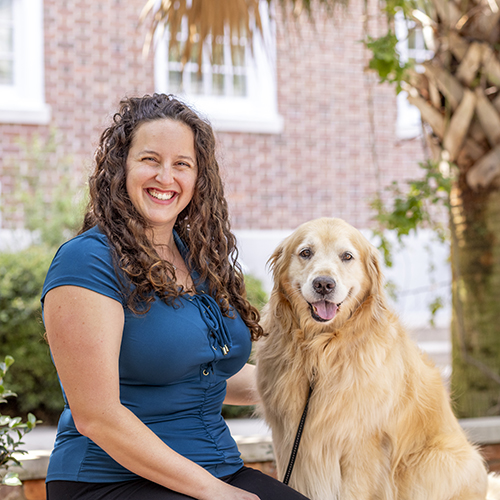
Knotts earned her master’s and doctorate in biology at USC. As a graduate student, she conducted research and taught as a graduate assistant. Originally, her goal was to run her own lab for the National Oceanic and Atmospheric Administration. But her experience teaching changed her mind.
“From the very first semester, I immediately fell in love with teaching. I started getting my hands in as many different courses as I possibly could,” she says.
Knotts joined the faculty at USC in 2020, just a few months after graduating. In addition to teaching, she works in the lab of her Ph.D. advisor, Jay Pinckney, where she researches the ecosystems of microscopic algae. Knotts is a co-principal investigator on a grant from the National Science Foundation and is advising a doctoral student.
She has also advised undergraduate researchers through a course that takes marine science majors to USC’s Baruch Marine Field Laboratory in Georgetown, South Carolina. When teaching research-based courses, Knotts takes her upper-level students beyond the basics of an introductory lab, letting them brainstorm their own ideas for experiments.
“It’s allowing them to experience real science, and science is failure. Science moves forward when it doesn’t go as expected,” she says. “I always tell them, ‘You’re going to try a bunch of things, and most of it is not going to work. Then eventually, something will work, and you’re going to talk about it. It’s more fun this way.’”
This scientific approach has led Knotts to success as an instructor. “I’m an individual who is never satisfied by what I know,” she says. “What worked this semester may not work for every class, but I have an insatiable curiosity driving me to find out what else is out there. What haven’t I tried?”