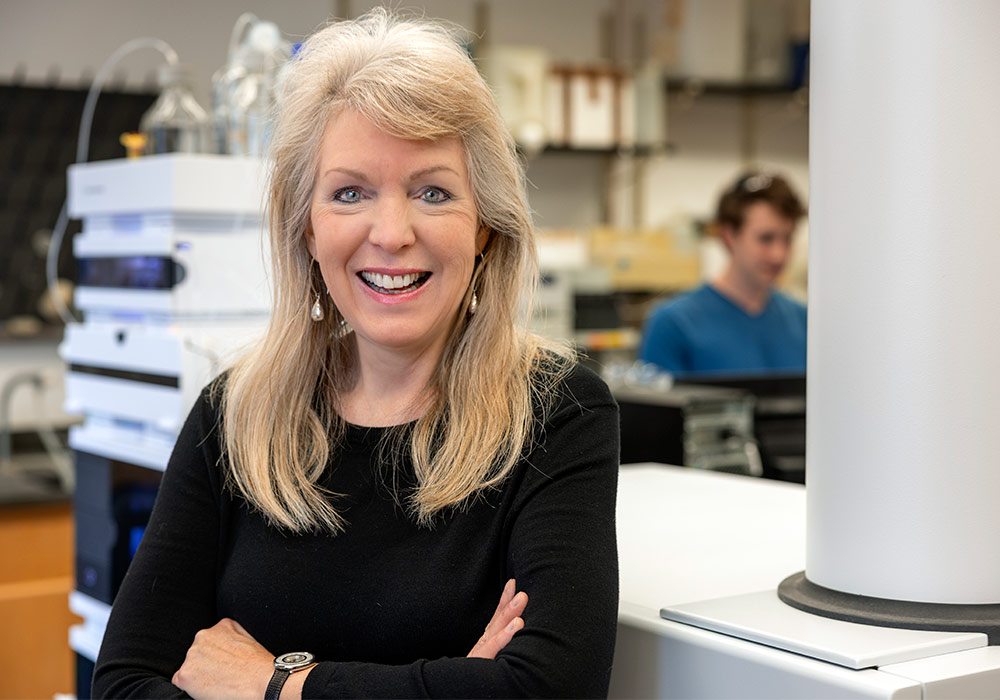
Susan D. Richardson thinks a lot about water — from the safety of the water we drink to the quality of water for our ecosystems.
Richardson, the Williams Distinguished Professor of Environmental Chemistry at USC, has spent her career researching water quality, with a focus on the disinfection byproducts and emerging environmental contaminants found in drinking water.
“I think we have good water, but I think we can do better. And so that's been an ongoing area of my research for a long time,” says Richardson, who was awarded the 2025 Carolina Trustees Professorship in Public Health, Engineering, Medical Science and Sciences.
It’s research that has culminated in hundreds of publications, more than $13.5 million in research funding and work that has led to the development of advanced analytical methods and the identification and measurement of new classes of disinfection byproducts. Disinfection byproducts, or DBPs, are the chemical compounds that are formed when disinfectants used to clean the water from harmful microorganisms react with other substances in water. They are the “unintended consequence” of trying to get rid of dangerous pathogens, and some DBPs have been linked to various health issues, including cancer, birth defects and miscarriages.
Richardson teams with toxicologists, engineers, epidemiologists and other researchers to study which DBPs are the most toxicologically important and understand how they are formed. It’s research that can play a major role in helping improve people’s drinking water — and their lives.
“We publish good science. But to do something that's going to benefit society? That's what I want to do,” she says. “That's why I've not given up on this area, because there's still more to do.”
Richardson has been at the University of South Carolina since 2014, where she has developed a reputation as both a skilled researcher and an engaging teacher and mentor, recognized for her ability to bring real-world examples from her work into a classroom lecture. She teaches analytical chemistry and mass spectrometry and has mentored 75 undergraduate and 17 graduate students in her research lab, eight of those have earned a Ph.D.
In 2024, her work to improve water quality by measuring disinfection byproducts and other contaminants earned her a spot in the National Academy of Engineering.
“I think we have good water, but I think we can do better. And so that's been an ongoing area of my research for a long time,"
She says she followed a “crooked path” to environmental chemistry. She grew up in Georgia, where she traces her interest in science to a high school chemistry and physics teacher who took an interest in students and ignited Richardson’s passion for the subjects. She studied chemistry at Georgia College and went on to graduate school at Emory University, where she studied physical organic chemistry before a postdoc with the EPA’s National Exposure Research Laboratory in Athens, Georgia, turned into a full-time position.
That started her 25-year career with the EPA and led to meetings with scientists who introduced her to emerging issues with disinfection byproducts, something that was first discovered in 1974.
“We’ve been disinfecting water since early 1900s, and it was 74 years later that we discovered there was an unintended consequence,” she says. “Of course, it's really important to use disinfectants to kill the pathogens in the water. But there are smarter ways we can do that to also minimize these disinfection byproducts, too. So, I got involved in DBPs. That became my major thrust because they really are important.”
What she calls one of the most important studies of her career was published in 2022 and determined DBP factors of toxicity in drinking water. The work discovered that unregulated haloacetonitriles and iodo-acids are the most important toxicity drivers in U.S. drinking water, and the EPA is considering those DBPs for regulation. Her research also discovered an entirely new class of DBPs — halocyclopentadienes — the first class predicted to bioaccumulate, meaning the toxins can build up in organisms, including humans, over time.
Some of her work takes place close to home. Her research into the impacts of harmful algal blooms on drinking water has led to a promising method to degrade their toxins. The algal blooms’ toxins, which have been found in South Carolina’s Lake Wateree and Lake Marion, can kill fish and wildlife, poison shellfish, sicken humans and threaten drinking water supplies.
“It's one thing to discover things; it's always good to know what's there,” she says. “But what can we do about it? What's the best treatment to use to minimize our exposure to these things? That's what I want to do. I want to make the water safer.”