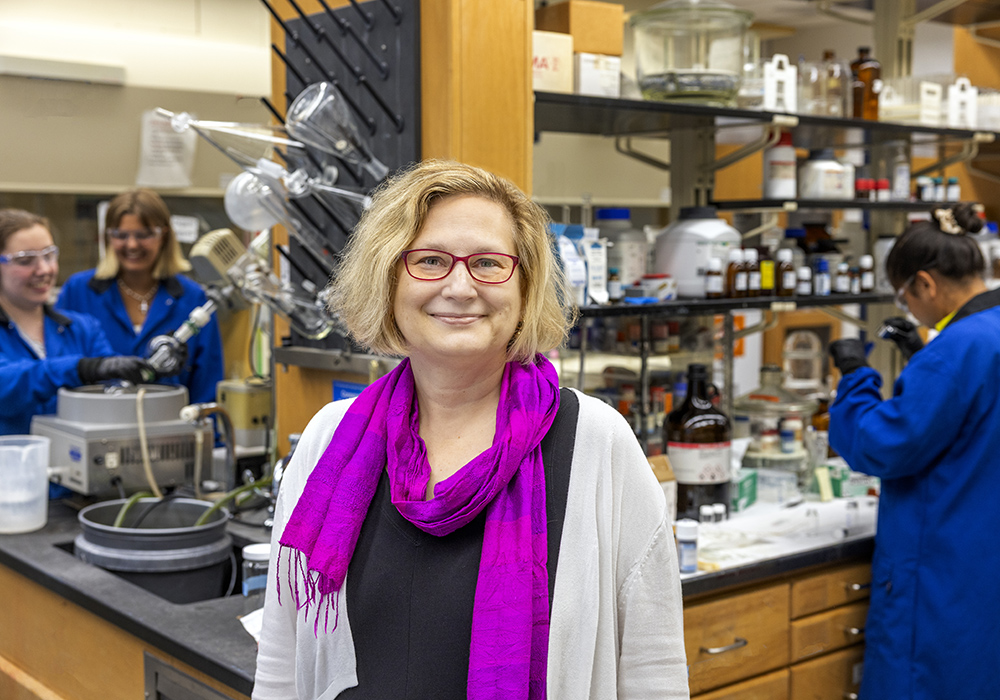
Linda Shimizu is not one to boast about her accomplishments, but the USC chemistry professor’s curriculum vitae points to many areas she could brag about.
For starters, there are the 16 external grants totaling more than $3.6 million she’s garnered as a principal investigator and her more than 70 peer-reviewed publications. Then there’s her receipt in 2021 of the S.C. Governor’s Award for Scientific Awareness and the 2024 Outstanding South Carolina Chemist Award. Most recently, she was named a fellow of the American Chemical Society, one of only 36 chemistry professors worldwide to receive the honor in 2025 for scientific and professional accomplishments.
But it’s the last part of her CV that Shimizu is probably most proud of — a listing of more than 80 names of high school and undergraduate students who have worked in her laboratory since she joined the chemistry and biochemistry department faculty.
“I went to Wellesley College to do my undergraduate, and their motto is ‘not to be served but to serve.’ I really do enjoy the impact of volunteering and contributing to the chemistry profession,” Shimizu says.
“In the United States, we’re not encouraging enough people to go into science, so it’s really important to showcase the careers and the creativity and excitement that can be found in these types of careers.”
Her contributions have taken various forms, but many of them have focused on inviting students into the scientific community and then helping them succeed. While still a research assistant professor in 2000, Shimizu launched the Chemistry and Biochemistry Outreach Program, which trains USC graduate students to visit area K-12 schools to highlight careers in science, supplement state science learning standards and showcase the scientific method. In recent months, Shimizu’s team has visited 15 schools.
"We’re trying to get the younger generations interested in becoming STEM scientists,” Shimizu says. “In the United States, we’re not encouraging enough people to go into science, so it’s really important to showcase the careers and the creativity and excitement that can be found in these types of careers.”
Shimizu also pours a lot into mentoring students in her lab. A few years ago, she started Chem Camp — summer sessions that impart the practical skills necessary for graduate school success and beyond. A recent session focused on mining for research ideas.
“We talked about looking for scientific questions that are unanswered, the unknowns that can be explored,” she says. “We’re thinking about that in our own area of research with supramolecular polymers where we want to learn how to control the length of the polymer stacks that we make. Nature can do this kind of thing really well, but chemists — we still have trouble doing that.”
That kind of scientific curiosity has fueled Shimizu’s research enterprise at USC for nearly 30 years, and the research, in turn, has cultivated her interest in teaching and mentoring.
“Research is teaching on a one-to-one basis, so it’s like an apprenticeship at the chemistry level,” she says. “And watching those students develop into independent researchers is exciting. I find it very fulfilling.”