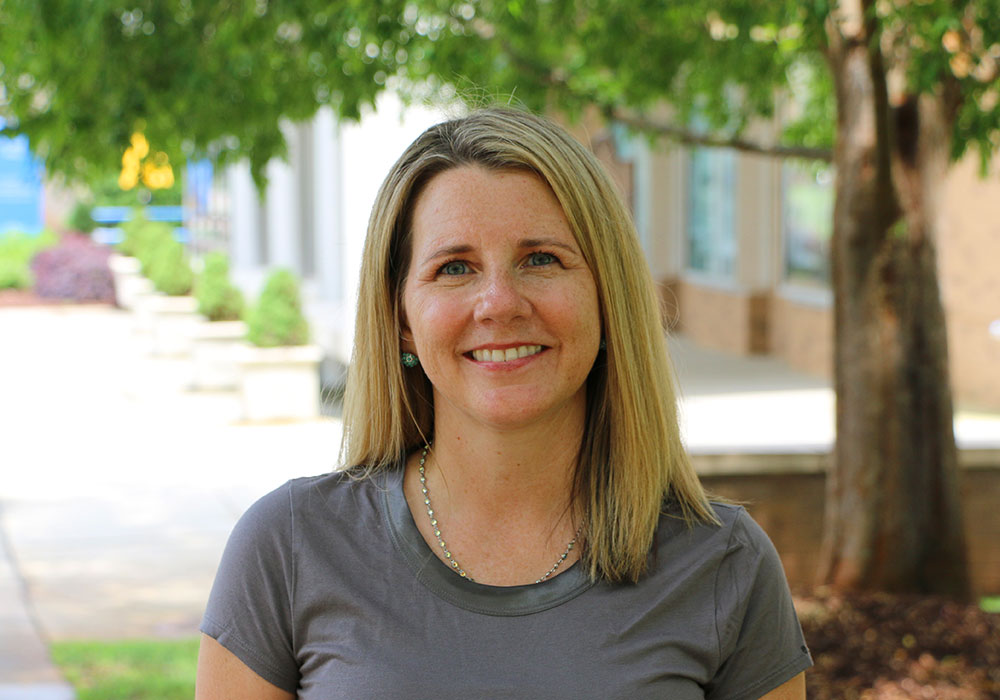
Susan Cruise did not always plan on becoming a professor. Although she was raised in a family of teachers, she initially pursued professional counseling.
But after a few years working part time as a counselor at a small college, she began teaching as an adjunct professor and discovered she loved teaching.
“Even if I was having a really bad day, going to teach just made me come alive — I just loved every second of it.” says Cruise, an associate professor of sociology at the University of South Carolina Lancaster who was awarded the John J. Duffy Excellence in Teaching Award for Palmetto College Campuses.
Her teaching philosophy focuses on creating an atmosphere where students can broaden their world view and learn from each other. She does this through in-class discussions, interactive activities and service-learning opportunities outside the classroom.
Creating a safe space where students can share their thoughts is imperative to her teaching style. One technique she frequently uses is putting students into small groups to facilitate group discussion. She says it gives students who may not feel comfortable sharing their thoughts with the entire class an opportunity to freely express their views to their peers.
“A challenge, especially with sociology, is presenting material in a way that gives everyone the opportunity to share, while not making anyone feel like they have to defend their existence,” she says. “The topics that we discuss often are controversial in nature. We all have our unique lived experiences that influence how we feel about topics like poverty, gender or politics, so we should be allowed to share those. If we can't, then I don't know why we're in college.”
Cruise organizes service-learning opportunities for students to better understand the course content. In her introductory sociology course, students collect non-perishable food to donate to a local food pantry and distributed it to people in the community.
“A challenge, especially with sociology, is presenting material in a way that gives everyone the opportunity to share, while not making anyone feel like they have to defend their existence."
In the last three years, she has taught additional sections of introductory sociology to help meet the demand for dual enrollment students. In 2022, she also wrote and published an interactive online textbook because of that demand.
“I wanted it to be brief, so that students don't look at it and think, ‘There's so much to read. I'm not going to read it,’ because that's often what happens, especially for an intro class,” she says. “This is an interactive online book with YouTube clips built in and articles that are interesting and relevant. I update it periodically so it’s continually current. I had students contribute stories about their experiences. I also have stories from my own life and other people I know that gave me permission to share.”
One of her most effective teaching tools is taking students abroad. She connects course discussions and readings with the cultures and social issues of the European countries she visits with students.
“Sometimes, we look at the problems that our culture, state, country and subcultures are experiencing and forget that other places in the world have their own issues and problems,” she says. “We are not mindful of those things until we're there. I love hearing students’ perspectives on various things; experiencing that with them in person, whether it's abroad or just in class, is my favorite part of teaching.”
She’s also mentored students whose work has been published in peer reviewed academic journals. “It's a gift to be able to mentor a student,” she says. “When we mentor them, students are the ones that are really doing all the work. We're just there to guide them, offer perspective and coach them along the way. It's a beautiful process to watch.”