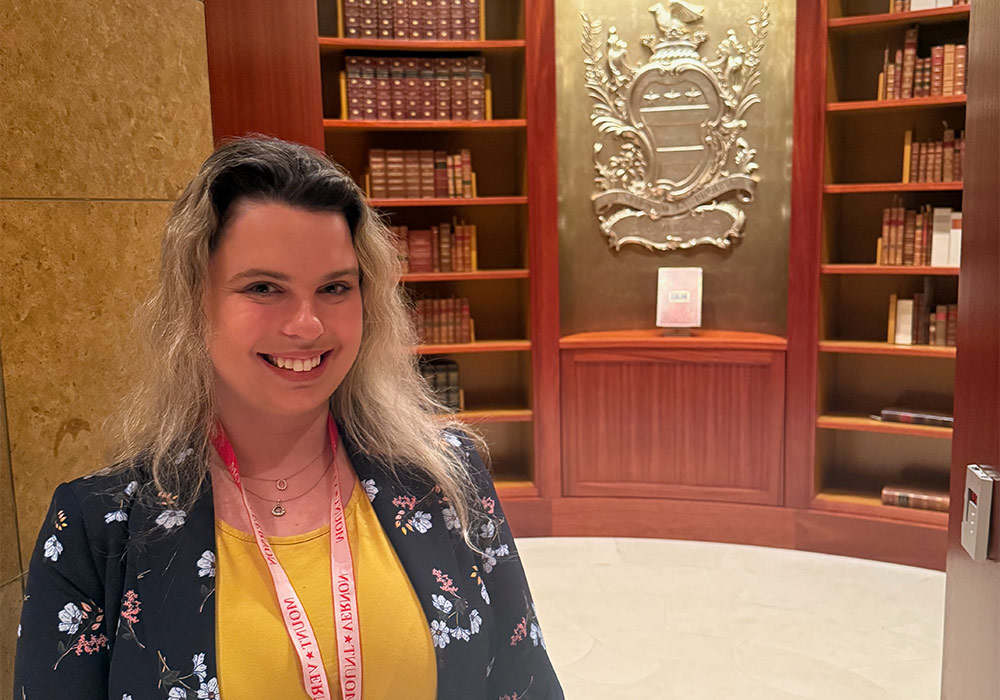
As the nation approaches its 250th birthday, Zoie Horecny is in the right place, with a front-row seat and a backstage pass.
Horecny, who earned her undergraduate, master’s and doctorate in history from the University of South Carolina, is now the Digital George Washington Papers editor at the Washington Presidential Library at Mount Vernon. She creates, oversees and facilitates digital collaborations and assists with projects undertaken by the Center for Digital History. She also edits and manages the Digital Encyclopedia of George Washington, a reliable resource for scholars and K-12 students and educators that received 3 million views in 2024.
It's something of a dream job for the Chapin, South Carolina native, who first became interested in history as a child watching PBS programs about the American Revolution. And the timing for the George Washington Papers position, leading into the celebration of the semiquincentennial of the signing of the Declaration of Independence, couldn’t be better.
“We’ve seen these kinds of pivotal moments in programming in the past that I think really grabbed people's attention, particularly young people,” Horecny says. “And I think we see that now, in the years leading up to the 250th. We have such renewed interest in this era. I think that's why it's really important what we do here, because when people are interested or Googling or looking for exciting resources, that's what we're able to create — things that coincide with those interests.”

“I feel like Carolina is a very supportive community... It was that collegiate atmosphere that brought me to the discipline, because that’s what being a historian is."
The decision to attend Carolina was an easy one for Horecny. She grew up just 20 miles from USC in a big Gamecock family. She says she immediately felt plugged into the campus and loved her undergraduate years as a Capstone Scholar and as a resident mentor in Columbia Hall. She came to campus as an English major, mostly because she always loved to read, she says. And while taking Southern Studies electives, she became hooked on history — and committed to USC.
“I feel like Carolina is a very supportive community,” she says. “I loved being in classes and having fun historical discussions, very Socratic-style classes where people are reading and engaging with secondary sources and primary texts. It was that collegiate atmosphere that brought me to the discipline, because that’s what being a historian is. You're discussing ideas, you're interrogating sources, you're going over interpretations, you're thinking about how you're going to educate. And I feel like that was really at the forefront of a lot of my courses.”
After earning her B.A. in history with a minor in Southern Studies in 2018, she faced the decision of where to attend graduate school. Again, it was an easy choice. She earned her master’s in public history from USC in 2021 on her way to her Ph.D. in December 2024.
“I really loved our history department,” she says. “I'm so lucky I got to stay at USC and I worked with an amazing advisor, Dr. Mark Smith. I had taken his class in undergrad, so it was really exciting for him to be my Ph.D. advisor.”
Horecny’s focus area is the United States from its founding to 1877. Her dissertation looked at the Backcountry of South Carolina — everything except the Lowcountry counties — in the early days of the Republic, from 1780-1833.
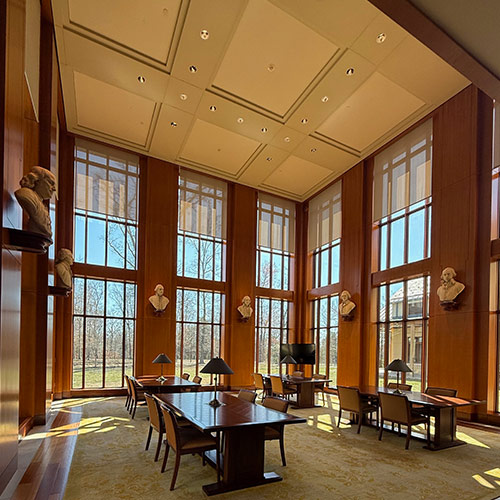
Horecny’s master’s work in public history has helped her in the role she has now, since part of her job in Virginia includes working with and presenting to the public. She also was prepared by her time at USC as a graduate research assistant working on the papers of the Revolutionary Era Pinckney Statesmen. The historical documentary editing project collects and publishes the personal and public papers of Charles Cotesworth Pinckney (1746–1825), his brother Thomas Pinckney (1750–1828), and their cousin Charles Pinckney (1756–1824). Each of these South Carolinians played a leading role in military, political, diplomatic and economic affairs during and after the American Revolution.
She says a history degree opens doors to various careers, despite a perception that job options are limited to tenure-track professorships or book projects.
“The reality of the history field is a lot more vibrant and diverse,” she says. “At Carolina, I worked and trained with people who became not only excellent instructors and tenure-track professors, but people that work in the field of preservation, or people that work with object collections for museums and state governments. And there are people like me who are working in the digital space to create resources. I think that's what's honestly incredible about having a history degree.”