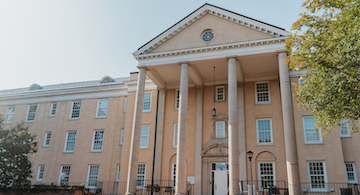
Preston College at the University of South Carolina was built before World War II, but the residence hall experienced a renaissance 30 years ago when it became the university's first and only residential college.
TRANSCRIPT
“Welcome to Coffee Club!”
I’m sitting in the lobby of Preston College, a residence hall at USC that was built in 1939 and named for William C. Preston, a graduate of South Carolina College and one of its presidents before the Civil War.
If you were a student at Carolina, you probably passed by Preston hundreds of times — it’s on Greene Street across from the Russell House and Thomas Cooper Library. The 1940 edition of the Garnet & Black yearbook described what was then USC’s newest dorm as "clamorous," as in loud and noisy, and 86 years later, Preston is still living up to that description.
I’m Chris Horn, co-host of Remembering the Days, and today we’re looking back at the history of Preston College, an older dorm that has experienced a renaissance in the past 30 years.
During its first few decades of service, Preston housed only male students, including WWII veterans and student athletes. But in 1995, after a major renovation, Preston became a co-ed dorm and was renamed Preston Residential College.
So what is a residential college? It’s a college dormitory with a faculty member — and his or her family if they have one — who lives full-time in a lodge within the dorm and shares life with the students throughout the academic year. Oxford and Cambridge have had residential colleges for centuries, and the purpose has always been the same — they’re intended to create a close-knit student community in the midst of a large university.
Sophie DeMaine is a junior who is in her third year at Preston, two of them as an RA. She’s seen up close how a residential college works.
Sophie DeMaine: “I really do think that an extra effort is made here to make sure that students are drawn in and make sure that they feel welcome and they can achieve what they need to achieve here. Also, Preston is one of the only dorms on campus that allows for returners, for upperclassmen to come back. And so that is helpful, I think, in creating this environment that we live in, because it's this whole idea that there's so many different people from so many different walks of life, and everyone kind of just gets to live here together. It's a lot of fun.”
On this particular morning, a few dozen Preston residents — they sometimes call themselves Prestonites — are hanging out in the lobby for Coffee Club, a once-a-month event that is just what it sounds like, an opportunity to sit down with a bagel or pastry and a cup of coffee and catch up with fellow students and perhaps with some of the faculty associates who sign up every year to be part of the Preston Residential College family.
I didn’t catch all of it or even most of it — my hearing isn’t what it used to be — but the free-ranging conversation at the Coffee Club I sat in on included riffs on everything from fingernail polish to the upcoming Thanksgiving holidays. It was a lighthearted slice-of-life moment in the university’s only residential college.
I tracked down Don Greiner, a retired English professor at USC who served for several years as the vice provost and dean of undergraduate affairs. Creating Preston Residential College was one of several ideas he came up with in the 1990s to improve the undergraduate experience at USC.
Don Greiner: “Once I got the position, I started doing what any decent professor would do, investigating what other schools do, etc. And I came up with the notion — are there many public universities, big public universities that have a residential college? The answer was no. They were almost all in private universities.”
After visiting other universities that have residential colleges, Don wrote a proposal for creating one at USC. He suggested Preston because of its central location on campus.
It was going to take a lot of work to convert Preston from an old-style dorm with hall bathrooms and no air-conditioning to a suite-style floor plan. Don also proposed what was then a radical idea of having male and female students on the same floors — not on alternating floors as USC had done in the mid-1970s at Bates West dormitory.
Don remembers the Board of Trustees meeting when he pitched the idea for Preston Residential College with a co-ed arrangement.
Don Greiner: “What I have in mind is co-ed. Dead silence, not a grin. I said, I want 120 women, 120 men, and there'll be an application. I'm trying to avoid the co-ed issue, but it comes up, of course.
And then I said, the issue will be how do we house these suites? And I said what I have in mind is two women, bath, two women. Two men. Bath. Two men. Two women. Et cetera. All three halls. Silence!
And one board member raised his hand and said, in effect, ‘We've never done this before. We're not sure about mixing male and female at age 18, 19, et cetera. in the same residence hall.’”
The debate went back and forth, and at one point it looked like the idea of a co-ed residential college was not going to happen — at least not like Don Greiner envisioned it. Everything shifted, though, when Dr. Eddie Floyd, a highly respected, longtime board member, spoke up and said, in effect, ‘I think we can do this.’ And so it came to pass.
When it reopened as Preston Residential College in 1995, religious studies professor Kevin Lewis and his wife, Becky, were the first co-principals, welcoming about 230 students who were a mix of freshmen, sophomores, juniors and seniors. After a three-year term, they moved out of Preston’s faculty lodge, and history professor Ken Perkins and his wife, Margaret, moved in. Ken recalls the process for students to get a spot in the residential college.
Ken Perkins: “There's a watchword for what was going on there, it was creativity. The students had to apply to live in in Preston, and there was a student faculty committee that reviewed the applications and made decisions. We always had more applicants than we could accommodate. But the application, as I recall it and I'm pretty sure this is accurate — the application was a blank piece of paper that said, ‘I want to live in Preston:’ and that was it. And so, you know, it was amazing to see what students would come up with. Some of them would write almost like a college essay, college entrance essay question. Others of them would attach artwork that they had done or would include videos of theatrical performances that they had done in high school, or something like that. It just, or musical performances. So it it was just so loosey goosey in that sense. And that was, that was a really nice aspect of it.”
Before his four-year stint as a faculty principal at Preston, Ken says he didn’t really know students outside of class, but that would change dramatically.
Ken Perkins: "Preston, from this point of view, was a great experience for me because I really came to understand that, you know, I was seeing students in class for a really tiny portion of their overall lives, not just their overall lives as students, but their overall lives in general. And I didn't know anything about them. And students who I might see in class as just sort of slugging along and not being very interested and just, you know, doing the minimum and so on, I learned at Preston that many of these students were incredibly talented in non-academic or marginally academic areas. I mean, many of them were tremendous musicians or actors or they just had all kinds of talents that didn't come out in a one-hour classroom interchange. And that was the whole, that was really the whole purpose of Preston. And, and I think its most significant accomplishment was creating a community where these kinds of student assets had an opportunity to, to really flourish."
One of Ken’s fondest memories of life in Preston occurred at a Halloween Party.
Ken Perkins: "Halloween was, wow, over the top all the time. I mean, it was one of my — one of the most fun things that happened at Preston because you never could tell what was coming, but you could be sure it was going to be over the top or very close to it. So at one of the Halloween parties while we were there, probably the best-costumed person there was Count Dracula. And this was obviously an older person.
“It wasn't one of the students. Students didn't really know who it was. And there was a lot of buzz about, you know, who was this person and who was interacting with the students all along and so on? But none of them could figure out who it was. And after he left, everybody wanted to know who was that? Who? Well, who it was John Palms, who was the president of the university at the time.
“And he just clearly had the most wonderful time because he was really in character as Dracula. And none of the students knew who he was. And then when they found out, they were astonished. It sort of changed — I think it changed their whole. They would never have thought that this eminent scholar and president of the university would be doing something like this. So if we were trying to change student-faculty relationships, that was a big step in the direction of doing that.”
Jim Stiver, a philosophy professor and associate dean of the Honors College, became the faculty principal in 2006 after he had retired from full-time university service. He and his wife, Marta, weren’t sure what the experience was going to be like.
Jim Stiver: "Jokingly we looked upon this endeavor with some skepticism, and we openly wondered why anybody would want this job to live with undergraduates — 200-plus of them. We discovered that it was a very rewarding experience. We're so glad that we actually agreed to do it.
"The one word I would use for it was unpredictable. You never knew what issue would come up that day with all these creative, zany, smart students who were always coming up with something. Not all the ideas were good. Some we had to nix, but very few. Some we tolerated and some we just reveled in.
"Zany — that's a good word for those students. Never a dull moment. We had themed dinners over at Preston Dining. We would have parties on the porch or in the back lawn. So all featuring the creativity these students were famous for. That's why they — one of the reasons they wanted to live there — The reputation was if you're creative, you need to live there.”
The focus of Preston Residential College began to tilt more toward student leadership with its subsequent faculty principals, which included history professor Bobby Donaldson and his wife, Elise, and French professor Lara Lomicka Anderson and her husband, Andy. Lara, who is now vice provost and dean of undergraduate affairs at USC, says each faculty leader of Preston develops their own style. For her and her family, that included having Preston students over for dinner with internationally themed cuisine.
Lara Anderson: “I like to cook. So we would have a different international focus. So I would find these recipes and cook German food one time or Ethiopian another time or Moroccan. It just kind of varied depending on what I was, what I was interested in for that particular dinner. And then we would welcome students into our apartment and just have dinner together. And often that dinner time would be quick. But then that led into games that would happen after with the kids because they were they were there with us enjoying the dinner. And, you know, we would have game nights that sometimes would last until 10 o'clock at night where we would just play whatever it was, monopoly or charades or whatever it happened to be at the time, I can't remember, but it was just so fun to develop these relationships with the students and for them to feel like they belong to a community that had a family. And even though their family was not in Preston, they had a family away from home.
One of Lara’s daughters, Maleah, was 10 years old when they first moved into the faculty lodge. She spent her growing up years embedded in a college dormitory in the middle of USC’s campus.
Maleah Anderson: “We were still in elementary school. I think I was in fifth grade at that time. So having my friends over and being like, ‘Oh yeah, I live on a college campus. Like it's kind of weird because my back door opens up to a hallway where a bunch of college students live.’ And then, you know, having the Horseshoe as my backyard and Chick-fil-A as my front yard was kind of fun. But I loved getting to go to a bunch of events on campus, different concerts and craft nights, and even my mom's principal hours, and the college students, they loved us. They were, I feel like it was probably fun for them to have kids in the building.”
Maleah was 16 when her family moved out of Preston, and you can probably guess where she applied to live when she enrolled at USC two years later. That’s right, she became, in her words, "the princess of Preston" by virtue of having already lived there for six years. She’s now a sophomore and still living in Preston. She’s hoping to stay there all four years.
Finally, I spoke with Armin Shaomian, a professor of entertainment management and the current faculty director at Preston Residential College for Leadership. He’s proud of Preston’s reputation for helping students feel connected, noting that 95 percent of freshmen who live in the residential college return to USC for their sophomore year. That’s a student retention statistic that any college or university in the country would be happy to have.
Like every other faculty principal who has preceded him at Preston, Armin loves the opportunity to mentor students there and encourages them to pursue study abroad opportunities with travel grants the college provides.
Armin Shaomian: “I am now in my fourth year and I'm already thinking about year six. And it's this, it's like a nostalgia while you're still in it because, you know, to wake up and have the campus in front of you and walk down the hallways and greet students, that is such a unique position that so few of us get to have. And you really connect with them, and you realize the impact you have on them. And just yesterday, I received a text from a former student who is now in England and landed her dream job, and she referred to me as giving her the best pep talk ever. And this is a South Carolina local that hadn't traveled outside of the country.
"I think when I look at the impact they have on me, it's the fact that I'm able to kind of give back to this community that I'm a part of and see the positive impact on them and the experience they get to have while they're here.”
Along with Preston Residential College for Leadership, USC has five other living-learning communities on campus that are led by faculty. For now, Preston is the only community that has a live-in faculty director, but that might change in the next few years. Lara Anderson mentioned that there are plans to demolish the remaining section of the old McBryde Quad and build new residence halls in that campus space behind Thomas Cooper Library. There’s talk of creating two more residential colleges, which, if they can replicate the success of Preston, would be a very cool thing.
That’s all for this episode. On the next Remembering the Days, co-host Evan Faulkenbury takes us way back to the early days of South Carolina College when students had to study Latin and Greek, then looks at how foreign language offerings at USC have expanded over time. So, adios and au revoir for now! Thanks for listening and forever to thee.