The summer before the United States entered World War I, sisters Augusta and Adeline Van Buren donned leather jodhpur breeches, mounted their 1916 Indian Power Plus motorcycles and kicked off from their home in New York City with the goal of becoming the first women to cross the country on solo bikes.
Their successful, and physically demanding, two-month trek was a testament to what women could do. But decades later, a rumor took hold. Six times during the trip, the story went, small town authorities arrested the sisters for wearing men’s clothing.
Karan “Kay” Andrea has her doubts about the story’s veracity. A first-year history Ph.D. student at the University of South Carolina and a motorcyclist herself, Andrea often mulls over why the Van Burens’ narrative evolved from achievement to oppression. It’s one of many notions she hopes to explore in her dissertation on the role women have played in the sport’s culture.
“I’m very much looking forward to documenting women’s history correctly, because so much of motorcycle culture is them telling their own story because no one else has,” she says. “The story that we get about motorcycle history is told from within the culture, and it’s not accurate. There are people who will say women weren’t allowed to ride, which is not true, almost like we should be grateful for what we have now because at least we’re allowed to ride, and that’s just not the way it was at all.”
Andrea came back to school later in life. Family obligations prevented her from going to graduate school right after earning an English degree from North Carolina State University in 1993. She discovered motorcycling later in life, too — entirely by accident. A friend going through a depressive episode found happiness in evening motorcycle rides, so Andrea offered to tag along.
“We’d fill up the tank, and we’d ride and just talk,” she says. “After a couple months, he was like, ‘If you like riding so much, why don’t you get your license?’ I never really thought about it, but I also didn’t know that I liked riding that much.”
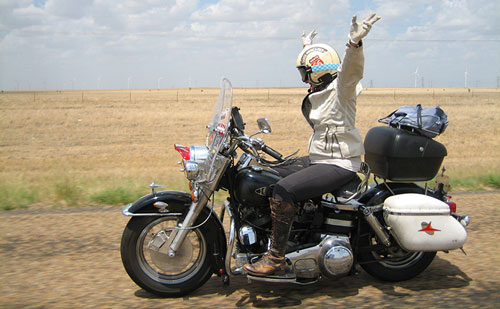
Popular motorcycling back roads, says Karan “Kay” Andrea, often run parallel to other means of transportation. Some, like the historic Natchez Trace Parkway, cut through ancient animal migration paths. Others hug crumbling stretches of decommissioned roads. Her favorite back roads hug train tracks.
“It’s really cool to feel the rumble of my bike and the rumble of the train and all that power and motion,” she says. “I always say I love hearing trains because it means people are moving. There are still people doing stuff, even if I’m not doing anything.”
Photos, above and top, courtesy of Tricia Szulewski/WomenRidersNow.com.
From there, a hobby was born. Andrea got her motorcycle license. After some trial and error, she found a bike that felt like a good fit — a 2001 Harley-Davidson Dyna Super Glide. And she learned how to interpret her bike’s noises, a key skill when it comes to diagnosing mechanical issues.
Finding a solution for each new challenge and problem in her new hobby helped Andrea build confidence. Learning more about the sport is now helping her narrow the scope of her research.
But she began to see another type of problem. While women have a presence in motorcycling — the most recent estimates put the percentage of female bike owners around 20 percent — they have not always had many opportunities to connect with each other. If she could build a community for other women like her, she could help them develop confidence, too.
“I love that women who ride motorcycles are typically going to strike out on their own,” she says. “And sometimes they just need that support and push to figure it out and go, ‘Oh, I can diagnose my own stuff on my bike. I can talk to the dealer or to a mechanic or find the tools to fix it myself. I can do all these things.’”
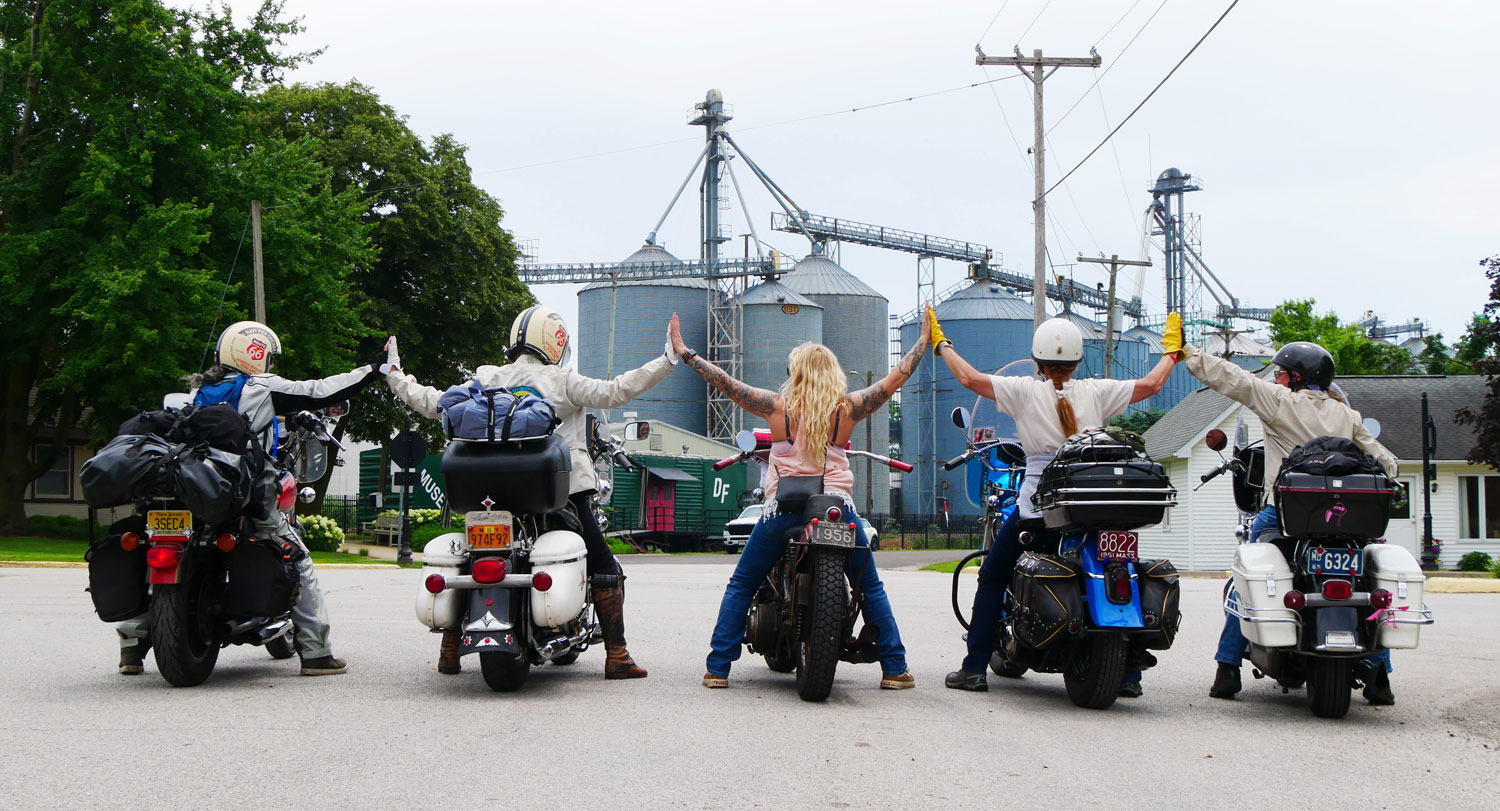
The solution came in 2021 when Andrea began organizing a 14-day women’s ride along Route 66, the historic American highway that runs from Chicago to Santa Monica. Planning the large-scale riding event as an individual would mean navigating insurance coverage on her own. She found an alternative option with the Antique Motorcycle Club of America. If she started what became the first woman-focused chapter within the AMCA, which Andrea was already a member of, she’d have the organization’s support. In 2021, the AMCA’s Riveter chapter was official. The ride, dubbed Chix on 66, took place the following year.
After kicking off from the Harley-Davidson headquarters in Milwaukee, the group burned a path past mid-century America’s towering roadside statues: the Gemini Giant, Buck Atom, the Golden Driller.
Some riders rode modern bikes and some rode vintage. Andrea, on her 1974 Harley-Davidson Electra Glide led the vintage group, which averaged about 35 miles per hour. Each morning, she mapped out their route, determining which stops they would have time for, if they had time to stop at all to hit their 200-mile daily average. Some days brought sweltering heat, others roaring rain.
“I’m very much looking forward to documenting women’s history correctly, because so much of motorcycle culture is them telling their own story because no one else has. The story that we get about motorcycle history is told from within the culture, and it’s not accurate.”
Then there were the complications that come with taking older motorcycles cross-country. Some bikes had shorter ranges between gas fill-ups, meaning Andrea had to keep careful track of their mileage. And even though two female mechanics were invited along for the trip to handle things that broke along the way — “I wanted women to see women working on bikes,” Andrea says — tire issues sidelined the group twice.
“Everybody was kind of figuring things out, and they were figuring themselves out, especially the ones who hadn’t done a trip like that,” she says. “That was in the beginning – Milwaukee, Chicago. By the end, they were different women. You don’t have a husband or boyfriend going, ‘Get out of the way, let me fix that for you.’ So there was a lot of growth.”
Last year, the timing was finally right for Andrea to pursue her Ph.D. Around the same, the Harley-Davidson Museum reached out with a request: Could she co-create an online exhibit about the Chix on 66 ride for a Google Arts and Culture project on Route 66?
Now, with the exhibit published and her doctoral program underway, she knows she won’t have as much time for riding or the Riveters. But her efforts to illuminate the mud-splattered, leather-clad women who rode before her have just begun.
“It’s about bringing motorcycle culture forward,” she says, “and telling women, ‘Hey, you’re part of something really cool, and it’s a lot bigger than just the Hells Angels or your local motorcycle club. It’s got a sustained history that goes back to the early 1900s.’ Giving women their legacy in the culture and in the sport, I think, is something I’m really looking forward to digging into because it hasn’t been done. It’s about time someone does it.”