If you grew up in the rural South, playing outside barefoot was a regular part of life. And before the widespread adoption of indoor plumbing, intestinal parasites were a regular part of life, too.
Hookworm, roundworm and similar parasites — also known as soil-transmitted helminths — are transmitted through fecal contamination. Helminth infections are medically important, as they can cause anemia, malnutrition, stunting and cognitive development problems. In the early 1900s, the hookworm infection rate across the South was as high as 40 percent. Today, helminth infections in the U.S. are considered eliminated thanks to improved sanitation conditions. But proving elimination is difficult; large-scale programs to monitor infection rates tapered off decades ago.
University of South Carolina researchers Dr. Melissa Nolan and Dr. Matthew Haldeman wondered if these worms might still be lingering under the radar in South Carolina. The two conducted a study last year to gauge the prevalence of one specific soil-transmitted helminth and better understand who is at risk. What they found surprised them.
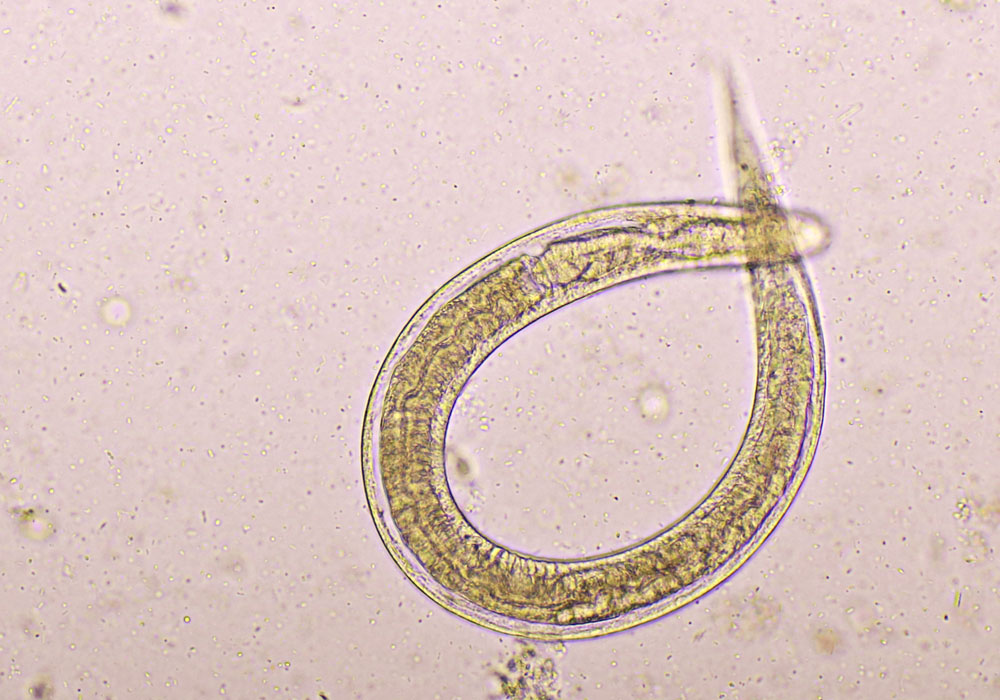
Nolan is an associate professor of epidemiology in the Arnold School of Public Health and director of USC’s Institute for Infectious Disease Translational Research. Haldeman is a clinical instructor at the School of Medicine Columbia and physician with Prisma Health. Their study focused on Strongyloides stercoralis, which can reproduce inside its host for years with few, if any, symptoms.
“Strongyloides is one of those parasites that can live pretty long term inside your body, and you would often not even know you have it,” Haldeman says.
In fact, many people — and even some physicians — are unfamiliar with Strongyloides or confuse it with other intestinal parasites, such as pinworms. If detected, the worm is treated with inexpensive antiparasitic drugs. But an active infection can be dangerous when people are prescribed immunosuppressant medications.
“The worst-case scenario is if you get put on an immunosuppressant drug, the worm’s life cycle and reproduction goes into hyperdrive,” Haldeman says. “Tens of thousands of larvae invade your tissues, and you can end up with Strongyloides hyperinfection syndrome, which can be deadly.”
Some people contract Strongyloides during international travel. Historically, clusters have also been observed in the Appalachian region, where wastewater treatment practices increase exposure risks.
“If you live in the country, you tend to have in-ground sewer tanks,” Nolan says. “Imagine when those get full. If you don’t have the money to replace that, or if you aren’t aware that your septic tank is full, it can seep up through the ground.” This, she explains, is a classic example of how people may unknowingly infect themselves and their families with Strongyloides parasites.
Phase I of the study involved a retrospective review of Prisma Health records. The team examined five years of medical charts to understand the demographics of patients who were tested for Strongyloides and calculated what percentage of those with clinical risk factors were positive.
In phase II, the team tested more than 1,500 frozen blood samples collected for previous research studies. Haldeman says he didn’t expect any to come back positive for antibodies — after all, Strongyloides is relatively rare — and was shocked when 78 did. Nolan suggested an additional phase: After notifying positive participants and offering treatment, the team would also request more demographic data and ask to perform a second, confirmation test.
“In some ways the study brought up more questions than answers, because this is not the classic Strongyloides patient you would expect. It really begs the questions: How did those people get it? What exposure did they have? And, honestly, we simply don’t know the answers to that yet.”
Ultimately, the study found that about 5 percent of South Carolina residents have antibodies indicating a current or recent Strongyloides infection. The Spartanburg area had the largest cluster of cases, suggesting the worms are still more prevalent in Appalachia, though smaller clusters were observed elsewhere across the state.
As many as 17 percent of people with clinical risk factors were, in fact, positive, according to the medical chart review. Interestingly, most of these patients reported no recent travel, meaning it’s possible they acquired the worms from gardening, working outdoors or other local exposure incidents.
Of the phase II respondents who agreed to a second test, nearly one-fifth still had active infections. And though this group was likely too small to reflect statewide trends, Haldeman was surprised that many participants did not live in a rural area or have a low household income, things once considered classic risk factors.
“In some ways the study brought up more questions than answers, because this is not the classic Strongyloides patient you would expect,” Haldeman says. “It really begs the questions: How did those people get it? What exposure did they have? And, honestly, we simply don’t know the answers to that yet.”
More research is needed, but Nolan and Haldeman believe these findings are an important step toward updating public health guidance to protect those most at risk.
“We are both really passionate about trying to elevate the care for our most vulnerable populations in South Carolina,” Nolan says. “This is one of those diseases that has historically always been here but has been somewhat neglected from public health and medical attention. But the great thing about it is there’s a really cheap and easy treatment. Focusing on this can directly impact patients.”