TRANSCRIPT
Chris Horn: “No doubt you’re familiar with the expression, ‘The only constant in life is change.’ Today, on Remembering the Days, we’re catching up with a former administrator at the University of South Carolina whose career at the university began in the early 1980s and ended in retirement in the early 2020s — a 40-year tenure that made him the longest-serving vice president for student affairs in USC history and a career that could be a case study on how to manage change over several decades.
Remembering the Days co-host Evan Faulkenbury and I sat down recently for a chat with Dennis Pruitt, who was responsible for admissions, student counseling and health, student life, academic integrity, student activities and myriad other programs aimed at helping USC students succeed academically, stay in school and complete their degrees and achieve personal growth and development.”
Evan Faulkenbury: “As Dennis shared with us just before he retired in 2022, when you think about all the things that go on at college campuses — all the things that students do — the position of vice president for student affairs can become a lightning rod. It’s why most student affairs VPs across the nation last only a few years in that role.
Let’s find out how Dennis Pruitt not only survived as VP for student affairs for so long but more importantly helped the university and its students — from yesterday’s Baby Boomers to today’s Gen Zers — succeed and thrive.”
Chris Horn: “To be a VP for student affairs, you've got to have your finger on the pulse of the students, not from five years ago or even two years ago, but the students who are enrolled now. How did you do that for 40-plus years?”
Dennis Pruitt: “In admissions, the whole business is understanding the clientele. And people didn’t like to talk about students as clientele. They didn’t like to talk about them as customers. But when families are paying $60,000 a year for their students to come to college, including, you know, room, board, everything, they become clients, they become customers. And so you have to understand them. You have to understand their needs and wants and wishes and expectations. I had one real secret advantage that nobody ever knew. For 25 years, I taught a class in the College of Education and higher ed program called Trends and Issues in Higher Education.
“So every semester I had 20 eager master students. And they were each assigned a trend. And they were each assigned a state to do analysis of. And their final paper in the class was an analysis of their trend and their state. And so I had these researchers out looking across the country, gathering information about everything we could about what the students’ needs, wants, expectations were, what the parents’ needs, wants, wishes, expectations were. And it really worked well. I mean, it really gave us a lot of information. But the second thing we had, we were always looking for the next big thing.
“Having that foundation data about who our students were, where they came from, looking at the big picture, what the analysis was going on about what students were thinking about and what their wants were compared to their needs. It really gave us a good opportunity to try to create an environment where what the students needed we provided, and things that detracted from learning we tried to eliminate.”
Evan Faulkenbury: “You've been here at USC since the early 1980s, all in all, up to the early 2020s. So four-plus decades. And earlier, before we started recording, you talked about how you visited over 400 other universities or colleges to consult or to provide guidance for student affairs or that kind of thing. So I’m just wondering, what do you say, kind of looking back on your time here, what's unique about the University of South Carolina compared to so many other places, and a place you know intimately, but is there anything distinctive, or is USC just kind of one among many as higher education has evolved in the last half century?”
Dennis Pruitt: “We were always looking for the next big thing and weren't afraid to try things. We weren't afraid to fail. Luckily, we were in an environment where after we had some successes, we gained a little credibility. So the board and the president and provost and others would give a little leeway. I used to tell our staff, ‘We can fail once, we’re fine. We fail twice? I said, you know, we’re all looking for jobs!” So we practiced good risk management, but we usually did things experimentally on a very small scale. And then if they were successful, we took them to a wider scale.
“Well, 1992, we got in the SEC, and one of my tasks for the Board of Trustees was to do an analysis of the University of South Carolina, what we looked like. And so I did an analysis of the University of South Carolina in 1992 compared to 1953, to show how much we had progressed, how much we’d changed, how much we’d grown. And it was really invigorating and exciting, and the board was thrilled about it. And then I did an analysis of the University of South Carolina from the day we got out of the ACC, and included in that was an analysis of comparing us to all the other SEC institutions,
“And so I did this analysis, and I said, ‘You wanted me to show how we compete with other SEC institutions. We don’t compete. We don’t even compare.’ And the truth of the matter was, in 1992, you looked at us by every data point, whether it was faculty salaries, number of faculty, faculty ratio, whether it was research, whether it was foundation amounts, every, you know, quality of the freshman class, every data point you looked at, we were completely out of sync with almost everybody but Arkansas and Mississippi.
“There was a moment there where we had to stop and say, ‘What are we going to do? How are we going to get there?’ And to the board’s credit, they said, ‘We got to recruit better students. If you recruit good students, better students will come.’ We’ve got to recruit better students. We have to have a wider base, it can't just be South Carolina.
“We’ve got to have students that leave here successful, so we've got to have a scholarship program that attracts them. Then we have to have a scholarship program that will help students once they leave the university to get postdoctoral scholarships and awards.
“We’re going to have better residence halls. We’re going to have better undergraduate programs. We’re getting better activities. We’re going to have a Greek village.
“So we really beefed up the admissions office. We really beefed up our scholarship program. It did wonders for us and it really made a difference. But there was tension on the board between having more students and having better students. And some wanted us to be small and elite, and others wanted us to serve South Carolinians and the region and the world. And so we had to have a combination of both.
“Early on, the size of your freshman class, the quality of your freshman class, what they looked like SAT-wise was important. Now nobody cares what the entry looks like. It’s how many do you graduate? What kind of salary do they make? How much? What's their employment? Are they good citizens? Do they contribute to the quality of life of others? Those output functions are more important. We were early adopters of all those things with the graduation with distinction program, Beyond the Classroom Matters....
“We, early on, convinced the faculty and others in the university administration that a student’s only in the classroom about 20 percent — 15 to 20 percent — of the time. They’re here the rest of their lives in college, 85 percent of the time is outside the classroom. So how they structure and use that time beyond the classroom is magical in terms of the joy they receive from their degree. And we created this expectation that not only are you going to do the stuff in the classroom, you’re going to do this stuff outside the classroom. One of our earliest surveys we did on graduating seniors after we started this Beyond the Classroom, which was our quality improvement plan for our accreditation, one of the earliest analyses we did is we asked graduating seniors if you had to change one thing about yourself, what would you change about your experience? If you were going to give freshmen advice, what would you do? And repeatedly, people were saying the same thing in different ways, but they were saying the same thing: ‘I wish I had taken greater advantage of the opportunities presented to me.’
“So we started telling freshmen that, you know, when you’re a senior, if you leave here and you say, ‘I wish I’d taken greater advantage of the opportunities presented to me,’ you will have failed and we will have failed. And neither one of us want to fail. So let’s change that.”
Chris Horn: “I would think one of the challenges would be how much students change over time. You can’t keep thinking, ‘This will work with the students.’ Well, it worked, you know, 10 years ago, but you saw several generations of students during your career.”
Dennis Pruitt: “In a lot of ways, the students in the earliest days I was here are the same as they are now. They have some of the same basic needs. And so if you build on those basic needs — and they all, you know, they all have a need for affiliation, they all have a need for validation. And this is the same, true back then, they all have a need, really, for help and assistance. They won’t tell you that a lot of times, but they’re all seeking it. That’s why when they have a favorite professor, it’s because of somebody who talked to them and helped them work through something, or a counselor or a secretary, you know, they want that kind of — not that they didn’t it get from their parents, but here they are on their own. They need that kind of support.”
Chris Horn: “Dennis, how did you get into student affairs work? I’m guessing when you were 15, you didn’t think, ‘I want to grow up to be a VP for student affairs.’”
Dennis Pruitt: “No, no. I went to a small college that doesn’t exist now: Armstrong State College in Savannah, Georgia. But I didn’t go there to get an education. I went there to play basketball and baseball. I was a college athlete. I learned a lot of valuable lessons as a college student. One of them was — I was the president of student body my senior year — and my senior year I thought I was going to play professional baseball, and it didn’t work out.
And I was unemployed. And the president of the university called me and said, ‘What are you going to do?’ And I said, ‘Well, obviously I’m not going to play professional baseball, so I got to find something to do.’ And I had a degree in political science and history. And he said, “Well, listen, Joe Buck, who is the dean of students, is getting ready to go to University of Georgia on sabbatical. Why don’t you come and be the interim director of student activities and orientation for the nine months he’s gone?” And I had nothing to do. And I said, yeah. He said, “We’ll pay you $6,000.” And I was like, I’m in.
“Well, Joe Buck went and got his Ph.D., came back, and when he came back, they decided to promote him to vice president and let me be the dean of students, so to speak, director of student activities really is what it was. But it was a full-time job, and that’s how I got into it. And then Joe was a good mentor, and he said, “Look, you got to have a master’s degree in this business. At least you can’t just have an undergraduate degree. So I went to West Georgia, and I got a degree in counseling and human development.
“So I got my master’s degree, and he said, ‘Well, you know, you can’t just survive in this field with the master’s degree, you start working on a Ph.D.’”
Evan Faulkenbury: “So Dennis Pruitt, the would-be professional baseball player, began work on a doctoral degree, a journey that would bring him to the University of South Carolina, where he finished all of his coursework for a Ph.D. in higher education administration — but not the dissertation to actually complete the degree. A few years later, in 1982, he was named vice president for student affairs at USC.
Fast forward 12 years, and John Palms is the president of USC. He asks Dennis why he hasn’t completed his Ph.D. and says, “Take a six-month sabbatical and get it done.” So Dennis wrote and defended his dissertation, got the degree … and President Palms presented him with yet another challenge.”
Dennis Pruitt: “He said, ‘Congratulations.’ He says, ‘Welcome to the world — to the guild — of scholars.’ He said, ‘Do you know what your next task is?’ And I said, ‘No, sir. What is that?’ He said now you’ve got to become an intellectual. And he said it was a big difference between being a scholar and an intellectual. And I’m thinking to myself, ‘Here is this magic moment in my life, I finished my degree, and he’s saying it’s not enough, you got to go back and do more.’ But the lesson sunk in with me. You’ve got to be a lifelong learner. You got to continue to bring it all in. And so I did.
Chris Horn: “Dennis Pruitt was and still is a person driven by curiosity. When he discovers something new, his first question is ‘Why didn’t I know that?’ or ‘How come I’m just now learning this?’
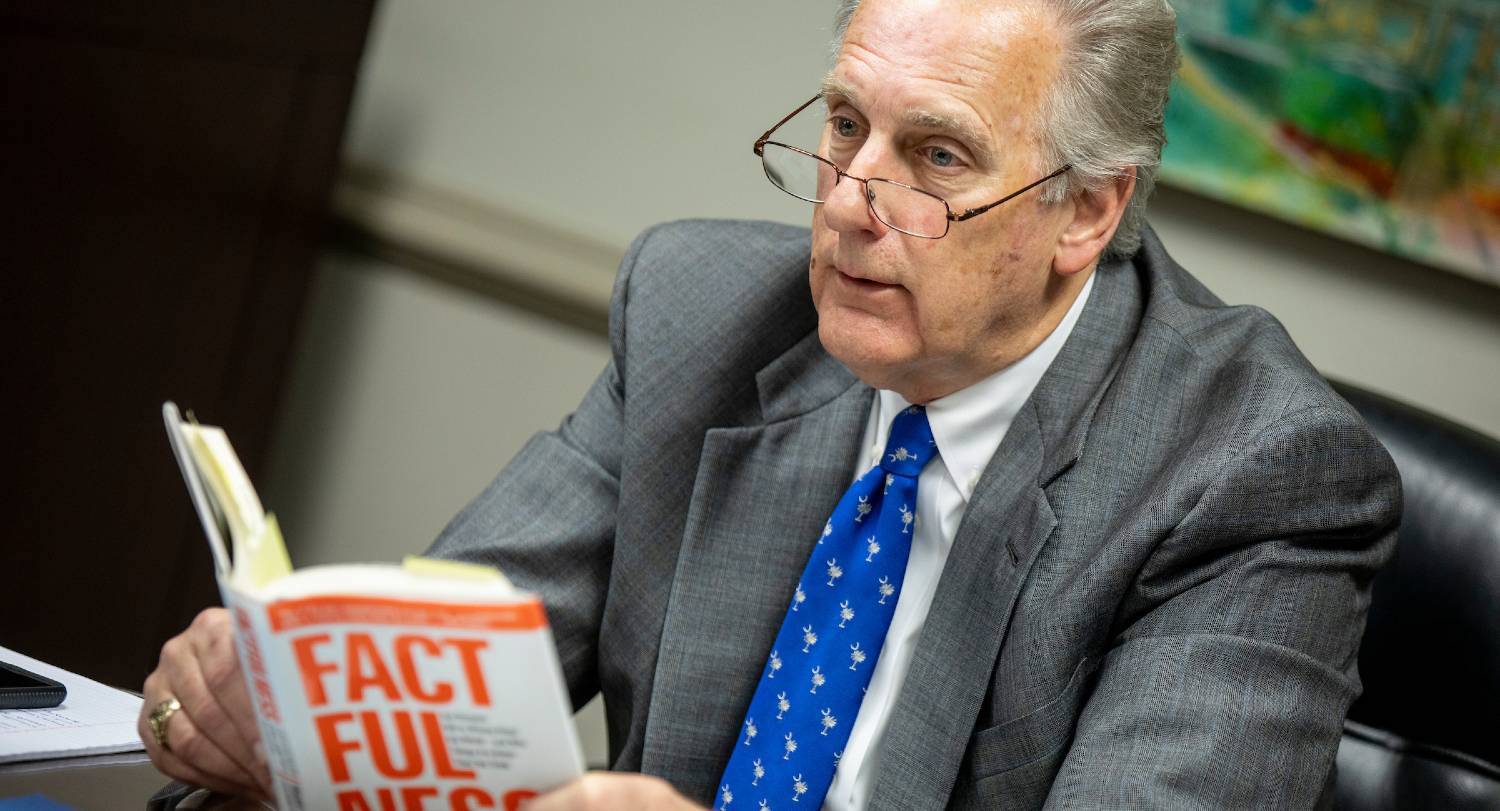
During his career at USC, he was a voracious reader of books that focused on trends in higher education, especially those that examined how college students were changing. In 2000, one of the first big books about the millennial generation was published — the title was Millennials Rising: The Next Generation, and Dennis invited the authors to USC for a seminar. The things that Division of Student Affairs staff learned about millennials led to new student programs.
Dennis’ penchant for staying well-read led to an informal “What Dennis Is Reading” seminar that kept USC student affairs staff up to speed on higher education trends and encouraged them to think about the next big thing.”
Chris Horn: “Dennis, you know, understand, the landscape of higher education. What counsel would you offer in terms of not just finding the place that has the degree that you want but thinking about the whole college experience thing.”
Dennis Pruitt: “The decision to go to college is the first time in many cases where a parent tells their student no, because a lot of times the student wants to go to an institution that’s too expensive. It’s out of state. It’s in Hawaii. They’re going there because their boyfriend’s going there, their girlfriend’s going there, their partner’s going there, you know, whatever. And so it’s the first time a parent tells their student no. And that’s very hard for a student to manage.
“It does have to be the student’s decision where they go. But if they make the wrong decision, it’s costly because most students, when they go to a college, the very first place they go as a freshman is where they get their best financial aid package because institutions are incentivizing students to come to their institution by providing them aid. And if you keep that aid for four years, it’s a good deal. If you lose it and you go to another institution, you’re on your own. You’re financing that education on your own in a lot of ways. So it’s a very costly decision if you don’t succeed, if you lose your scholarship or lose your aid, or if you decide to transfer to another institution.
“Too many parents are bankrupting themselves — I’ve seen this with friends — bankrupting themselves to send their kids to college, second mortgaging their house, taking out of their retirement funds. Even if the student assumes a little bit of debt, you’ve got to get them out on their own. They’ve got to make the decision, but you’ve got to help them make the decision that’s financially sound.”
Evan Faulkenbury: “You think about what students can experience here at Carolina, beyond just going to class and getting their degree. You know, like you said, 85 or 90 percent is outside of classes. And so you think about going to Gamecock games, or going to the Tiger Burn, or getting involved in clubs and activities on campus or volunteering across Columbia or the state. Could you pretend to be just one of those university ambassadors for a moment? Taking prospective families — they got their stickers on their shirts of the Gamecock — and could you be a university ambassador for just a minute and not lead us on an hour and a half tour, but kind of a quick sell? Pretend me and Chris are prospective students here. Why should we choose Carolina over some other school in the country?”
Dennis Pruitt: “One of the things we always try to teach our tour guides in our ambassadors and our faculty is that we don’t want to oversell the University of South Carolina. The University of South Carolina has tremendous merits, but we want to give personal experiences that we have had, and those personal experiences that we have had will demonstrate the value-added education. That's the term we use.
“The things that these students have learned, and the personal experiences they can share, and the affiliations they’ve made, the friendships they’ve made, the love they have for their institution, the bigger picture about the world they understand, the exposure they’ve had ... that’s what sells the University of South Carolina. That’s what sells any institution. But having somebody endorse an institution through the experiences they’ve had, through the value-added education they've had, through the ability to make friends and to be happy. When I talk to parents, I ask them, ‘What do you want for your child’s education? What’s the one most important thing?’ The first thing they always say is, ‘I want them off the payroll. I want them to be employable.’ But they always say that facetiously. I always say, ‘What do you want?’
And they say, ‘I just want my child to be happy. I want them to be happy. If they’re happy, I’m happy.’ And when you have an ambassador, or an admissions counselor or faculty member talk about what a wonderful experience they’re having at the University of South Carolina and how happy they are, and they radiate it and they believe it, and it’s authentic, and it’s not made up, and it’s not because you’re disparaging somebody else and you’re just building up the experience we have here, it works wonders. It creates magic.”
Chris Horn: “So there you have it — a 40-plus-year career summarized in about 15 minutes. Seriously, I hope you enjoyed this episode. It’s part of our effort to tell the more recent history of USC through individuals who played a major role in shaping the institution over the past few decades.
On the next episode of Remembering the Days, we’re going back briefly to the 1960s when USC was dramatically expanding the size of its campus — and making some people angry in the process. One of those enemies ultimately became a friend, and that’s what our story will focus on. Next on Remembering the Days.”