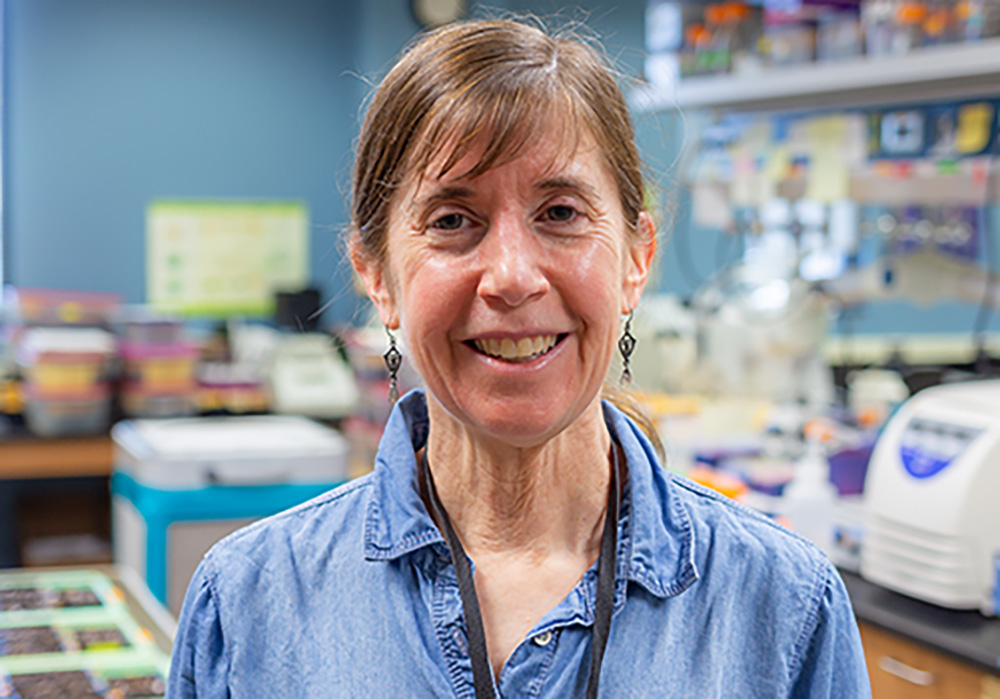
Award-winning USC professor Beth Krizek, whose research in plant biology holds the potential to transform agriculture production, has been named an American Association for the Advancement of Science Honorary Fellow for 2025.
AAAS Fellows are elected annually for their extraordinary achievements in science. It is a lifetime honor.
“I'm thrilled and honored to be elected an AAAS fellow, as it is peer recognition of the significance of my work on transcription factors regulating floral organogenesis,” Krizek says.
Krizek’s research explores how transcription factors determine the destiny of cells in the plant Arabidopsis thaliana, commonly called the thale cress, a member of the mustard family that produces small flowers with four white petals.
I really enjoy the puzzle-solving aspect of scientific research.
Because plant cells with the same DNA use genes differently, they can develop into different organs of varying sizes, producing various quantities of fruit. This has significant implications for one day alleviating world hunger.
“This year’s AAAS Fellows have demonstrated research excellence, made notable contributions to advance science and delivered important services to their communities,” says the organization’s Chief Executive Officer Sudip S. Parikh. “These Fellows and their accomplishments validate the importance of investing in science and technology for the benefit of all.”
Known for her easy rapport with students, Krizek is determined to ensure they fully understand the empirical research process and, step-by-step, how conclusions are drawn from the data.
If students aren’t engaged, they focus simply on memorizing information, rather than logically examining and interpreting it. Krizek feels it’s extremely important that students use their critical thinking skills.
“I really enjoy the puzzle-solving aspect of scientific research,” she says. “I love designing and carrying out experiments, observing novel phenotypes in mutants and transgenic plants, and putting experimental data together to reveal new insights about plant development.”