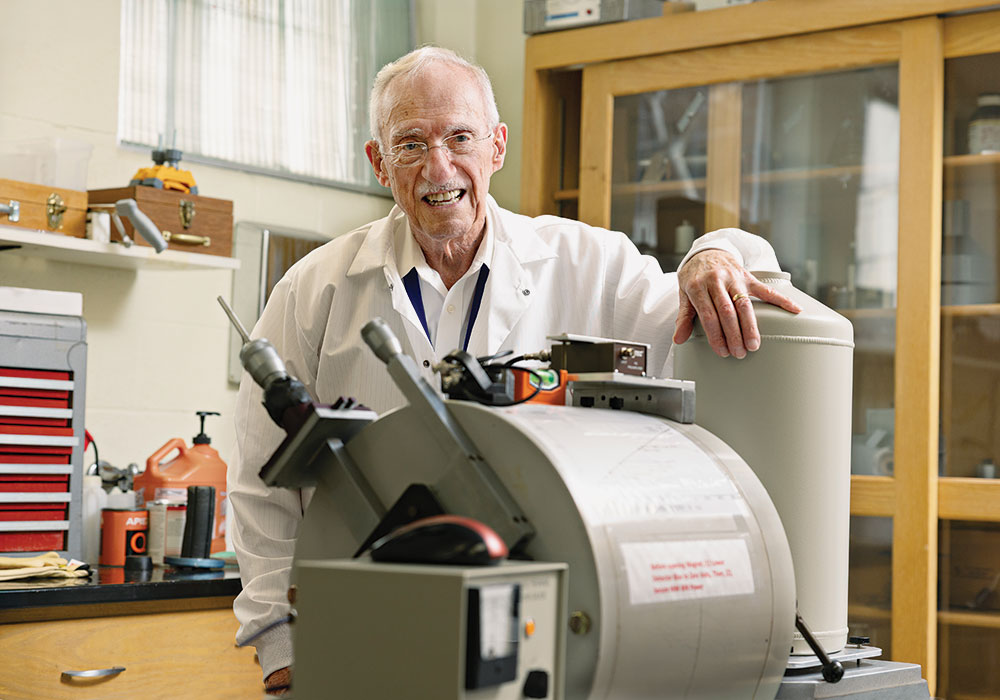
Frank Avignone has been fascinated by physics longer than most people have been alive, an intense curiosity that began in the waning days of World War II.
Now, more than six decades after being recruited to the faculty of USC’s Department of Physics and Astronomy, Avignone continues to conduct particle physics research with renowned scholars, some of them at international laboratories he helped build decades ago.
His current venture involves searching for the heavy neutrino, a hypothetical elementary particle whose existence would go a long way toward explaining the asymmetrical balance of matter and antimatter in the universe. If that sounds incomprehensible, take heart — this is Einstein-level science.
“I think this experiment is the last hurrah for me, probably the end of my career,” Avignone says, though it’s probably best not to interpret that statement to mean that USC’s most senior physicist, who turns 93 in May, is getting ready to retire. Physics experiments of this scale and complexity can take years to complete. Physics is a discipline that favors the long game, and Avignone’s career is a testament to that.
The genesis of Avignone’s interest in physics was sparked by two events — big bangs, if you will — that occurred when he was in middle school. The first was an actual bang, the cataclysmic detonation of atomic bombs over Japan that ended World War II in August 1945. Then, early in 1946, U.S. Army scientists used the new technology of radar to calculate the distance from Earth to the moon. Avignone read about both events in a physics magazine because, yes, he was already keeping up with scientific literature.
Graduating high school in 1951 and having lived six miles from the ocean on Long Island, New York, Avignone briefly envisioned a life at sea. He applied to the Merchant Marine Academy but was told he’d have to wait a year. He enlisted in the Navy instead, serving on the USS Hawkins in the Gulf of Tonkin during the Korean War, then took his G.I. Bill to Georgia Tech, where he majored in physics.
“The physics department at USC back then was classical, and most of the people were just teaching classes that served the engineering school and whoever else needed physics. (Tom) Jones wanted real research, and several of us were recruited for that purpose.”
“Georgia Tech was not a place where you went out for a couple of beers after class. It was a place where you study, study, study or you disappear,” Avignone recalls. “Being married already and not having money to do any social things, I had no trouble with discipline.”
Fast-forward to 1964 when Avignone was wrapping up a Ph.D. in physics at Georgia Tech, and Ed Lerner, USC’s physics department chairman, came calling. USC’s president at the time, Tom Jones, was on a mission to transform Carolina into a research university, and physics was earmarked for new resources.
“The physics department at USC back then was classical, and most of the people were just teaching classes that served the engineering school and whoever else needed physics,” Avignone says. “Jones wanted real research, and several of us were recruited for that purpose.”
Avignone might have been a little too eager to get started, reporting for duty at Carolina on Jan. 1, 1965, and finding an empty campus. Lerner, the department chair who had recruited him, reminded the new assistant professor that it was, after all, New Year’s Day. “But my contract starts on New Year’s Day,” Avignone replied.
President Jones took a liking to the energetic new faculty member and found funding for a special instrument needed for Avignone’s first physics experiments. When the direction of his research shifted, Avignone had technicians carefully pack the device away for safekeeping — a wise move considering that 50 years later he was able to retool it for another series of experiments. In a nod of appreciation, Avignone attached a sign to the device that reads Thomas F. Jones Memorial Electron Spectrometer.
Avignone’s early career at USC included scholarly collaborations that would serve him well for decades to come, including stints as a visiting professor at the International Centre for Theoretical Physics in Trieste, Italy, and as a visiting scientist at Oak Ridge National Laboratory in Tennessee. He also served on international scientific committees that oversaw construction of premier physical science laboratories in Spain, Italy and Argentina.
For 19 years, Avignone was chair of USC’s physics and astronomy department, advocating for the department’s budget while recruiting new faculty members, teaching courses and, of course, maintaining his own robust research agenda. He also served 27 years in the U.S. Naval Reserve, retiring at the rank of captain at about the same time he stepped down as department chair.
He had been at Carolina for 33 years at that point and finally was ready to focus exclusively on research. When Mary, his wife of 50 years, passed away in 2005, research kept him going. Now more than 20 years later, he is remarried and still retains his title as Carolina Endowed Professor of Physics and Astronomy.
What’s the secret behind the longevity of Avignone’s scientific career? His explanation doesn’t require an understanding of quantum physics.
“A lot of scientists don’t keep up — they’ve done their best research 20 years ago, and they get to the end of it and it’s not interesting anymore,” he says. “Whenever I found myself in that situation, I would kick it away, do something new. Sometimes I would wake up in the morning and say to myself, ‘What the hell are you doing? You need to find something else.’”