One day during the second semester of Todd Herman’s junior year at James Madison University, the classroom went dark. His professor clicked a remote. The slide carousel shimmied, and a series of images beamed onto the screen behind her. The Parthenon. The Colosseum. The Venus de Milo. The Sistine Chapel.
For an art history major, this was business as usual. For a biology major who took the survey course as an elective, it was a game changer.
“They turned the lights out, put the slides up, and it was like, ‘Oh my God, where has this been my entire life?’” says Herman, now CEO and president of Charlotte’s Mint Museum. “When I started seeing all these great works of architecture and sculpture, it opened up so many windows and knocked down so many walls that I just wanted to know more.”
The York, Pennsylvania, native took more art history electives and eventually had a second major. He landed a job in a genetics lab at Johns Hopkins in Baltimore after graduation, but lab work proved unfulfilling, so he reached out to his former art history advisor about graduate programs.
“She said, ‘Well, have you thought about the University of South Carolina? Randy Mack is there. He’s a great scholar of Renaissance architecture,’ which is what I was interested in. ‘You need to apply, and you need to go see him,’ so I did, and she was right on all counts.”
Herman arrived in Columbia in 1993, and Mack — Dr. Charles Randall Mack, renowned Italian Renaissance scholar — became his mentor. “I couldn’t have asked for a better person,” says Herman. “Great teacher, great advisor, great supporter, great scholar. All of the things that you want when you get to grad school.”
And it wasn’t just Mack. Leaning back in his chair, Herman describes a small graduate program in a small department. The program ended at the master’s level. If you wanted a Ph.D., you had to move on.
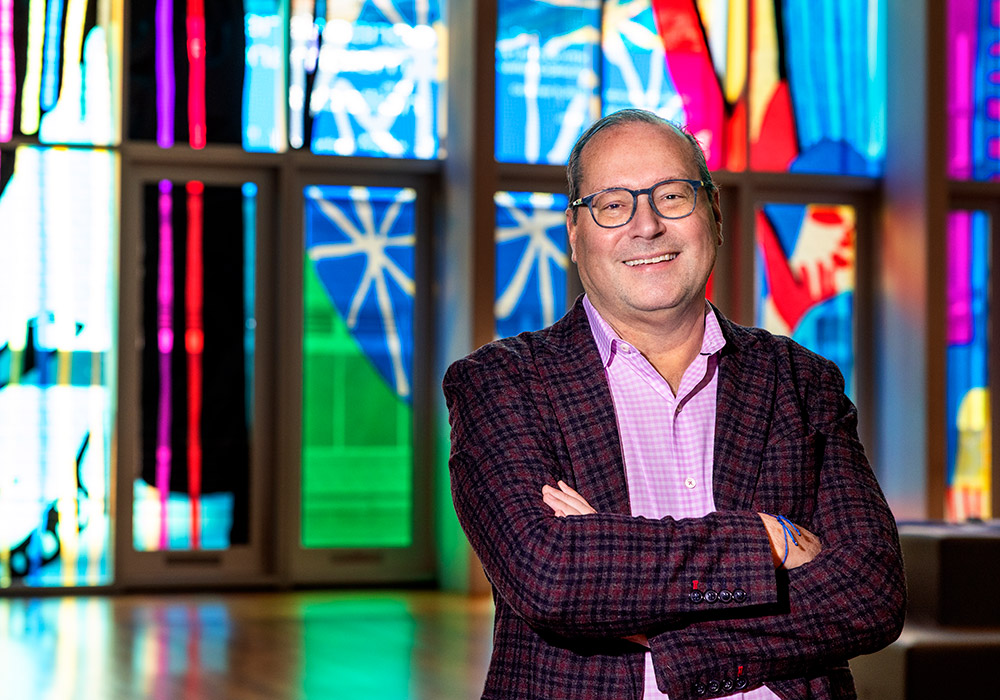
Todd Herman wanted to be an architectural historian. His graduate advisor at USC gave him a broader canvas.
But you got what you paid for and then some. Whereas some big-name scholars at larger programs taught light course loads and kept lighter office hours, the equally accomplished faculty walking the halls at USC’s Sloan College were there when you needed them, whether for a thesis conference or just to chat. They taught full loads. They had grad student get-togethers in their homes.
“One of the things I really cherish about my time at South Carolina was that all of the professors — from Beverley Heisner to John Bryan to Brad Collins to Randy Mack to Annie-Paul Quinsac — every one of those people was interested in helping the students,” says Herman. “It was very much a supportive atmosphere, almost like a family, and that was what I needed at the time because I still wasn’t sure how this was going to manifest into anything productive.”
As an undergrad he had fallen in love with Renaissance architecture, and his coursework at USC built on that. But he hadn’t thought long term. He hadn’t considered how grad school would set his course going forward.
Mack cut to the chase. He didn’t ask what Herman wanted to do for a thesis; he asked what he wanted to do for a career. And when Herman waffled — “I said, ‘I don’t know, maybe I’ll teach at a university, maybe I’ll work at a museum’” — Mack stopped him.
With a few exceptions, his advisor explained, museums didn’t employ architectural historians. And when it came to teaching, the bigger programs were churning out more than the market could bear.
“He said, ‘I would ask you to consider something a little more flexible. Would you consider a subject in Renaissance painting? That way, museums are open to you. Galleries are open to you. You could work at Christie’s or Sotheby’s in addition to teaching, if that’s what you want to do.’ That was extremely good advice and extremely important.”
On that advice, Herman elected to study an oil painting by 16th-century Venetian painter Bonifazio de’ Pitati. The painting was in the Samuel H. Kress Collection at the Columbia Museum of Art, which made it accessible, and very little had been written about it, which made it exciting.
The thesis became the springboard for a dissertation at Case Western Reserve. The dissertation became the springboard for everything else. After curatorial positions at the Cleveland Museum of Art and the Columbia Museum of Art, he was named executive director of the Arkansas Arts Center, where he guided the institution to financial stability, expanded programming and oversaw a $100 million renovation and expansion.
And then it was back to the Carolinas. In 2018 Herman was named CEO and president of the Mint, where he oversees an operating budget of $10 million and a full-time staff of 50-plus.
He also keeps a toe in the world of scholarship. He curated the museum’s “Renaissance, Romanticism and Rebellion” exhibition in 2025 and “Caravaggio I Revolution” in 2026. “Becoming Mark Rothko,” another of his babies, opens in 2028. He writes an essay or the introduction for pretty much any exhibition catalogue the Mint puts out.
But he spends the bulk of his time positioning the Mint for what’s next. As his old USC advisor Randy Mack might have counseled, he’s broadening his horizons, thinking ahead.
“My charge is figuring out how this museum stays viable and grows for the next 50-100 years,” he says. “My job is obviously taking care of the present but also making decisions that make future needs easier to attain.”