A dog missing its right front leg happily moving around a classroom and getting sized for a prosthetic leg at a meeting of the student group called Hands On Prosthetic Engineering.
At the University of South Carolina, the future of engineering isn’t waiting for students after graduation. It is being created by them in their undergraduate years.
Hands on Prosthetic Engineering, better known as HOPE, is a student-run nonprofit organization that works to build prosthetic limbs at no cost for those in need. Until this semester, HOPE had only worked with human limbs, but this winter, they took on a new patient: 18-month-old pit bull Roo.
Roo was hit by a car and lost her front right leg. Following the accident, she was taken to Columbia Animal Shelter, where she stayed before being adopted by her current family.
By happenstance, this was the same family that junior public health student and HOPE member Ivy Langland dogsat for. She connected the two after Dan Walters, a junior mechanical engineering student and HOPE member, brought Langland to a HOPE meeting.
“Dan invited me to a few club meetings, and I saw that they had some projects going on. Eventually, we were looking for another project, and Dan proposed a leg for Roo,” Langland says.
About two weeks into the semester, the club reached out to Roo’s family and began coordinating the project with them. HOPE ensures that no one they are building prosthetics for has to pay for the service, and Roo was no different: club funds are covering all of her care.
The first step in working toward building Roo’s leg was a lot of research, says HOPE president Trinity Oglesby, a junior biomedical engineering student. Having only worked on human limbs before, the group had to start from square one to understand the difference in anatomy and how to gather measurements from Roo.
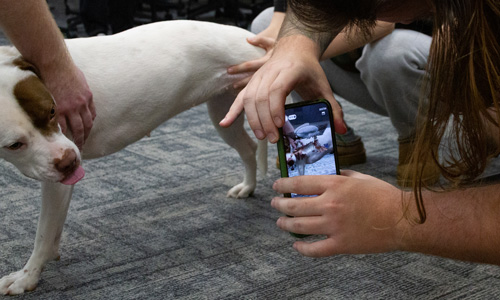
The leg will be composed of three main parts: the harness, which will wrap around Roo’s body; a carbon fiber rod, which will serve as the leg; and one of the most challenging components, the paw.
“We have about eight designs that we’re still working on for the paw to find out what is going to grip the best and what’s going to compress the best to lower the strain on her,” Oglesby says.
HOPE plans on having a prototype of Roo’s leg finished by the beginning of May. From there, the team will fit it to her and begin the testing phase.
While Roo is one of HOPE’s most unique patients, the club is no stranger to serving the community. Having previous partnerships with the Oliver Gospel mission to build prosthetics for the homeless and build swan rings to fix hyperextension issues in patients, the club has an impressive pedigree, considering the engineers behind the limbs and devices have yet to even graduate college.
Junior Honors College public health and neuroscience student Dharmik Namineni shares that HOPE has been a defining part of his experience at USC and has prepared him for med school and his career.
“Ultimately, the goal of this club, and I think even engineering and the overlap between engineering, public health and medicine, is that we’re all trying to serve the people that we’re trying to help, and we’re going to do our best and adjust as much as we can to improve their lives.”
Despite not being an engineering student, Namineni has become the vice president of HOPE and has helped to lead the club to new projects and recruit more students from across the university.
“USC really allows you to be interdisciplinary in a way that a lot of other places might not," Namineni says. “It’s easy to make connections in different fields and then to grow as a student in a way I honestly never thought I would coming into college.”
It’ll be a while before Roo has her new prosthetic limb, but the members of HOPE are confident in the process and looking forward to seeing a four-legged Roo running across the Horseshoe soon. Then it’s on to the next service project.