
Robots built by middle and high school students in the VEX Robotics camp at the University of South Carolina are amazingly agile, picking up objects and navigating obstacles.
Billed as an immersive opportunity to develop skills in programming, mechanical design and teamwork, the camp — now in its 20th year at USC — serves as a gateway to competitive robotics teams and, sometimes, to enrollment in USC’s Molinaroli College of Engineering and Computing.
For Nathanael Oliver, the camp was a pathway to both.
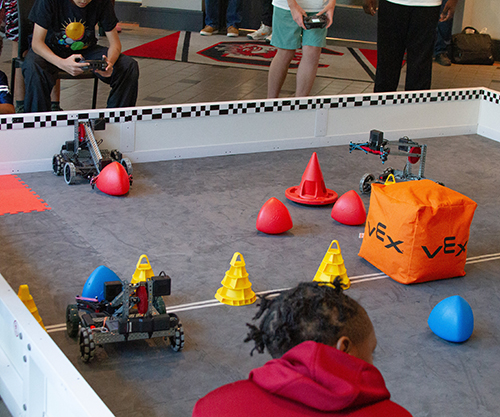
As a rising ninth grader, Oliver had grown up playing with Legos and Snap Circuits. So, building robots in 2015 at USC’s VEX Robotics Camp was a natural progression. When he started high school the next year, Oliver joined the robotics team.
“We made it to the state championship, and robotics became a big part of my social life — most of my friends were in that ecosystem,” Oliver says. “Then, in my sophomore year, we made it to the world championship, which was really exciting.”
Oliver had already learned a bit of computer coding in robotics competition, and computer science classes at Dutch Fork High School deepened his interest. He also took courses through Project Lead the Way, a partnership with the Molinaroli College that offers high school students STEM courses and college credit.
After graduation, he enrolled at USC, majoring in computer science. With robotics club friends from high school, he helped launch a VEX U robotics team in his sophomore year.
“We started the team in late February and ended up competing in the world championship in May,” he says.
Oliver’s team was operating on a compressed timeline. Normally, teams start thinking about designs and work through prototyping in spring of the previous year. Because the team had formed so late and was still figuring things out, “We got an award basically for how well we did considering the situation,” he says.
The club won another award the next year for its engineering notebook, a documentation of their design process and how they went about building the robot. In Oliver’s senior year, the team built its robot using a system he designed that coupled artificial intelligence and a camera to pick up objects and score them in a goal.
“That was a really fun project that I did in conjunction with one of my favorite courses at USC on neuromorphic and edge computing that’s all about running AI on a small computer instead of on massive servers,” says Oliver, who also interned with the college’s IT department. “We got an award for that project as well, so it was a really good way to end my senior year.”
Oliver completed his bachelor’s degree in 2024 and is currently tutoring high school and college students in mathematics and physics as he looks for a computer science position.
“If you are STEM-minded in general, trying something like robotics camp or a programming camp to gauge your interest is a super-low investment of time,” he says, “and you might find something that you really enjoy doing.”