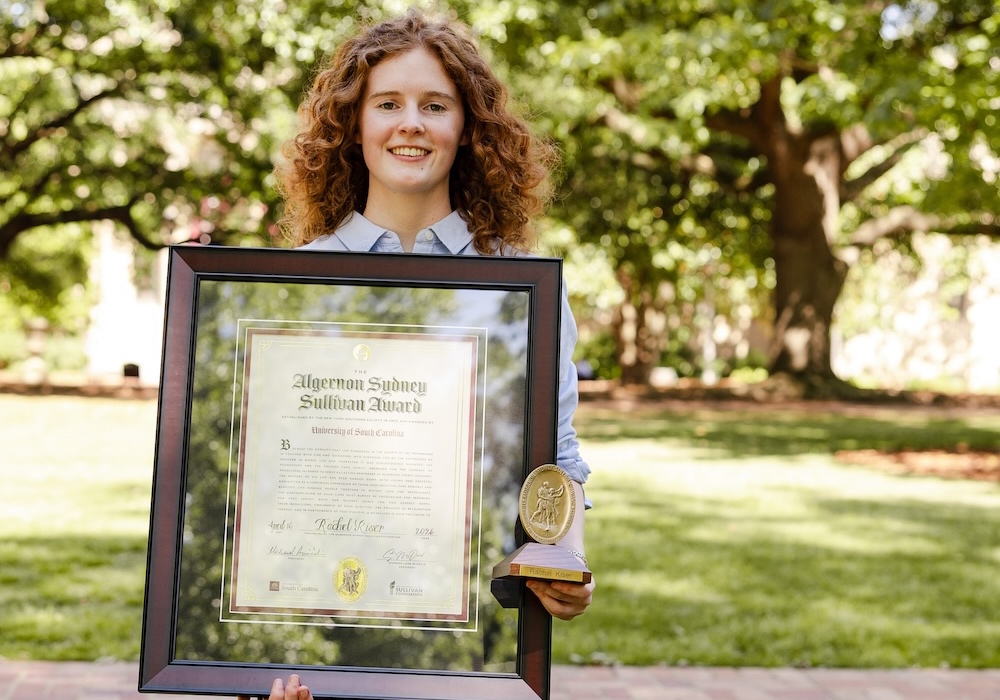
Rachel Kiser’s fascination with life began when she was eight years old running around her backyard catching lizards.
Her job — as she calls it — as a backyard lizard hunter required her to question the world around her and led her to continue to do the same once she arrived at the University of South Carolina.
Now, as her undergraduate time at USC is ending, Kiser was honored Thursday (April 16) as one of two winners of the Algernon Sydney Sullivan Award.
“My fascination for how life behaves and functions was channeled into exploring the world of biology around me as I knew it,” says Kiser, a biochemistry and molecular biology major in the McCausland College of Arts and Sciences. “My job as a young lizard-hunter required me to question the world around me, and I have continued my same curious perspective.”
The award, the university’s highest student honor, is a testament to the integral research and community outreach the South Carolina Honors College student did during her time on campus.
The senior from Charlotte, North Carolina worked with USC faculty member Lydia Matesic doing research focused on how the overexposure to certain proteins has been linked to heart failure.
“My time at the University of South Carolina has not only provided me with a platform to succeed academically and in research settings but has also allowed me to extend that academic success to others and has encouraged the spread of ethical scientific literacy across the country.”
She continued that research thanks in part to the Honors College Research Grant to better understand human heart health and the development of pharmaceuticals focused on protein interactions in the body.
Kiser has also held internships with the National Institute on Drug Abuse, studying how negative experiences can shape addictive behaviors, and with Boehringer Ingelheim Pharmaceuticals where she helped research the progression of Crohn’s Disease pulmonary fibrosis to better develop treatments for the diseases.
Some of her most integral work, though, has centered around paying it forward. Kiser serves as a supplemental instructor for the Student Success Center helping other students taking organic chemistry and calculus.
She also volunteers with the Chemistry Outreach Program, led by Linda Shimizu, traveling to local elementary, middle and high schools to teach students about the importance of studying chemistry.
“The most rewarding element of my education is using my knowledge to improve the success of others,” she says. “Although organic chemistry has an intimidating reputation, I teach with passion to foster a love for the subject with its unique and prevalent applications in all aspects of our lives. Both roles have had a significant influence in driving my future career path towards professorship, to continue serving students in their academic pathways and motivating their love for chemistry.”
Kiser will graduate with her undergraduate degree in May and plans to pursue a doctorate in organic chemistry, focusing on drug synthesis and development with the hopes of improving disease treatment.
“My time at the University of South Carolina has not only provided me with a platform to succeed academically and in research settings,” she says, “but has also allowed me to extend that academic success to others and has encouraged the spread of ethical scientific literacy across the country.”