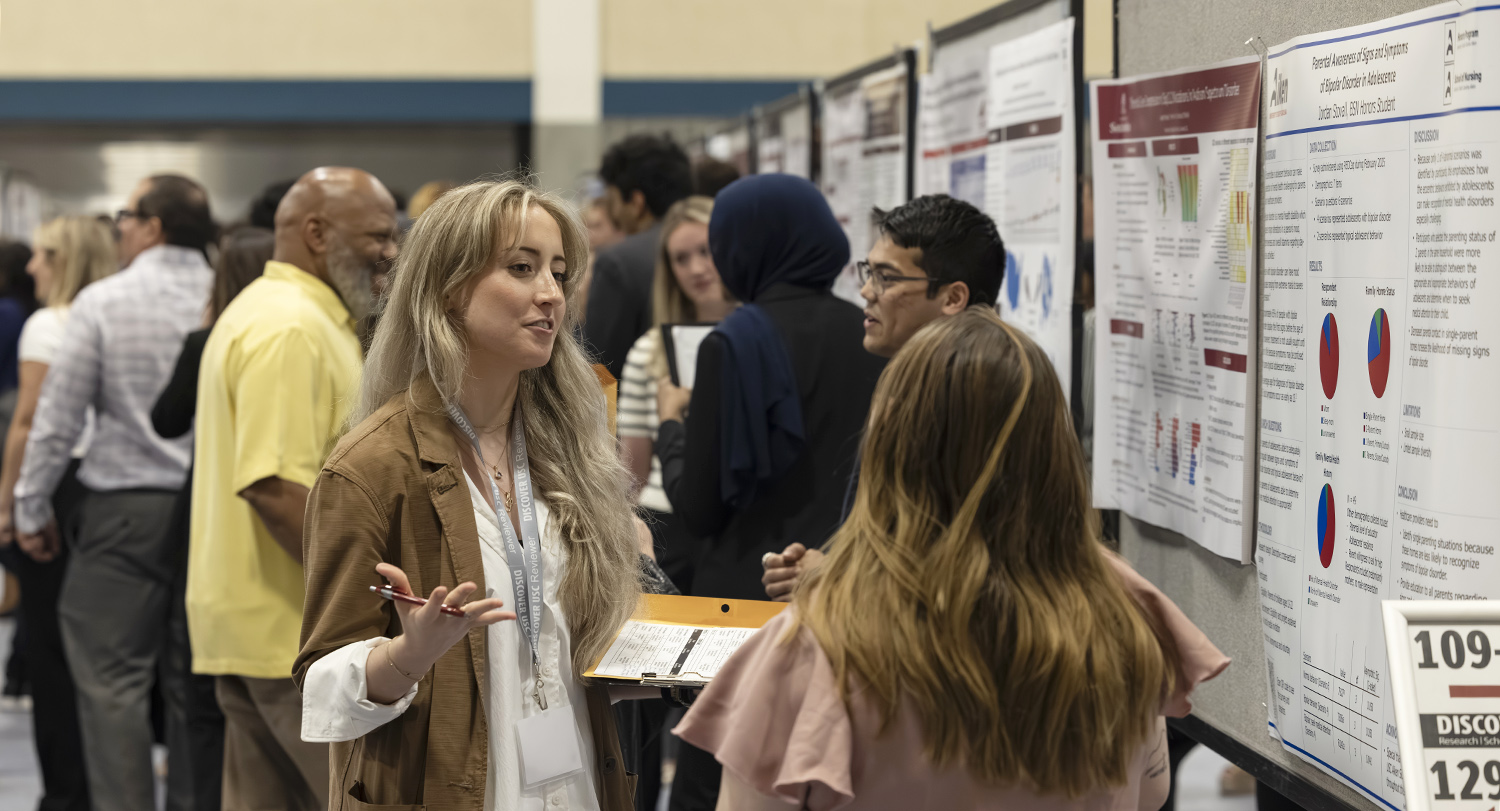
Every year, University of South Carolina students and scholars from a wide variety of backgrounds and academic disciplines come together to mark a milestone in their research journey — presenting at Discover USC.
Reading through descriptions of the 1,000-plus research projects featured annually at the event, it’s impossible not to be inspired by the passion behind projects, which range from psychology to education to public health. On each of those projects, USC scholars — including undergraduate and graduate students, medical scholars and postdocs — work with faculty mentors to learn more about research skills and work on how to present their findings to an audience.
Sponsored by the Office of the Vice President for Research, this year’s Discover USC research projects can be seen throughout the day at the Columbia Metropolitan Convention Center on Friday, April 24. There will be poster presentations at 9:30 a.m. and at 1 p.m. Shuttles will run between the Horseshoe (Sumter Street bus area) and the convention center from 8:30 a.m. to 3:30 p.m. Also, if you are still looking for that elusive selfie with Cocky, stop by between 10 and 11 a.m.
The following are highlights from a few participants’ projects, told in their own words.
Nick McCormick
Second-year medical student
School of Medicine Columbia
Research project: “Integration of Telehealth in Clinical Practice and Clinical Education: A Qualitative
Study of Athletic Trainers and Physicians”
Campus: USC Columbia
Hometown: Suwanee, Georgia
Inspiration: In medical school, we are strongly encouraged to participate in research, which has always been an area of interest for me. I have a strong interest in both education and sports medicine, so I knew I wanted to pursue research within those fields. An opportunity opened up to help Dr. Zachary Winkelmann and his team on their project, which allowed me to further explore my interests while also learning more about qualitative research.

Challenges: One of the biggest challenges we faced was finding health care providers willing to participate in our surveys and interviews. To overcome this, our team had to think creatively. We reached out through our personal and professional networks and also used social media platforms like Facebook, LinkedIn and X to connect with potential participants. Working together and sharing ideas helped us successfully recruit enough participants.
Lessons: One of the most valuable things I learned was the importance of qualitative research, which I wasn’t very familiar with before. Unlike quantitative research, qualitative research helps us understand the “how” and “why” behind people’s experiences and decisions. In the context of telehealth, this is especially important because it allows us to explore how providers actually use telehealth, the challenges they face and their perspectives on its effectiveness. These insights can help improve how telehealth is implemented, guide better training and ultimately enhance patient care and access.
Jasmine Feltenberger
Master’s Entry to Practice Nursing, second year
College of Nursing
Research project: “The Positive Impact of Using Young Adult Literature in the English Language Arts
Classroom”
Campus: USC Columbia
Hometown: Tylertown, Mississippi
Partners: Jada Pressley, Trinity Conyers
Inspiration: We were inspired to do this project because screen time has become a normal part of children’s daily lives. As a group, we noticed how often young children are exposed to phones, tablets and TVs, both in our personal lives and in clinical settings. This made us curious about how screen time might affect development, especially in areas like language, attention and social skills. As future nurses, we wanted to better understand this topic so we can educate families and promote healthy habits that support children’s growth and development.

Challenges: One challenge we faced was finding clear and consistent information about screen time. Some sources highlighted benefits, while others focused on negative effects, which made it difficult to determine what was most accurate. We worked together to review recent, reliable research and compare findings. Collaborating as a group helped us break down complex information into simpler ideas. Our instructors and course materials also guided us in focusing on the most important points and ensuring our explanations were easy for anyone to understand.
Lessons: We learned that excessive screen time in young children can impact development, including communication skills, attention span and social interactions. While some screen use can be beneficial when it is educational and supervised, balance is key. This is important because early childhood is a critical period for growth, and these early experiences can affect long-term development. As future nurses, this knowledge will help us educate families on healthy screen habits and support children in reaching their full developmental potential.
Carli Mendelow
Public health, senior
Arnold School of Public Health
Research project: “Driven West”
Campus: USC Columbia
Hometown: Cleveland, Ohio
Inspiration: During my senior year of high school, I visited Moab, Utah, and felt drawn to its landscape and community. I returned during my sophomore year of college with a purpose beyond vacation, driving 30 hours west with my father after independently securing a summer internship through outreach to local clinics. Having no prior connections, I built meaningful relationships with providers and became integrated into the community I served. By shadowing in a family medicine practice, I observed care across generations and diverse backgrounds. I often commuted over an hour alone to the Monticello clinic, driving through the desert each morning. This experience reinforced that healing requires meeting patients where they are and honoring their values, even when they differ from our own.
Challenges: Initially, it was very hard for me to be away from my family for so long, let alone across the country. However, I quickly created a bond with the staff at the clinic and my attending physicians that made it feel like home. Also, being in a new place with a new culture in itself is something to get used to. Because I value the differences we as humans have, I was able to get comfortable with the uncomfortable and learn how to speak to populations different than my own. I left my experience feeling more confident in my medical knowledge and the idea that I was going to become a physician — something invaluable to my growth and development at USC.
Lessons: My experience in Moab taught me that medicine is not about authority, but about honoring a patient’s values while still guiding them toward care. Standing beneath the arches I hiked to on weekends, I began to understand that perspective is everything. In medicine, patients and physicians often stand on opposite sides of the same opening, each seeing something different. Healing does not occur when one side overpowers the other, but when both are acknowledged. Working with rural patients deepened my commitment to those affected by health disparities. To me, “underserved” extends beyond geography to include barriers related to race, gender, socioeconomic status, stigma, insurance, time or cost. This is a perspective I will carry with me into medicine.
Patrick Wilson
Education Administration, higher education concentration
First-year doctoral student
College of Education
Research project: “If You Teach a Man to Fish: Examining Persistence and Retention of Underserved Populations
through Resource Engagement”
Campus: USC Columbia
Hometown: Plantersville and Conway, South Carolina
Inspiration: I have a passion for access to higher education for Black students especially Black male students, and I have been inspired by my students both past and present. As a former K-12 teacher who has taught in the Mississippi Delta and Orangeburg, South Carolina, I have seen firsthand that capability is not the issue — rather, it is access and resources that keep Black male students from continuing education. I want to further explore how Black males who come from South Carolina’s Corridor of Shame use their lived experiences and cultural backgrounds along with campus resources to navigate a system and experience that can be both unfamiliar and uncomfortable. Allowing these students to share their stories allows everyone to see how they overcome and thrive in order to graduate.
Challenges: As a first-year doctoral student, my fear of pushback about my topic was a challenge as I specifically am focusing on Black males when discussion of race and equity is depicted as negative or taboo. Determining how I would show that Black males bring so many assets to higher education through culture and lived experiences was tough, but I found my framing in community cultural wealth theory. Though this experience is challenging, I have found support through my faculty advisor Dr. Dorian McCoy, my cohort, my TRIO Opportunity Scholars and TRIO McNair colleagues, and most importantly my TRIO students and former K-12 students who constantly tell me to keep pushing because I’m one of if not the first Black man they know pursuing a doctorate.
Lessons: Although this is the beginning of my research, I have learned that so many factors come into play in how underrepresented students, in particular Black males, are barred from higher education access. Starting this research has shown that there is such a knowledge gap not because of intelligence or capability, but resources and a deficit mindset that says these students simply cannot handle the rigor of college. It is not enough to get these first-generation Black male students from this area into college; we also need to ensure they see themselves as contributing scholars at their schools. If Black males who come from the Corridor of Shame are given equitable resources based on what they need as scholars, they will succeed.
Collan Campagna
Psychology, freshman
Humanities and Social Sciences
Research project: “How stress affects sleep paralysis”
Campus: USC Beaufort
Hometown: Hilton Head Island, South Carolina
Inspiration: For most of my life, I have struggled with sleep paralysis that flares up every night for weeks at a time. I have asked specialists and professors many times about why this is and have been on and off countless sleep medications, which also help with my anxiety. Regardless of what I did, I still noticed myself getting sleep paralysis, especially during high-stress times. When this project was first presented to me, I knew I wanted to choose the topic of how sleep paralysis and stress are related because it would give me the opportunity to conduct my own research and find answers to a question I’ve had my entire life.
Challenges: Finding multiple articles that address both sleep paralysis and stress in a single paper proved to be challenging. There was a lot of research on sleep paralysis and stress separately, but not much that covered both at once. Something else I struggled with was figuring out how to put all of my data together to make it presentable while still interesting and easy to understand. My goal was to educate the audience and have them leave with curiosity on the topic, so I had to find a way to make it both professional and educational. I received help from my psychology professor in tackling these problems and finding a way to make a compelling display for the final product.
Lessons: This project is my first time using scientific research to answer a compelling life question. Prior to this, I had no idea how extensive the scientific literature is, how to locate it or what to do with it once I found it. But thanks to this project, I now understand how to access and utilize scientific research, and I look forward to being able to solve most problems in my life by asking the question, “What does the research say about this?”