
Sharon Donovan first studied play therapy during her graduate work in counselor education in the University of South Carolina College of Education almost 20 years ago. Many things have changed during the past two decades, but the positive impact of play therapy has been a constant.
“My background focuses on high school students, so I had less opportunity to implement play therapy practices,” says Donovan, who now works as director of counseling services for Aiken County Public Schools. “I knew it was a powerful tool for supporting students and helping them overcome difficulties, so I was excited about the opportunity to expand my foundational knowledge. I gained a whole new, refreshed appreciation through the coursework.”
Thanks to a new partnership between the university and Aiken County School District, funded through a three-year grant from The Duke Endowment, 17 school counselors received training in play therapy and family relational skills. USC is the only university in South Carolina with a certificate in play therapy. Donovan served as the liaison between the College of Education faculty and the counselors participating in the training. Counselors attended virtual and in-person sessions throughout the fall and implemented their new skills with students and families in the spring semester. Throughout the implementation period, College of Education faculty offered three consultation meetings to discuss progress and challenges.
“It was a little like Christmas,” says Donovan. “We built a fantastic relationship with the College of Education faculty on a previous grant (Project PRISMS), so we enjoyed being the benefactors of this additional opportunity.”
During the grant application period, Donovan served as the voice of Aiken County schools and identified why her school district would be a great fit to pilot this programming. Aiken County boasts a strong reputation for its school counseling program. The county is primarily rural with small cities and a wide range of demographics between extreme wealth and poverty. Many of the schools are Title I, and there is a larger pool of transient students in this district.
“This combination of students and families who might require extra support and a population of counselors who are eager to learn and expand their professional knowledge made us the perfect match,” says Donovan.
Play therapy in practice
Even with an excellent program, counselors can always benefit from expanding their professional toolbox. The program provided an expanded framework for engaging with the community and strategies for supporting parents. Clinical assistant professor Jessie Guest and assistant professor Nicole Silverio led the training sessions. They shared evidence-based counseling strategies that maintained a student-centered approach. Play is the language of children, and play therapy provides a mechanism for adults to communicate and better understand children. By allowing the student to guide the session and communicate their needs, counselors move from solving the problem for the student to building resilience within students.
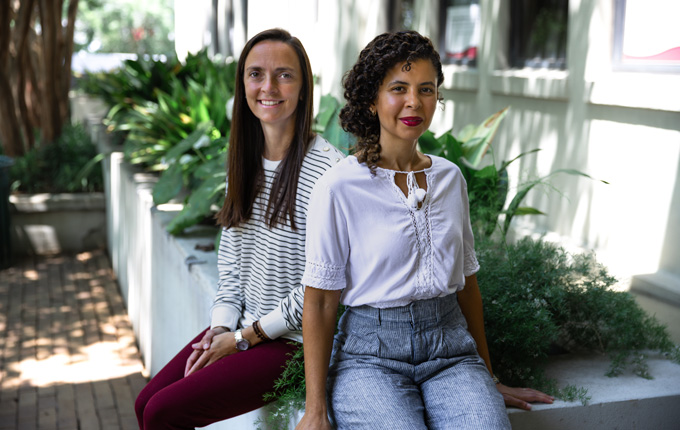
College of Education faculty members Jessie Guest (left) and Nicole Silverio.
School counselor Ordean Crews has served students for 28 years. Her greatest passion is letting her students figure out their own solutions with gentle guidance and encouragement. Even with years of experience, she was excited to learn how to use play therapy appropriately and efficiently. Crews’ biggest takeaway was learning how to step back.
“I learned how to wait, how to be silent while still conveying interest and engagement,” says Crews. “In a traditional session, you ask questions and talk. In play therapy, you watch and wait. One of my instructors said, ‘If you know enough to ask a question, you know enough to make a statement.’ I found that to be so profound.”
Supporting the whole family
Beyond play therapy, the counselors also focus on family relational skills. Working with families in schools is not a typical practice, but it allows for the whole family unit to benefit from services from school personnel they trust. Crews used her training to encourage a mom to be more communicative about expectations with fellow family members.
“She made plans but didn’t always share those plans with her family members,” says Crews. “By stopping to say, ‘this is what we are going to do, and this is what I expect to happen,’ she was able to mitigate disappointment and increase enjoyment in the activity.”
This small reminder has big returns. Adults can often forget what it was like to be children and how explanations can smooth transitions and get everyone on the same page. Additionally, supporting parents in healthy relational skills provides a trickle-down effect impacting the children’s well-being.
Learning to let students lead
Aretha Tarver began her career as a classroom teacher but transitioned to school counseling because she saw firsthand how environmental and social factors hindered academic success. Play therapy was a new concept for Tarver, and she had to overcome her own misconceptions about what play therapy was and how it could help her students.
“It was nothing like I imagined once I began studying it,” says Tarver. “I thought the counselor might lead the student in play, but it is actually the opposite. It was uncomfortable at first because it was hard for me to see if I was helping the student.”
Tarver learned how to use the concept of tracking, or reflecting content, where you repeat what your student is sharing in a way that acknowledges and validates their experience. She had a student who attempted to wreck the toy house they were using in their session. Instead of correcting the student or asking the student about their destructive actions, she waited and allowed space for a deeper conversation.
“Sometimes you just need to be a safe place,” says Tarver. “When you respond without judgment, you can assure your students that they can be themselves when they are with you.”
The hardest and most rewarding part of the training for Tarver was relinquishing control. But she’s seen great progress with some of her students in challenging circumstances because they feel freer to share and be themselves. She’s meeting students on their level and speaking in their language.
“After they have played with the house, they might sit and talk about their day,” says Tarver. “I’ve found that I have been able to build stronger connections through play.”
Both counselors acknowledge that technology has changed the types of challenges students face today. Bullying, for example, is different in the age of social media. Counselors need the tools to support and help students build resilience.
Crews regularly reminds her students that the practices they build now can be carried with them for the rest of their lives.
“They want us to think that they are strong and don’t need help, but we can show them how to grow,” says Crews.
About The Duke Endowment
Based in Charlotte and established in 1924 by industrialist and philanthropist James
B. Duke, The Duke Endowment is a private foundation that strengthens communities in North Carolina and South Carolina
by nurturing children, promoting health, educating minds and enriching spirits. Since
its founding, it has distributed more than $5 billion in grants. The Endowment shares
a name with Duke University and Duke Energy, but all are separate organizations.
