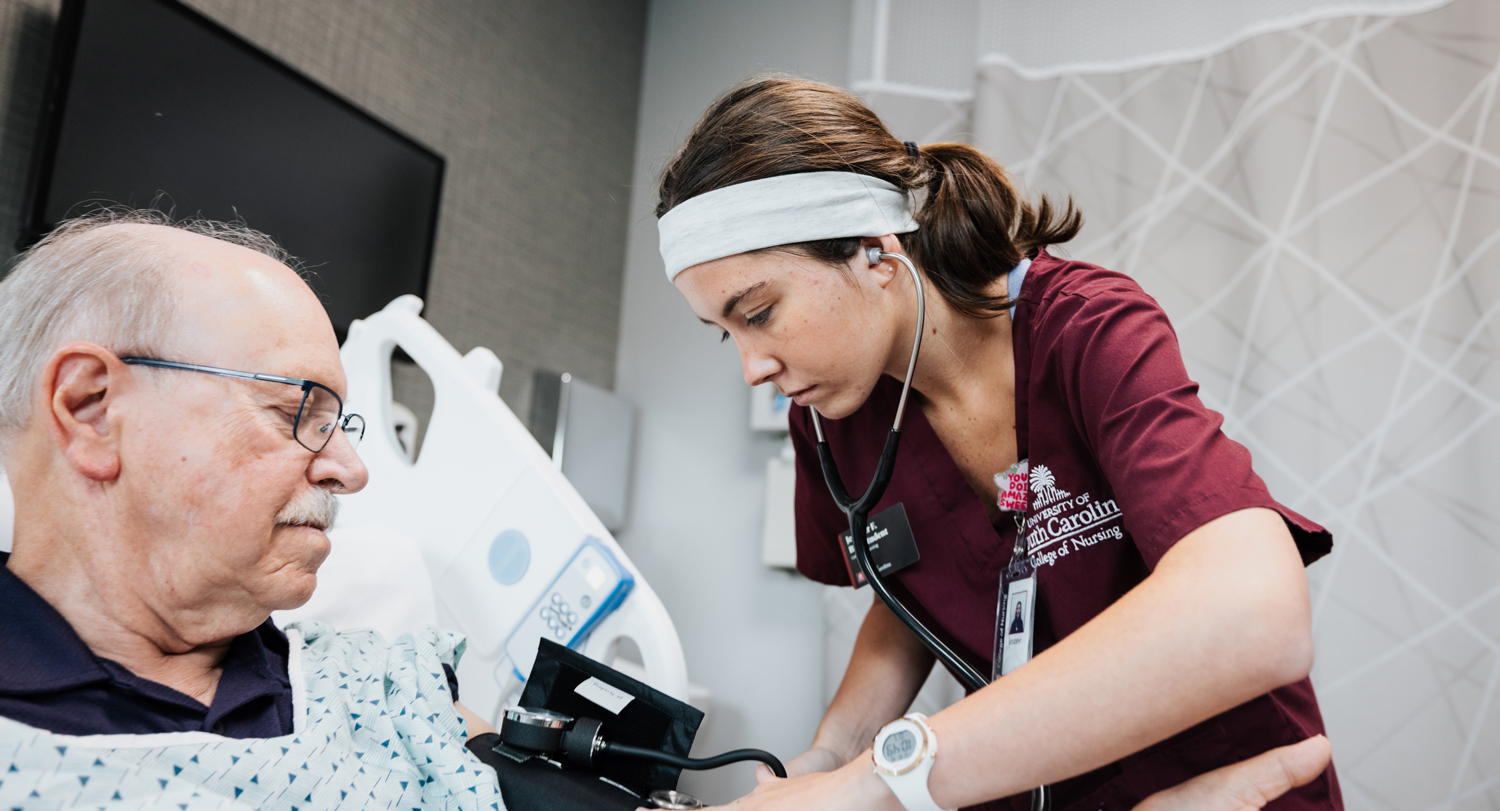
Madison Goldman and Kristina Brock were more than a little nervous walking into the hospital patient’s room. It was the first time the two University of South Carolina nursing students were trying out their clinical skills with a real person, not a computerized manikin.
“We’re going to start with some of your vital signs, all right?” one said cheerfully to the patient, who nodded in response.
The person lying in the hospital bed was a standardized patient, trained by the College of Nursing to interact with the students. But there was an added twist — the standardized patients on this day of clinical training also had aphasia, a limited ability to communicate vocally. The nursing students were going to have to improvise as they engaged with their respective patients.
“A couple of years ago one of our faculty members wanted to expose the students in our simulation lab to patients who had experienced a stroke and had trouble speaking,” says Kelly Russin, an assistant professor and director of the nursing college’s Center for Simulation and Experiential Learning, which is nationally accredited by the Society for Simulation in Healthcare.
The simulation lab could have hired standardized patients and asked them to feign a deficiency in verbal communication skills, but an authentic option emerged. The Aphasia Lab in the Arnold School of Public Health at USC had five patients who were willing to work as standardized patients for the nursing college. Their varying degrees of aphasia were perfect for helping the nursing students to adapt their communication skills for language-compromised patients.
“This experience promotes greater awareness of aphasia while helping nursing students develop effective communication, empathy and patient-centered care skills,” says Sara Sayers, associate clinical director of USC’s Aphasia Lab. “These interactions not only prepare future nurses to provide more effective, person-centered care but also give individuals with aphasia a powerful opportunity to raise awareness and make their voices heard.”
Employing standardized patients with aphasia is quite rare in clinical training for nurses, Russin says, noting that when she’s presented on the topic around the country, almost none of the conference participants have ever heard of the practice. But it is especially needed, she adds, given the high degree of language exchange between nurses and patients. Unless nurses are trained to accommodate the more than two million Americans with aphasia, those patients will potentially be at a disadvantage, and the communication breakdown could compromise clinical decision-making.
Undergraduate students in Nursing 312, the foundational course in clinical training that deploys the standardized patients with aphasia, seemed to embrace the opportunity.
Goldman and Brock said the experience was a confidence builder.
“It was interesting to see how you have to find ways to communicate outside of normal communication when they're struggling,” Goldman says.
Brock concurred: “It was nice being able to see how we would speak to a patient and understand them from what they are trying to tell us and remain calm to keep them from getting overstimulated or confused.”
In addition to getting valuable feedback from the standardized patients themselves, the students also are evaluated by a faculty member who monitors their nurse-patient conversations via video cameras in the simulation lab.
“I watch how they’re interacting and communicating with the patients and then go back to the classroom to talk about what issues there might have been or gaps that might have been missed during the simulation period,” says Anfel Crews, an assistant professor of nursing and lab coordinator. “It really prepares them because they’re going into clinicals next week for the first time. The first encounter with a patient in a simulation environment helps them have the confidence to go into a real patient’s room in the hospital.”
Russin says the real payoff in employing standardized patients with aphasia happens near the end of the clinical exercise.
“The SPs give face-to-face feedback to the students about how they made them feel — the way the students spoke to them and responded to the situation,” she says. “That is so important because the SPs are critiquing the students from their perspective as patients. That’s the most valuable part of the training.”