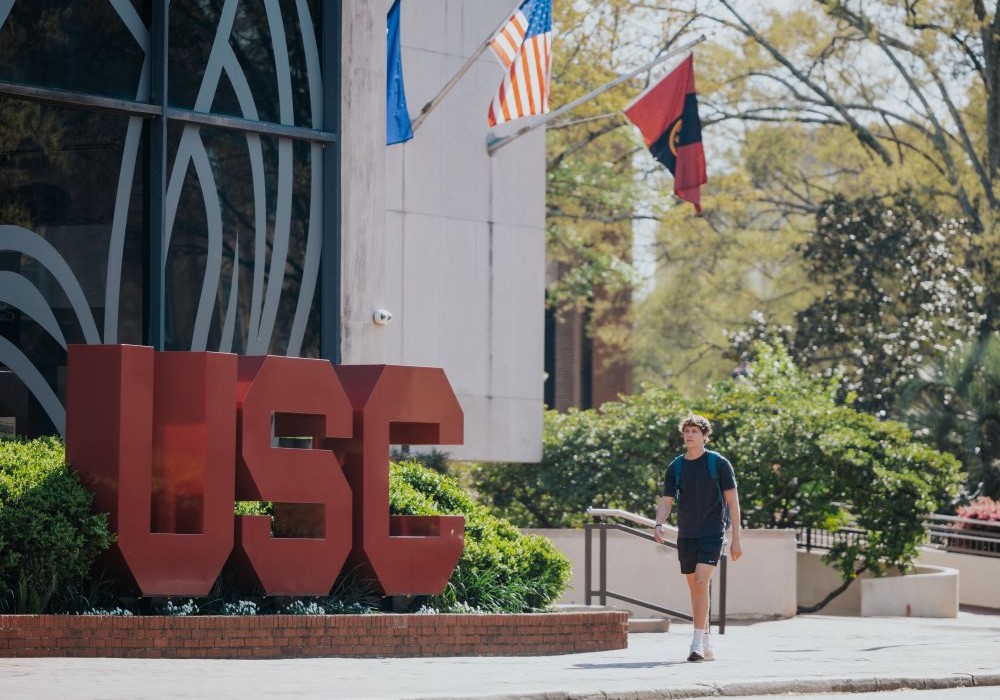
The University of South Carolina Board of Trustees elected Rose Buyck Newton as its new chairwoman on Friday (Aug. 21).
She was elected to the USC Board of Trustees in 2018 and chaired the board’s Audit, Compliance and Risk Committee through 2022. She was elected as vice chairwoman in 2022 and chairs the board’s Governance Committee.
“Serving the University of South Carolina is an honor and a privilege,” said Newton,
who will lead the board of the state flagship university with more than 55,000 students
on eight campuses. “For 225 years, USC has played an indispensable role in guiding
the economic prosperity and well-being of our state, adding to its rich culture. As
chair, I look forward to working with President Amiridis, the communities represented
by each of our eight campuses, and leaders throughout South Carolina to ensure we
continue our mission of education, research and service.”

Newton is a third-generation banker who chairs the board at the Bank of Clarendon. She holds degrees in finance and economics from Converse College and a master’s of business administration from USC. She serves on the board of the S.C. Bankers Association Bankers School and chairs the Board of Governors for Novant Health Coastal Carolina Medical Center.
Newton, a trustee of the Business Partnership Foundation at USC's Darla Moore School of Business, was the recipient of the 2026 Moore School Distinguished Service Award. With her election as chair, USC joins a small but growing number of South Carolina college boards led by women.
Newton is married to S.C. House Judiciary Chairman Weston Newton. Her daughter Reedy was USC’s student body president before graduating in 2023. Her son William is a 2025 graduate and first-year USC law school student, and her daughter Eliza Rose is a senior at USC.
Also on Friday, Reid T. Sherard was elected vice chair of the Board of Trustees on Friday. The Greenville attorney joined the board in 2023 and graduated with a bachelor’s degree in political science from USC's Honors College in 2000 and a law degree from USC in 2004.
Newton succeeds Thad H. Westbrook, who was chairman from 2022 through 2026.
During Westbrook’s tenure as chairman, USC:
- Set records every year in applications, enrollment, fundraising, research and state investment.
- Developed the Health Sciences Campus that includes a new Floyd School of Medicine building, Brain Health Center and the state’s first neurological hospital and rehabilitation center.
- Continued to freeze tuition for South Carolina students while remaining strong financially.
- Received major gifts from donors to name four colleges.
- Expanded its economic development role and developed a statewide internship program to retain graduates in South Carolina.
- Became a founding institution of the Commission for Public Higher Education, a new accrediting body.
- Improved significantly its free-speech ranking with the Foundation for Individual Rights and Expression to No. 22 in the nation this year.
- Created the Center for American Civic Leadership and Public Discourse.
The board also approved the USC Next campus master plan, including major renovations and expansions in academic buildings, student services and athletic facilities.
When he was the board vice chairman, Westbrook chaired the presidential search that led to the hiring of Michael D. Amiridis.
“During the past four years, the Board of Trustees implemented governance practices and created conditions that have enabled USC and President Amiridis to thrive,” Westbrook said. “We focused on establishing clear responsibilities with our leadership, building trust across all our campuses, aligning with stakeholders and setting ambitious expectations while maintaining institutional stability, including strong financial performances every year. We have worked to ensure USC focuses on its core mission to educate students and develop knowledge through research as we serve the needs of our state and nation.”
USC to launch Nuclear Innovation Center
As South Carolina’s population and economy continue to grow, the expansion of secure and affordable energy solutions is critical to the state’s future prosperity. With renewed federal investment and private-sector leadership from companies such as Westinghouse, the United States is poised for a nuclear energy resurgence. The University of South Carolina is well positioned to play an integral role in advancing nuclear energy solutions that will power South Carolina’s growth and strengthen America’s energy future.
To this end, USC’s Molinaroli College of Engineering and Computing will establish the Nuclear Innovation Center as part of its emerging Engineering District in Columbia. The center will position South Carolina as a national leader in applied research, advanced construction and manufacturing methods, nuclear workforce development and the digital economy, attracting innovation, investment, high-growth companies and corporate headquarters to the state. By creating a model for developing the skilled talent and technology infrastructure required by the rapidly expanding nuclear energy industry, the center will strengthen South Carolina’s ability to compete for the next generation of nuclear and technology-driven economic development. Matched by private investment, USC is requesting $100 million in state funding to support the project as part of its next budget request.
Through partnerships with private industry, federal agencies and the South Carolina Technical College System, USC is preparing to serve as a state and national hub for developing the workforce critical to supporting America’s next-generation nuclear energy ecosystem. These partnerships will expand the pipeline of technicians, engineers and specialized construction and service professionals and operators needed to support technologies ranging from large-scale nuclear reactors to deployable small modular reactors and microreactors.
In addition to helping meet South Carolina’s future energy needs, this initiative has the potential to generate substantial economic benefits for the state and region through the creation of high-paying jobs and new industry investment. With established strengths in engineering education and nuclear research, a network of statewide technical college and industry partners, and a commitment to developing the workforce of the future, USC is uniquely positioned to lead this effort.
USC seeks state funding for new ROTC center named after Lindsey Graham
USC’s new state budget request also includes a new ROTC Center named after the late Sen. Lindsey Graham.
USC plans to ask the General Assembly for $20 million in funds to build the Senator Lindsey Graham ROTC Center of Excellence, which will serve more than 2,000 military-affiliated students and ROTC cadets in what will become the Southeast’s premier ROTC training and education facility.
State investment will complete federal funding received for the $32.5 million project that will enhance military education, boost leadership development and improve student support services.
Graham served in the U.S. Senate for 23 years and received two degrees from USC: a bachelor’s degree in 1977 and a law degree in 1981. He served in the U.S. Air Force, S.C. Air National Guard and U.S. Air Force Reserves from 1982 to 2015.