For most people, the exciting part of peering through a telescope is what you see — the Moon’s craters, Saturn’s rings or distant star clusters. Thanks to a telescope that scans the sky with the eyes of a dragonfly, Mehrnoosh Tahani is excited about something less obvious.
Polarized light.
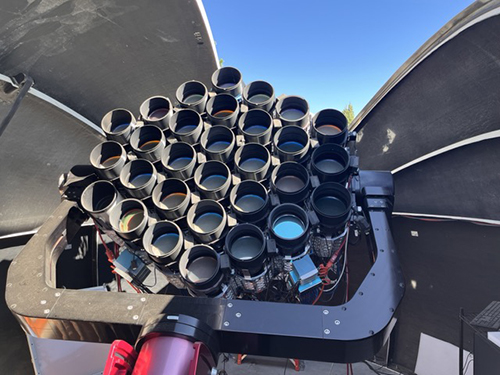
You can see polarized light — in fact, you might wear sunglasses to shield your eyes from it on a sunny South Carolina day. But you can’t tell whether it’s polarized, because that would require seeing how each light wave oscillates, or vibrates, back and forth. Leave that to the dragonfly and DragonflyPol, an innovation Tahani devised to let a telescope detect polarization.
Tahani, an astronomy professor at the University of South Carolina, said that detecting polarized light through “polarimetry” can reveal more details about stars, magnetic fields and dust in the far corners of the universe, as well as look for clues about the origin of life.
“The complete polarization state of cosmic light remains largely unexplored,” Tahani said. “Complete optical polarimetry is a powerful way to reveal astrophysical information, from our solar system to early universe, that remain hidden.”
Tahani’s interest in astronomy began in Iran when she often hiked in the Alborz mountains to stargaze with her family. Her father always talked about the stars.
“He would tell us about different constellations, the physics of the stars, the physics of how we can understand the universe,” Tahani said.
While doing postdoctoral research at the Dominion Radio Astrophysical Observatory and Stanford University, Tahani thought about making a telescope that can see like a dragonfly so she could see more than the obvious.
“It’s all about understanding the universe,” Tahani said. “I think astronomy is the best field to understand the universe.”
A vision for seeing polarization
While Tahani focused on the big mysteries of the distant universe, University of South Carolina biologist Dan Speiser zoomed in on tiny creatures to learn about their vision. He said dragonflies have the rare ability to see polarization because their eyes contain comb-like structures that detect light waves oscillating in a certain direction.
When light reflects off a surface, it can become linearly polarized, meaning light wave vibrates along the same line. Dragonflies home in on that.
“They use polarized reflections from water to find it,” Speiser said. “If you have low-resolution vision, and you’re flying over an environment, finding a pond isn’t that easy. ... But if you see a sudden burst of linearly polarized light, then you're probably over a pond.”
Glass also can polarize light, meaning a dragonfly that smacks into your windshield may have been looking for a drink.
Magnetic fields and dust clouds in space can polarize light, too. As a postdoc, Tahani thought of using polarized light filters much like the structures in dragonfly eyes to help a multi-lens telescope detect linear polarization, which would reveal information about the environment light passes through on the way to earth.
After laboratory tests confirmed the method could work, the scientists running a telescope called the Dragonfly Telephoto Array gave Tahani the green light to test the idea on their telescope. Last year, she spent two weeks in New Mexico installing the equipment with USC students and research partners, working long days to install and fine-tune the equipment.
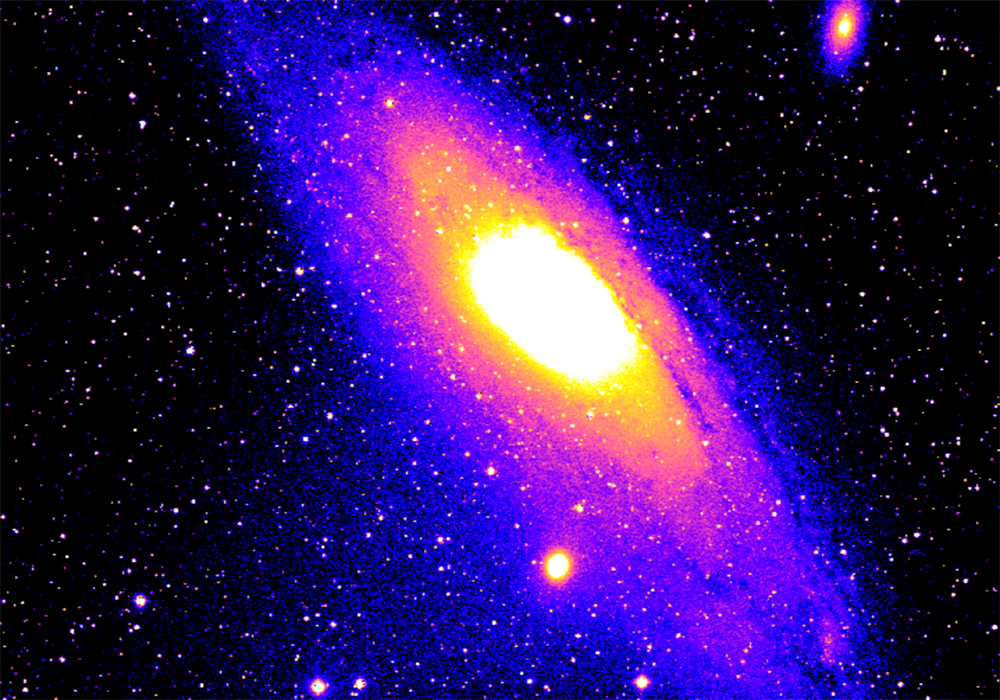
The telescope achieved “first light,” taking its first image, in September 2025.
“Just seeing the light, having the telescope function the first night, and seeing that it was consistent with theory — I can't describe the feeling,” she said. “I felt a big relief, but also a huge amount of responsibility. We have a lot to do with this capability.”
More than stars
Since then, Tahani and her collaborators, including USC students in her lab, have studied images from the telescope to continue testing its capabilities. They recently published their first paper about DragonflyPol, outlining how it can be used to map magnetic fields, study the evolution of the universe or explore questions about dark matter.
Meanwhile, Tahani already is looking at more projects with the technology. An Aspire AI grant will support the creation of an artificial intelligence chatbot that can teach people about astronomy, polarized light, how DragonflyPol works and what polarimetry will help scientists learn. Denise Davis, in the Molinaroli College of Engineering and Computing, and Nicole Silverio in the College of Education, will work with Tahani.
Tahani hopes the chatbot will improve confidence in science by talking about what scientists don’t know yet. She said scientists are sometimes pressured to speak with certainty, but part of the reason for doing science is because there are so many unknowns — a whole universe of them.
“We’re doing the best we can, but there’s always something that we don't know, and we’re trying to push the boundaries of what we don't know,” she said.
Tahani also hopes to create a new telescope project that has a superpower even DragonflyPol can’t rival — the ability to see circularly polarized light, much like a mantis shrimp.
Tahani met Speiser at a workshop organized by (In)Visibility, a research group sponsored by USC’s Humanities Collaborative. Katherine Ryker, a geologist who also uses polarization in her research, introduced them.
Speiser mentioned that Maddy Janakis, a 2026 Ph.D. graduate from his lab, had done research about the ability of crabs to see polarized light. They also spoke about how the mantis shrimp, a creature that loves bright, shallow water, can see circularly polarized light, in which the light waves turn in a corkscrew pattern.
“There aren’t many things that reflect circularly polarized light,” Speiser said, and the armor of a mantis shrimp is among those few things. That allows mantis shrimp to use circularly polarized light to communicate, find a mate and hunt.
Tahani, Speiser and Ryker are seeking funds for a telescope project that would detect both linear and circular polarization. This could gather more details about interstellar dust and magnetic fields, but it also could help study the origins of life in the universe. Some of the biomolecules that form the building blocks of life cause circular polarization.
“With the circular polarization upgrade, our aim is to look for these subtle signatures in star-forming regions and dusty clouds in space, where complex organic molecules could exist,” Tahani said. “These molecules are not just theoretical. They have been studied in the lab, and some have been found in meteorites and interstellar clouds. What is new here is using polarization as a potential tracer of their presence.”
There is a lot going on in this research: An astronomer, biologist, geologist, computer scientist and education professor are working together. They’re connected by the unique vision abilities of dragonflies and mantis shrimp. They hope to learn about the evolution of the universe and the origin of life, and share that knowledge with others.
It’s part of what happens when researchers with different expertise collaborate.
“Astronomy, as one of the oldest sciences, has flourished for thousands of years through human curiosity and the contributions of people from many different fields, from mathematics and physics to chemistry and biology,” Tahani said. “Interdisciplinary collaborations bring new ways of seeing and approaching questions we have been trying to answer for generations.”
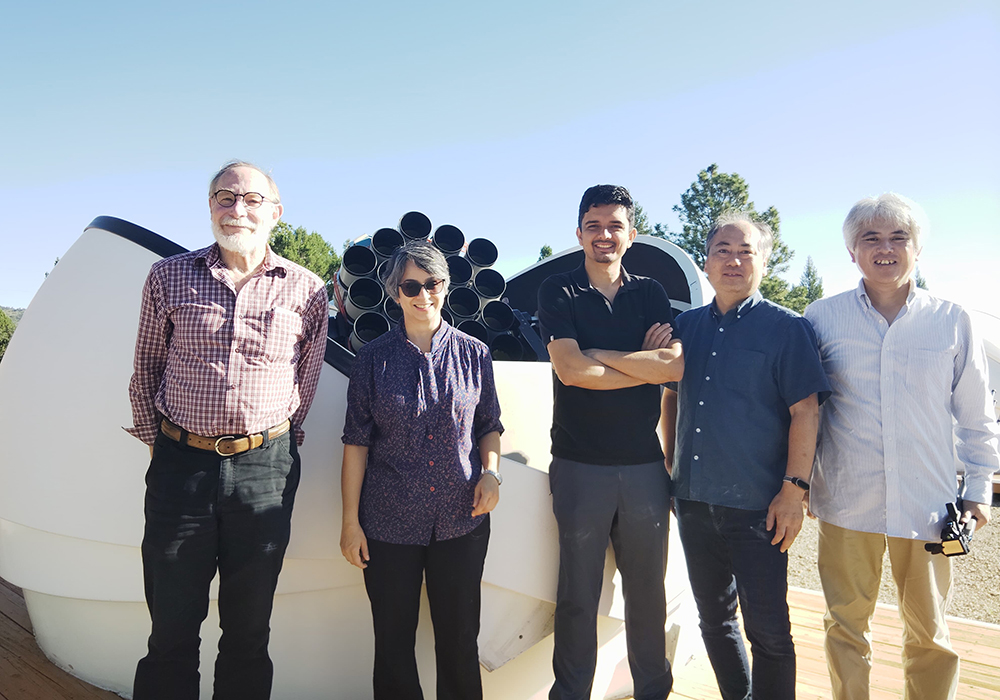
Banner, left to right: Leo Hollberg, USC professor Mehrnoosh Tahani, USC graduate student Paras Regmi, Hiroshi Akitaya and Koji Kawabata. Images courtesy of Tahani and the DragonflyPol team.