Violence against women is a significant public health and human rights issue worldwide. Nearly one in three women have experienced partner or sexual violence.
Many have turned to social media as a way to make their voices heard. The #MeToo Movement, which supports survivors of sexual and gender-based violence, went viral on Twitter and spread to social media sites around the world. Since 2017, tens of millions of people have used the hashtag to share their own experiences.
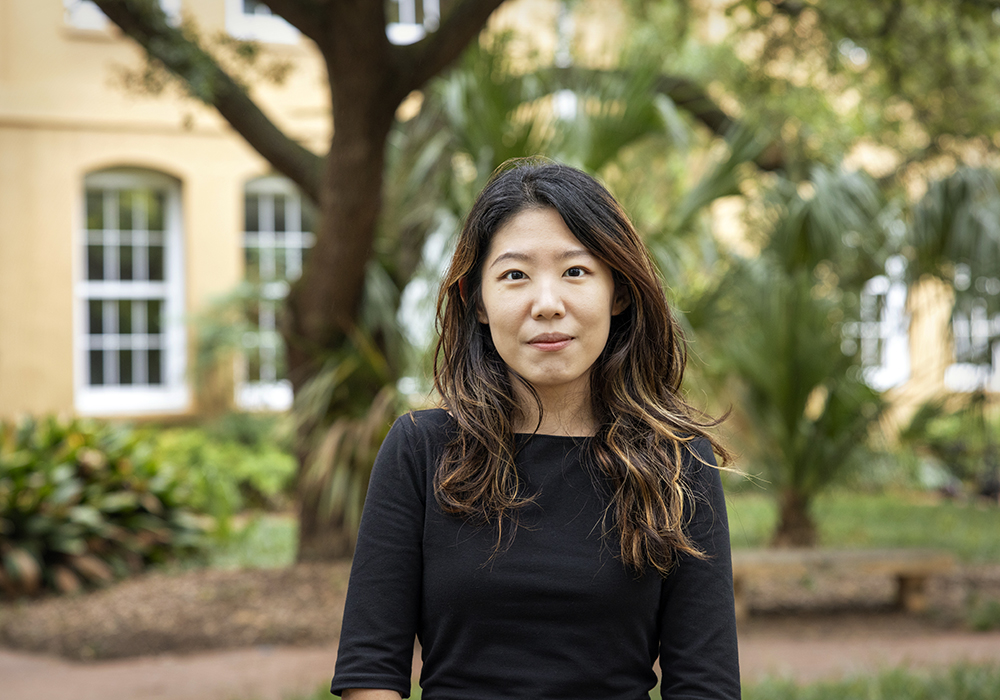
Zhaodi Chen, an assistant professor at the University of South Carolina, observed this phenomenon unfold in China, where she grew up and attended college. When Chen trained as a sociologist in graduate school, she researched how women can use social media to bring attention to their stories of domestic and gender-based violence.
“In the past, we have seen that social media serves as a very important channel for victims or survivors of gender-based violence to seek help, build community and social change,” Chen says. “This is especially important in China, where social media has become a critical way for people to voice themselves.”
But despite the huge awareness raised by movements like #MeToo, Chen’s findings show that many stories shared online still face relative silence.
“Social media gives everybody the ability to talk about themselves and their own stories, but I noticed there’s actually this highly unequal distribution of public attention and public influence,” Chen says. “I’m interested in understanding what is shaping the gap between stories that get a lot of attention and those that go unnoticed.”
Is anyone listening? When posts face silence
Before joining USC’s Department of Sociology this fall, Chen completed her doctoral work at Indiana University Bloomington. Through her dissertation, she set out to answer these questions: How often are people reaching out on social media to share their stories and get help, only to be met with relative silence? And what underlying dynamics influence which posts do get attention?
“I approached these questions first by building a data set where I tracked certain keywords related to gender-based violence and captured those dynamics in real time,” she says.
Chen analyzed more than 20,000 online disclosures of gender-based violence from the Chinese social media site Weibo, looking for patterns in how people responded.
“What I found was that private violence — which refers to events that happened in an intimate or family context — is much more likely to be ignored than things that happened in a public setting or in public-facing social relationship,” Chen says.
“Social media gives everybody the ability to talk about themselves and their own stories, but I noticed there’s actually this highly unequal distribution of public attention and public influence. I’m interested in understanding what is shaping the gap...”
In short, what happens behind closed doors tends to stay behind closed doors, even in digital spaces. But Chen also wanted to understand why certain stories do break through those barriers into the public spotlight.
“People think that if you want attention online, you have to communicate very effectively. You want to use hashtags, maybe attach photos or video, use language with a higher level of emotional energy. What I discovered is effective communication isn’t really a factor in shaping this attention gap,” she says.
Chen observed that even if a social media user did all the right things, it wasn’t enough to overcome the dynamic driving certain posts to remain under the radar. Instead, the posts that broke through did one important thing differently.
“For the gap to be bridged, social media users have to cross the boundary between what seems like a typical private incident, which usually involves complex relationships with family, to what seems like more of a public or institutional incident,” she says.
For example, a post about an abusive incident between spouses at home may be easier to scroll past than a post about a confrontation that took place in someone’s place of work or which resulted in the police being called. Legal matters tend to get more traction.
Chen says she can’t speak to what the audience is thinking when they scroll past a post, but the patterns suggest that the tipping point for engagement seems to be whether people recognize the situation as a public issue — something they could or should do something about. Posts are less likely to rise to that level unless the incidents are perceived as spilling over into the public somehow.
“In private situations, it’s usually harder to engage in institution-level interventions compared to more public violence. But most of those private situations, such as domestic violence and sexual assault, happen to be issues that disproportionately affect women,” she says. “The result is that the most common types of violence tend to be ignored.”
Why some doors stay closed even online
Chen says it goes back to the idea of the public sphere — the social spaces where people come together to discuss issues that matter to the broader community, like the public square. Historically, these spaces were shaped by gender inequalities, and concerns associated with women’s lives and the home were often excluded from what counted as public issues.
“The boundary between what is considered private and public is historically understood as one of the mechanisms that has shaped the exclusion of women from public life,” Chen says. “What I’m interested in is how digital media is changing the mechanism. I want to understand to what extent those boundaries still have power.”
While Chen’s work started out looking at gender-based violence, she also wants to understand the mechanisms of power and equity on social media in other areas.
“I think looking at gender, along with other dimensions like race and sexuality, shows how historically marginalized groups use digital media to break down barriers, and how digital media itself is shaping these barriers in new ways,” she says.
Chen plans to build on her research to see which findings can be applied broadly and which may vary across contexts, such as different countries or other sites.
She also hopes that her findings will raise awareness — both about the stories that go unheard and about the digital environments that quietly shape our attention.
“We have so much information to navigate online and different things competing for our attention,” she says. “I just want people to have better awareness of what we may be missing.”