Researchers often strive for perfection — perfect controls, perfect samples, perfect conditions. But what if the key to discovery is imperfection?
That’s what a team of researchers at the University of South Carolina found out while exploring ways to make batteries last longer: The more imperfect a crystal anode, the better lithium was able to pass through it.
While there is certainly a poignant life lesson in the researchers’ findings, the practical uses of the discovery offer enticing applications in the realm of energy storage. It could help make lithium-ion batteries charge faster and last longer.
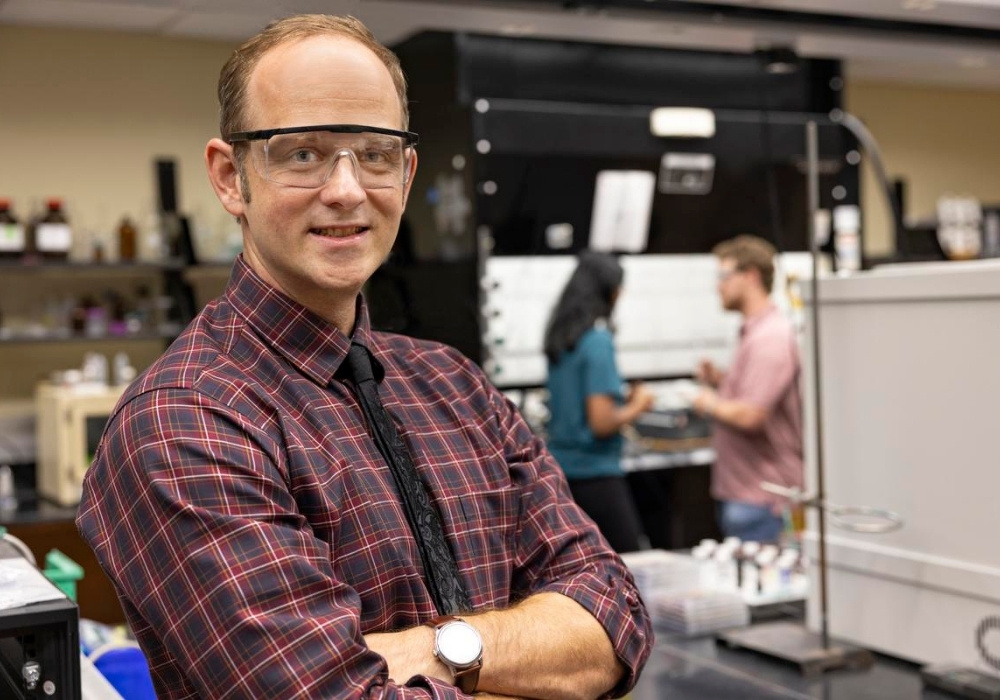
“If you spend a thousand bucks on a battery and it lasts for a thousand cycles, then that’s a dollar per use,” explains Morgan Stefik, a chemistry and biochemistry professor in the McCausland College of Arts and Sciences and the principal investigator on the $2.55 million Department of Energy award. “Well, if you make a battery last a million cycles, even if it costs more initially, then you’re winning economically.”
That was the target the DOE gave Stefik’s team: Find a 10-time cost reduction for batteries.
The researchers wanted to approach the problem from a different angle than many of their research competitors. Instead of trying to replicate existing battery technology with cheaper materials, Stefik decided to aim for longevity.
“I said, ‘Forget cheaper. We’re going to get better economics by making batteries last longer.’”
Imperfections perfect the process
Batteries, particularly lithium-ion batteries, are a major research priority for the U.S. government and an economic priority for the state of South Carolina.
Lithium-ion batteries are crucial for advancing electric vehicles and stabilizing the energy grid. The lithium-ion battery itself simply stores energy for use later. The magic happens on the atomic level. A lithium atom removes itself from an anode, passes through an electrolyte and then joins the cathode. This action requires electrons to also pass from the anode to the cathode, which is how batteries provide electricity.
Stefik relates it to an everyday use: When you plug your phone in at night, lithium moves into the anode, charging up the battery. During the day, the lithium leaves the anode and moves to the cathode, powering the phone and draining the battery.
This was Stefik’s first battery grant. An expert in polymers, nanomaterials and electrochemistry, he is used to studying things at the molecular level. Why not do the same for batteries?
The microscopic experiments led to big-time breakthroughs.
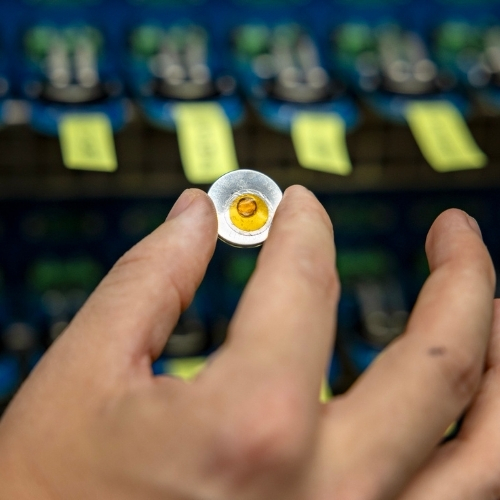
The “pretty basic chemistry experiment,” as Stefik describes it, works like this: Mix up molecules containing the atoms you want and then put the mixture in a furnace, heat it up, and let it crystallize into a perfect arrangement of atoms — like a diamond.
But the discoveries came when the team pulled the materials out before the crystallization finished. The atoms weren’t perfectly ordered but somehow moved lithium three times faster.
The express lane to power
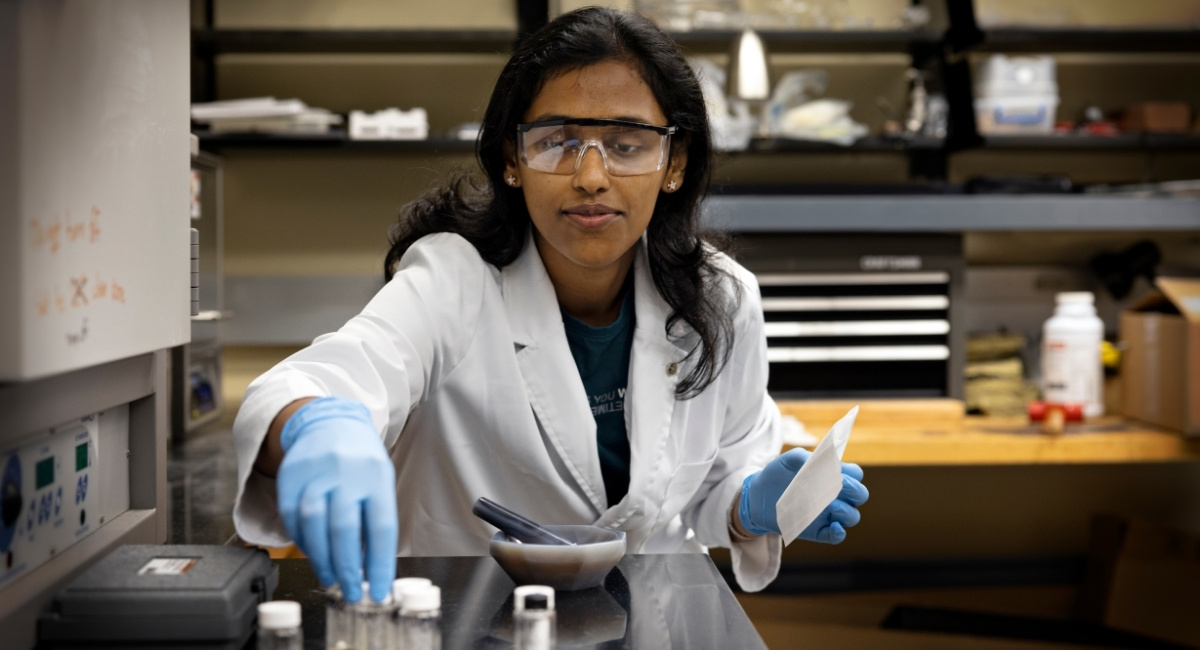
That was a “pleasant surprise” encountered by Stefik and his team, a multidisciplinary group of four USC faculty members, graduate students and one off-campus professor. Think of them as an Avengers-style team of chemistry and engineering researchers. They specialize in making crystals, understanding atomic structures, battery production, electrochemical measurements and computational chemistry.
The team wanted to understand how lithium moves through all the different paths in the anodes, which requires computer simulations that would take too long to finish with traditional methods — even using supercomputers.
Assistant professor Chris Sutton led the computation. Machine learning enabled 1,000-times faster calculations so they could understand how imperfections change the movement of lithium.
What those models revealed was “yet more puzzling,” Stefik says.
“When the team broke it down, the lithium moved slower through most of the defects, which is a conflicting starting point for explaining how these imperfect materials are somehow faster.”
That’s where computers came in handy again.
It turns out that the defects rerouted lithium to the fastest pathways within the crystals. Stefik likens it to a highway where potholes in the slower lanes might make drivers move to the faster express lanes.
The result is a lithium-ion battery that can charge more quickly and last longer. Stefik’s batteries can reach 50-percent charge in just three minutes and last 10 times longer than the 1,000 cycles you might be able to get from a typical cellphone — all while retaining 74 percent of the initial storage capacity after 10,000 cycles.
A new approach to lithium-ion battery research
Not only did Stefik’s team find out the why and the how, they did so by developing new research methods and processes across the disciplines of materials, chemistry and computation.
“Every layer of this project is at the forefront of different fields,” Stefik says.
The findings were presented on the cover of Advanced Energy Materials, a major academic publication. Stefik indicated that the team has a long line of papers in queue as a result of the collaborative work crucial to the project.
“If you spend a thousand bucks on a battery and it lasts for a thousand cycles, then that’s a dollar per use. Well, if you make a battery last a million cycles, even if it costs more initially, then you’re winning economically.”
Building South Carolina’s battery hub
Building on-campus infrastructure to conduct research like what Stefik’s team is doing is a priority for the university — and the state of South Carolina. Enter the Carolina Institute for Battery Innovation.
The center, housed within the Molinaroli College of Engineering and Computing and led by chemical engineering faculty member William Mustain, is aimed at providing the research and development arm of the battery manufacturing industry in South Carolina, where investments in battery and electric vehicle manufacturing have been a major economic priority for years.
The institute is fast becoming a place for researchers to dream big and for industry professionals to get answers to questions they might not be able to track down themselves.
Stefik describes it as “a place you can go when you’ve got challenging battery questions or you need to try out a new material and see if it’s worth commercializing.”
The institute brings together researchers from different colleges and disciplines, allowing for collaboration and feedback that might not occur if the institute didn’t host regular gatherings for affiliated faculty.
And, Stefik says, the institute will allow researchers to not only think bigger but experiment bigger, too.
As the center gets up and running, Mustain believes the team’s work could prove valuable in helping build a better battery industry in South Carolina.
"The Stefik group has been custom-designing metal oxide battery materials for several years now — using their chemical and physical structure to improve how fast they can be charged and discharged,” Mustain says. “It is very interesting and exciting that they might be able to bring new materials to battery systems.”