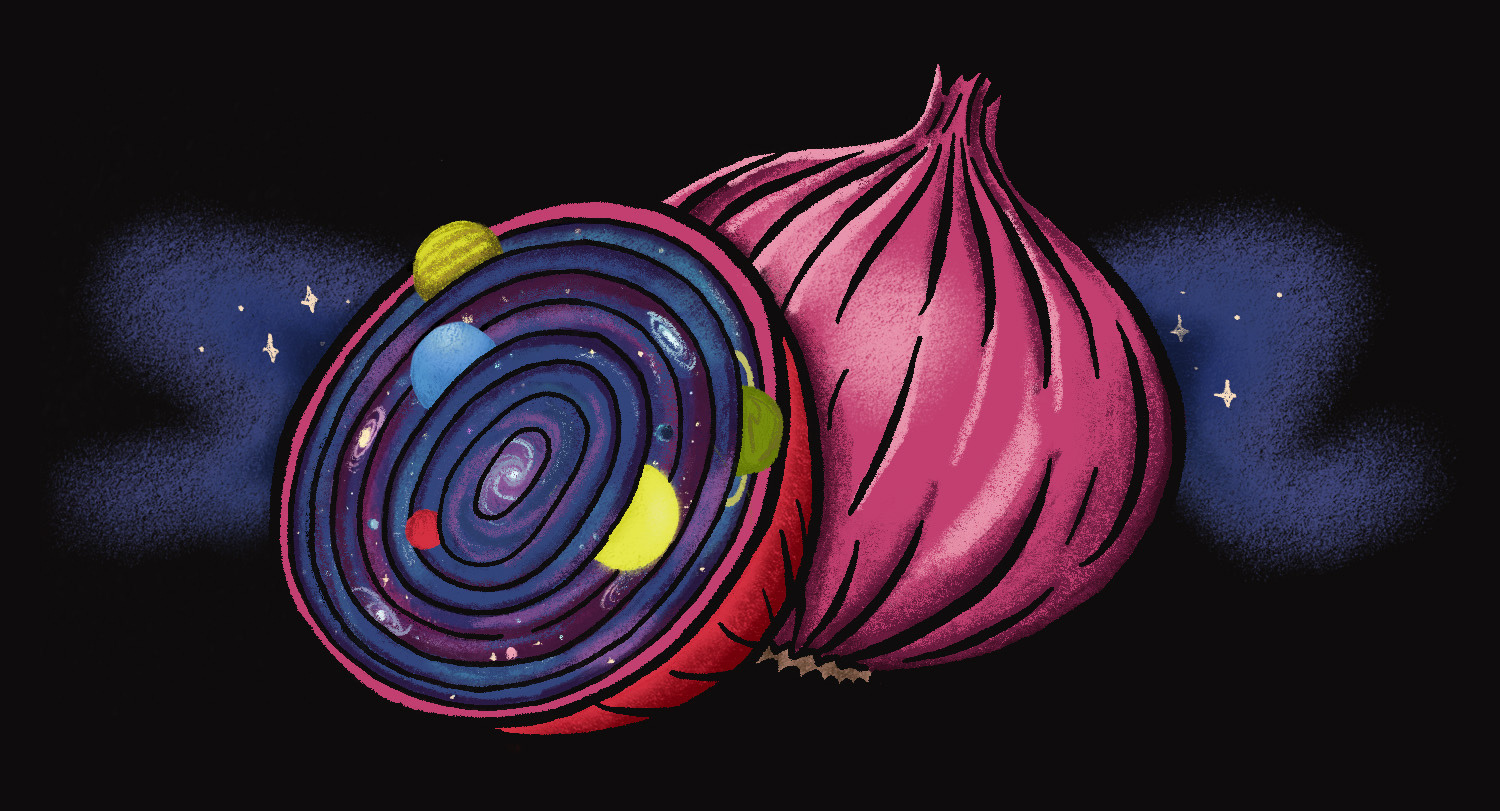
Theoretical physicist Alexey Petrov explains the universe in terms that may feel familiar to anyone who has watched DreamWorks Animation’s Shrek. Much like the movie’s titular ogre, the cosmos is like an onion.
“They both have layers. That's how the universe works,” explains Petrov, chair of the University of South Carolina’s department of physics and astronomy. “The only reason we can understand how each layer works is because those layers are not exactly overlapping.”
From nebulas and planets to particles so tiny you need a five-mile-long particle accelerator to see them, the faculty Petrov leads are committed to revealing what’s between each layer of the universe
Naturally, the department chair is taking a layered approach to help them succeed.
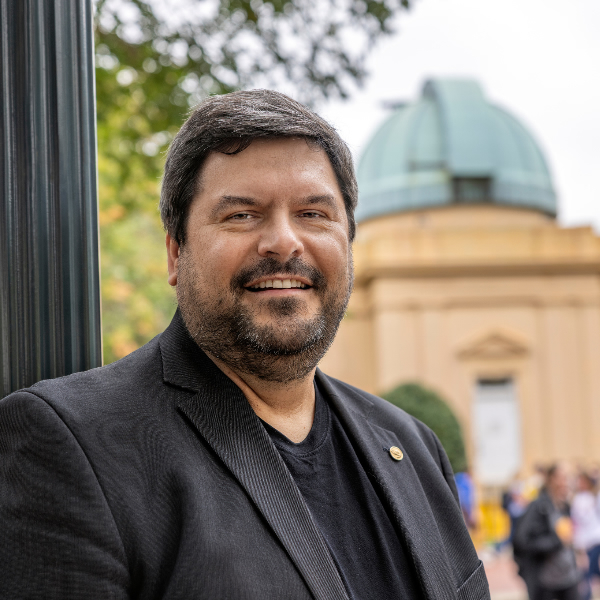
Petrov is a Russian-born, American-educated physicist with a 2005 National Science Foundation CAREER Award under his belt (among many other bona fides), a love of espresso and a knack for explaining complex topics — like the structure of the known universe and everything within it — in an accessible way. He’s also committed to creating an atmosphere that fosters research and mentorship.
“At some point I realized that I wanted to help people become better scientists,” the professor says.
No theories. All practice.
Since coming to USC in 2022, Petrov’s mission has come into focus. Research awards in the department have increased nearly 500 percent, almost hitting $5 million for fiscal year 2026. He’s expanded the faculty by hiring seven professors and formalized three research directions by discipline.
The major condensed matter group focuses on nanotechnology and houses the SmartState Center for Experimental Nanoscale Physics, an interdisciplinary lab led by Rongying Jin.
“This is where people look at the properties of materials and the way to study them,” Petrov explains. “They create new devices, quantum devices and all of that.”
The second group is particle and nuclear physics. The experimental side of the group often needs to venture off campus for their research, heading to government labs in Virigina, Illinois and even Switzerland to work at mammoth particle accelerators. The theorists, including Petrov, keep offices a bit closer to home.
The third group is the department’s newest. Petrov formalized the astronomy research group with the recent hiring of two professors. The successful launches of NASA satellites and probes in recent years promise a wealth of data from the deep reaches of space. And with every new mind-boggling set of photos NASA releases of cosmic bodies and far-flung planets, more children worldwide are bitten by the space bug.
“Half of our students who come here want to do research related to astronomy,” he says, “and that was another reason why this was important.”
In addition to expanding the faculty, Petrov has instituted new incentives to encourage professors to apply for grants. He’s also taken special interest in faculty at the beginning of their careers.
“The most important part is to support junior professors, people who just started,” Petrov says. He’s built in mentorships to help with setting up labs, applying for grants, teaching and presenting findings.
He likens a professor setting up their lab to an entrepreneur launching a startup: They must secure funding, buy equipment, hire and train assistants, manage a budget and get people on board with their ideas.
“Can you imagine that frustration?” Petrov posits. “If you have this topic that you're so passionate about, but you can't figure out the steps to take to start digging into it?”
Every junior faculty member in the department is assigned a mentor, Petrov says, and he often offers up his own expertise by sharing his successful grant proposals.
Trickle-down physics
The support infrastructure he’s adding into the department is trickling down to graduate and undergraduate students, too.
Unsatisfied with the advising structure in recent years, Petrov created a three-pronged advisement apparatus for students. A professional advisor, a faculty mentor and student ambassadors form a fleshed-out model for ensuring students are on track to graduate, understand the research landscape, and have someone to help navigate the twists and turns of an undergraduate education.
If that’s not enough, Petrov keeps an open-door policy for students and faculty.
“My wife tells me that I should have been a priest because I usually listen to the students or faculty … maybe I was in my previous life,” Petrov says with a laugh.
Building better scientists
Mentorship and training are the foundations of Petrov’s leadership, but he’s also expanded opportunities for students.
At his previous institution, Petrov was program director for the Research Experience for Undergraduates, a National Science Foundation-supported program that allows undergraduate students to conduct research alongside professors. Running the program for nine years showed Petrov the importance of training the next generation of physicists. Now, USC’s department runs a similar program.
And to further help students find their path, Petrov led the creation of two new concentrations within the department: biomedical physics and astronomy and astrophysics.
The biomedical physics concentration is targeted towards pre-med students. Petrov says those majors perform second-best (behind computer sciences majors) on the MCAT, the medical school entry exam.
Those high scores are because physics focuses on developing problem solvers. Scientists.
Petrov says 60 percent of undergrads in his department go on to graduate school. But he’s working to ensure 100 percent graduate better thinkers.
“It’s not just problem solving and critical thinking,” Petrov says. “It's actually trying to simplify the problem to the point where you make it understandable and easy to solve.”
And that’s how Petrov approaches leadership. He takes each piece — grant funding, faculty recruitment, undergraduate enrollment — and gives it the attention it deserves, ensuring every level of education and research within his department is supported.
It’s a layered approach. Like an onion. Like the universe.