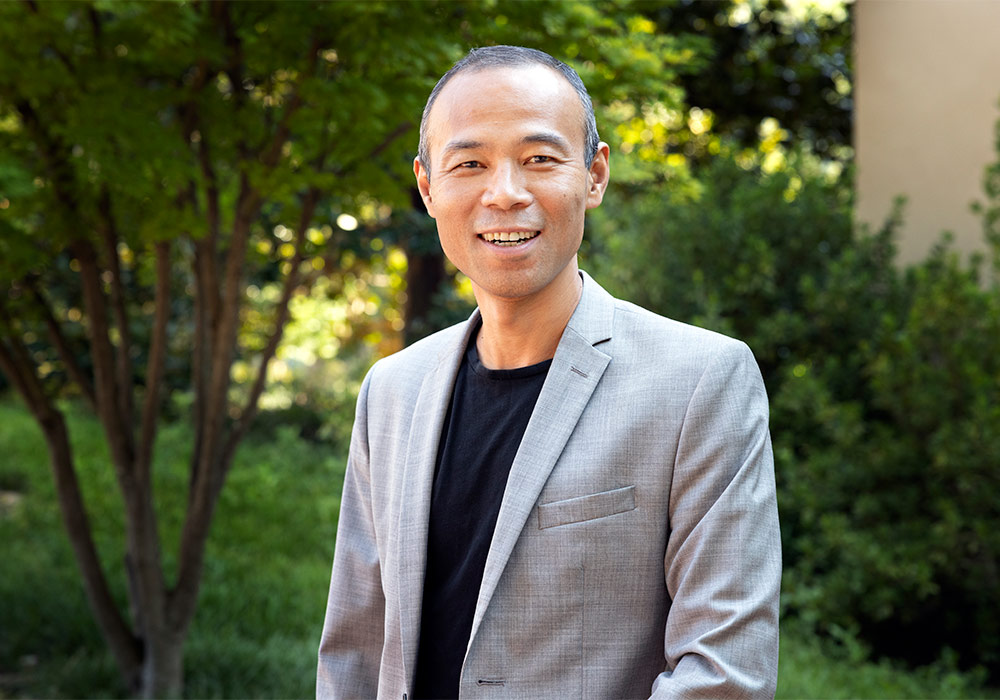
Qian Wang says there is a lot to like about teaching graduate students at the University of South Carolina. Top of the list? The learning opportunities — for the student and the professor.
Wang, Carolina Distinguished Professor of Chemistry and former department chair, has established a world-class research program in chemical biology, biomaterials science and nanotechnology, earning national and international recognition. His research is focused on how to modify proteins and protein assemblies for applications in chemistry, materials and biomedicine. He describes it as “basically, how to develop better treatments for disease.”
Since arriving at USC in 2003 from the Scripps Research Institute in San Diego, he has delivered over 200 invited talks, published more than 300 articles in peer-reviewed journals and secured more than $15 million in external grants.
He’s a researcher, but he’s also a teacher. At USC, he has taught undergraduate and graduate students and supervised more than 100 doctoral students and post-doctoral fellows. Last spring, he was chosen as the recipient of the 2026 Michael J. Mungo Graduate Teaching Award.
“As a professor, you’re talking to your future colleagues. You want them to challenge you as much as you challenge them. The appeal of graduate teaching is learning, learning, learning.”
And he still is learning — particularly, he says, with graduate students, where classes tend to be smaller and afford more interactions with students.
“Graduate students have their own backgrounds, their own preparation. They have their own research interests,” he says. “You have to make sure the class can offer enough information and enough background to all the students. But also, on the other hand, you don’t want them to waste their time here or learn something not useful or that cannot contribute to their research program in the future. So how to balance the diversity in background and the different requirements and different career paths is a challenge. And it’s always a great opportunity for the instructors teaching graduate classes.”
Wang says that’s partly because science is always moving, meaning teaching the core materials stays the same, but something new is always added to the class.
His approach to teaching and mentoring fosters scientific independence and promotes innovative thinking. His goal is to equip graduate students with advanced, up-to-date knowledge and to eventually transition the relationship from one of teacher and student to a professional partnership, preparing them as colleagues in the scientific community.
“As a professor, you’re talking to your future colleagues,” he says. “You want them to challenge you as much as you challenge them. The appeal of graduate teaching is learning, learning, learning.”
And in his role of teacher, he leans heavily on mentoring.
“I treat them as colleagues and collaborators, working with them through every step, from brainstorming paper ideas to line-by-line revisions of drafts,” Wang says. “This collaborative process ensures that they grasp the broader paradigm of their projects, developing skills in scientific communication and an understanding of the research landscape. Each publication is a reflection of our collaborative journey and the mutual respect we build through mentoring.”
Wang understands that the graduate students in his classroom are future leaders in their fields, so “integrating management and leadership training into their Ph.D. experience is essential. Through a curriculum that includes soft skills, I aim to prepare my students not only as experts in their fields but as effective leaders. Many of my former students now excel as leaders in academia, industry and beyond.”
And it’s a relationship that doesn’t end when the students finish their studies at Carolina. He makes close connections with the students in his classroom and lab — calling his former students his “academic family.”
“We have so many great, great graduate students and we should celebrate them and we should really be proud of them. Most of them stay here for five years. USC is one of the first places they enjoy a tightly knit academic community, and that becomes part of their life. And the instructors here, the faculty — and also the environment in our university — has a profound impact on their lives.”