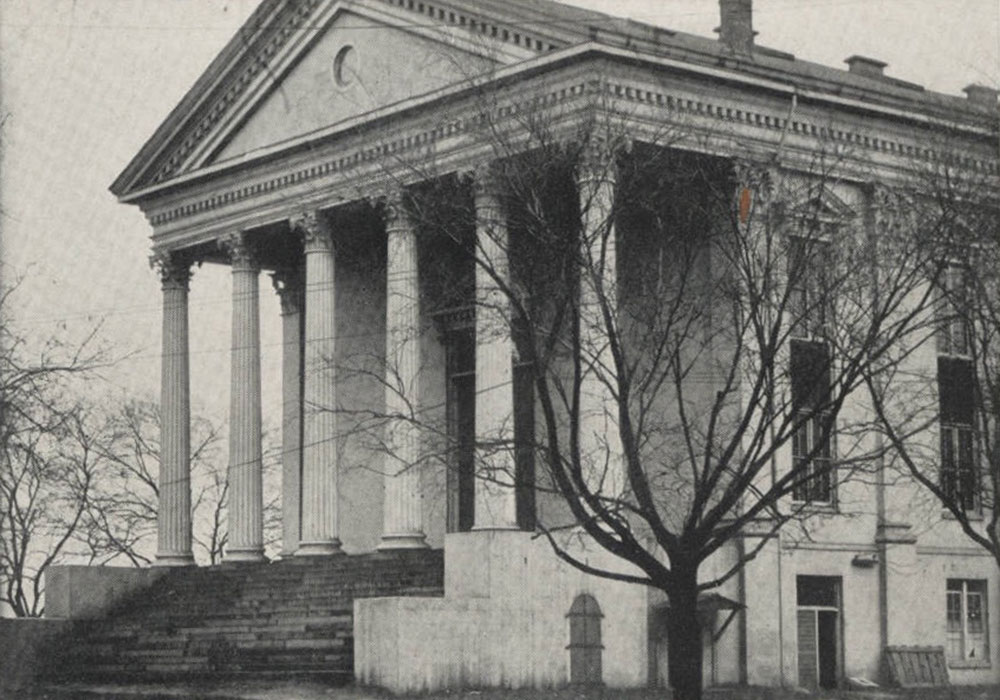
One night, two theater majors rehearse a scene on the Longstreet Theatre stage. It starts like any other night leading up to a big performance — until the stage lights flicker. Heavy footsteps reverberate as someone traverses a steel walkway in the darkness overhead. When the students glance up to see which castmate has joined them, no one is there.
Originally called College Hall, the 171-year-old Longstreet Theatre was one of several campus buildings used as a Confederate hospital during the Civil War. Anyone who has spent time there has had encounters they can’t explain.
“As an actor in a show at Longstreet Theatre,” recalls alumnus Jesse Breazeale, “I'd hear footsteps in the lighting grid when no one was there, hear rustling from empty dressing rooms and [feel] random cold spots even under the hot lights!”
Ghostly lore and historic places go hand in hand. And with a history that dates back to 1801 — and architecture of the era — the University of South Carolina has spooky stories aplenty. Many of these stories recirculate every Halloween in online features (ahem) or campus ghost tours. Why do people enjoy ghost stories so much?
“There's a long history of people being fascinated with the afterlife,” says McCausland College of Arts and Sciences professor Shane Thye, who teaches Sociology of the Paranormal and Extraordinary Claims. “People are attracted to the unknown, the questions that science can't answer. For a lot of people, the idea of a spirit or a ghost may be a way to cope with grief or the loss of a loved one.”
While most seemingly paranormal phenomena can be explained by science — the human eye and ear can misperceive things, and old buildings do make strange noises sometimes — Thye says it’s in our nature to interpret these kinds of experiences as supernatural.
“There's a long history of people being fascinated with the afterlife. People are attracted to the unknown, the questions that science can't answer.”
Humans are also hardwired to make sense of randomness and look for patterns in stimuli thanks to a phenomenon called apophenia. This is why people might see a religious icon in burned toast, for example. Think of apophenia as early man’s “better safe than sorry” approach.
“It’s an evolutionary holdover,” Thye says. “If you heard leaves rustle thousands of years ago, you were better off making the mistake of assuming it was a tiger when, in fact, it was just the wind. If you assumed it was the wind and, in fact, it was a tiger … well, you were in big trouble. So, people have evolved this tendency to look for patterns and meaning in random things.”
Science aside, nothing satisfies like a good ghost story. In search of Halloween hair-raisers, we asked the USC community to send us their scariest campus paranormal encounters. And because many of us have heard about Longstreet Theatre and the third-eye man, we specifically sought new and lesser-known stories. Read on for a few of our favorites.
Lieber College: Going up?
Built in 1837, Lieber College was the third Horseshoe housing duplex constructed for faculty members and their families, after the McCutchen House (1813) and a faculty residence where the President’s House now stands (1810).
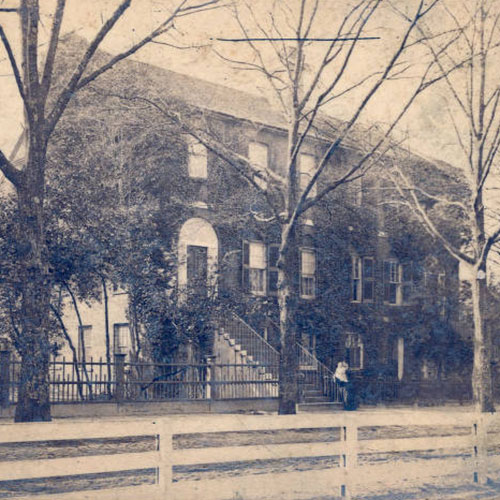
While the building bears the name of former resident and longtime professor Francis Lieber, history enthusiasts might also be interested to know that Richard T. Greener, the university’s first Black professor and librarian, also lived there from 1873 to 1877.
Today, Lieber is home to the Office of Undergraduate Admissions. Employees have long wondered if their building is home to something else, too. Staff member Rob McCartha was working late one fall evening when he heard the elevator ding. Footsteps approached his office. Several minutes later, the sounds repeated. Then, he heard them a third time.
I decided that someone else must be in the building and they could hear ME moving around. I assumed they were spooked (there have long been rumors about a ghost in Lieber College), and they were trying to find the source of the noise. I waited until I heard the elevator and footsteps a fourth time. I gently opened my office door so I didn't scare the other person. My plan was to let them know that I was also in the building. However, there was no one in the hallway and my office had a direct line of sight to the elevator.
That is when I realized that I hadn't heard another door open or the footsteps walking away during the previous "cycles." Also, the footsteps I was hearing were shoes on wood, but the whole building has carpet. I promptly packed my bag and left.
War Memorial: Hallowed as their tomb
An inscription inside War Memorial reads as follows: Wheresoever sleep these loyal sons of a proud mother, wheresoever they await the glorious
reveille, this chapel is hallowed as their tomb.
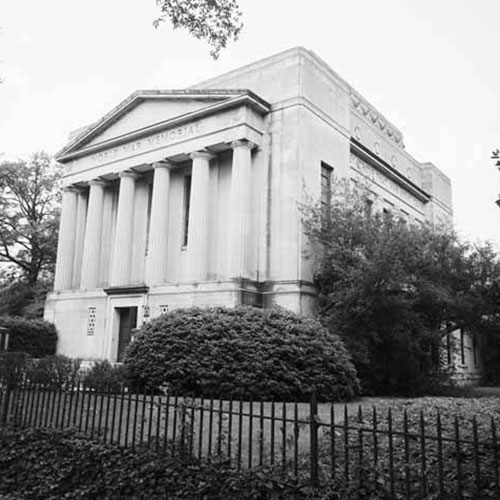
The mausoleum-like building at the corner of Sumter and Pendleton streets isn’t actually a tomb, but it was designed to look like one. Plans for War Memorial were proposed in 1919 to honor South Carolina’s soldiers who served and died in World War I. Despite receiving legislative approval, funding issues after the Great Depression delayed construction; War Memorial didn’t open until 1935.
The building’s first floor initially served as the home of the South Carolina Department of Archives and History. Up the marble steps to the second floor was a chapel, complete with an altar (how many other campus buildings boast an altar?) as well as meeting spaces for the American Legion Auxiliary.
Eventually, though, the building became office space. USC’s marketing and communications staffers worked in War Memorial from 2002 to 2023. Among them was Bob Wertz, who recalls arriving to work extra early one morning. The building was empty … or so Wertz thought.
The door was locked when I arrived. Since it was early and I didn’t want any unexpected visitors, I locked the door behind me. I took a seat at the long table in the middle of the entryway, pulled out my laptop and started to catch up on email. After a couple of minutes, I heard some noises from upstairs. War Memorial has lots of distinct sounds, and the sound of footsteps on the marble steps was one of them. Someone was clearly walking around upstairs. I yelled up the stairs, assuming that someone had arrived before me. No answer. Anyone who came in would have walked right past me, but I double-checked the lock. Still locked. I walked up the stairs, expecting a designer or writer to be hard at work with headphones on, but there was no one. I checked the bathrooms, the conference room, the closet with roof access. Even behind the altar. Empty.
I went back downstairs, convinced I was hearing things, and got back to work. And, again, I heard the unmistakable noise of footsteps on marble. About that time, other coworkers started to show up, and confirmed that, indeed, there was no one else in the building.
Maybe it was nothing… the wind, an echo from outside, a squirrel looking for a snack, or the heating starting up… I don't know. I do know I never showed up that early to work again.
South Caroliniana Library: Grave concerns
One of USC’s most beautiful places to study is South Caroliniana Library. Located at the foot of the Horseshoe, South Caroliniana became the first free-standing academic library in the United States when it opened in 1840.
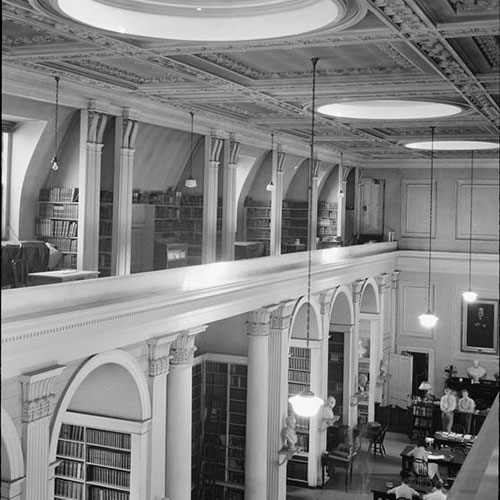
Like the Maxcy Monument, South Caroliniana was designed by Robert Mills, famed architect of the Washington Monument. Its second-floor reading room is a replica of Thomas Jefferson’s personal library in the second Library of Congress. Beyond being a historical gem, the building provides critical resources for researchers of Southern history and culture thanks to its repository of manuscripts, photographs, artwork and other materials.
Rumors have swirled over the years that something besides archival materials can be found within the library’s hallowed walls. In fact, contractors who helped renovate South Caroliniana from 2017 to 2023 had some eerie encounters that left them shaking in their work boots. Abby Cole, development communications and social media manager for University Libraries, explains:
One contractor heard footsteps in the stacks area, which is only lit through motion sensor lighting. When he checked to see who was there, there weren't any lights on and he didn't see anybody. Another contractor working in the elevator shaft saw a man walk through the hallway and into the electrical room, which was confusing because the building was closed and restricted to contractors only. When he went to escort the man out, there was nobody there. We always like to joke that the ghosts are nice; they just want to make sure their historical papers and family items are preserved and well taken care of.
One reason South Caroliniana might seem like an ideal haunt for USC’s restless spirits is the unusual sight just outside the library’s front doors: the grave of the university’s 19th president, James Rion McKissick. The grave has fueled plenty of spooky speculation since McKissick’s interment in 1944. To date, his is the only known grave on campus. Cole shares more:
Of course, the most likely ghost would be that of President McKissick because he is buried right outside, and he is responsible for the South Caroliniana Library we know today. He cared so much about this place and wanted it to be a home for all things related to South Carolina including its people and their stories. While we can't confirm that President McKissick haunts the building, that is the story people like to tell. However, being the only place on campus that can claim they have a grave in their front lawn definitely makes the library a fun place for Halloween and history enthusiasts alike to pay a visit.
More to explore
The goosebumps don’t have to end here. Check out the Oct. 6 episode of Remembering the Days, USC’s history podcast, to explore more campus ghost stories.